
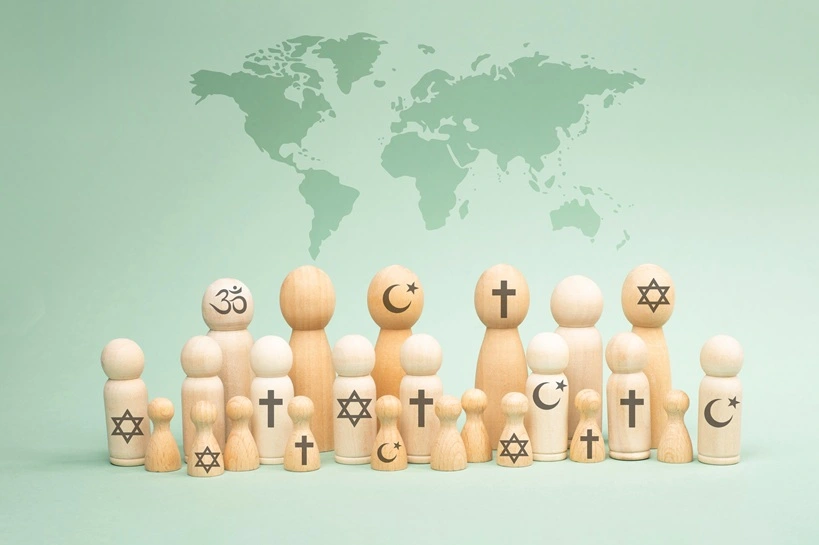

In today’s world, religion continues to occupy an important place in understanding social and political reality. Far from disappearing with the advance of modernity, religious beliefs have demonstrated a remarkable capacity for persistence, influencing both people’s daily lives and the dynamics of the international system. This phenomenon requires considering religion as a relevant variable in the analysis of international relations.
Consequently, this article examines the role of religion as a factor in global politics, addressing its impact on the formation of alliances, diplomatic processes, and the creation and promotion of human rights. It will also briefly explain the theological differences among the three main monotheistic religions, namely Christianity, Judaism, and Islam. These considerations were of great importance in signing the Abraham Accords, which, far from being a marginal element, can become a structuring axis of geopolitical strategies, especially in the current context of the war between Iran, the United States, and Israel.
The advance of religion
Religion encompasses various systems of beliefs, rituals, moral codes, and social institutions that provide individuals with frameworks to understand the world, find meaning, and establish social cohesion. Therefore, it is impossible to separate religious motives from economic and political ones (Modongal, 2023). Since the Enlightenment, intellectuals of all kinds have believed that the inevitable consequence of modernity is the decline of religion. It was thought that progress would come solely through human means, namely reason and science. As a result, religion would lose its social and political influence. This became known as the “secularization thesis.”
However, the thesis was not fulfilled. Peter Berger (2008) argues that modernity is not intrinsically secularizing; rather, it is characterized by an increasing plurality within the same society that poses a challenge for all religious traditions: one must confront the fact that there are “all these others,” not only in a distant country but right next door. Therefore, modernity is not characterized by the absence of God, Berger argues, but by the presence of many gods.
At the global level, most people say they belong to a religion, although patterns vary across countries and regions. The following map shows religious affiliation by country.

Figure 1: Ritchie et al. (2026). Our World in Data.
A Pew Research Center report shows the global change in the size of religious populations between 2010 and 2020. Christianity continues to have the most adherents, and Islam is the fastest-growing religion. The growth of the global Muslim population is largely due to Muslims having a relatively young age structure and a high fertility rate (Hackett et al., 2025).

Figure 2: Hackett et al. (2025). Pew Research Center.
Religion continues to be a powerful force in global politics, operating at three levels: individual, state, and systemic (Modongal, 2023). Although most of the world’s population is affiliated with a religion, international relations have tended to be studied from a secular perspective, a fact that dates back to the “Westphalian presumption,” which leads to the conclusion that religious pluralism cannot be integrated into international public life (Wellman, 2016: 579).
Nevertheless, Berger (2008) argues that this is due to “a Europeanization of the cultural elite. This elite became increasingly secular, and its politics became increasingly secularist.” This characterizes Western countries; in contrast, countries in the Middle East and others have not accepted the Western version of separating religion from the public sphere. For example, the Constitution of Saudi Arabia in its Article 1 proclaims that it is “a sovereign Arab Islamic State.” Article 7 states that “the regime derives its power from the Holy Qur’an and the Prophetic Tradition of the Prophet, which govern this and all other state laws.” In the same vein, Article 6 states that “citizens must pledge allegiance to the King on the basis of the Book of God.” Moreover, its flag bears the statement of faith: “There is no god but Allah; Muhammad is the messenger of Allah” (BCN, n.d.). Similarly, the constitutions of Iran, the United Arab Emirates, and others do not separate religion and politics, the sacred and the secular. This must be taken into account in international analyses.
Furthermore, the role of religion is reflected globally through one of the main international norms: the Universal Declaration of Human Rights. This represents a fundamental milestone in establishing an ethical and normative framework that guides state behavior and enshrines basic rights that have served as the basis for international treaties, national legislation, and the promotion and protection of human rights in the foreign policies of many countries. However, the foundation for justifying the principles of the Declaration was inspired by theological notions about the human person.
Human Rights
The Universal Declaration of Human Rights (UDHR) of 1948 was drafted as a common ideal for all peoples and nations. The Preamble proclaims: “freedom, justice and peace in the world are based on the recognition of the inherent dignity and of the equal and inalienable rights of all members of the human family” (United Nations, n.d.). The former UN High Commissioner for Human Rights, Zeid Ra’ad Al Hussein, called these opening words “perhaps the most beautiful and resonant of any international agreement.” According to Zeid, these words emphasize that human rights are for all people at all times and in all places (United Nations, 2018).
While the UDHR has its precedent in the U.S. Declaration of Independence (1776) and the Declaration of the Rights of Man and of the Citizen (1789), its content is grounded in the Christian religion. The Declaration of Independence proclaims that “all men are created equal” and “are endowed by their Creator with certain inalienable rights.” Analyzing these words, Yuval Harari (2015: 128) argues that Americans derived the idea of equality from the Christian claim that all souls are created equal before God. Likewise, Francis Fukuyama (2026) stated: “one of the deepest Christian values is the belief in the universal equality of all human beings in the eyes of God.”
When Christianity emerged, it introduced the idea that humanity is essentially equal. Paul wrote: “there is neither Jew nor Greek; there is neither slave nor free; there is neither male nor female; for you are all one in Christ Jesus” (Galatians 3:28). The former French minister Luc Ferry (2007) maintains that this idea was unprecedented at the time and that “our democratic universe inherited it in its entirety.” The Greek world conceived a “hierarchized universe in which the best by nature should be on top” (pp. 95–96). Unlike other monotheistic religions, Christianity emphasizes the concept of the person in God and His relationship with humanity, reaching its peak when the Son of God became man, elevating the value of each person. In other words, the descent of God meant the ascent of humans. In this sense, Alexis de Tocqueville (2002) argued that “the coming of Jesus Christ to earth was necessary to teach that all members of the human race are by nature equal and alike” (p. 500).
The Lebanese philosopher and diplomat Charles Malik drafted the preamble of the UDHR and, due to his Orthodox faith, drew on the Christian notion of human dignity as the foundation of human rights. Although the format remained secular, the notion of the human person was rich in religious ideas (Petkoff, 2023). At the end of the Second World War, Malik sought to prevent any philosophy of the person from being hijacked by totalitarian ideologies and drew inspiration from the language and paradigms of Chalcedonian Christology (Petkoff, 2023). Malik also contributed to the drafting of Articles 16 and 18, which deal with freedom of religion and belief. After his death, his son Habib Malik (2022) stated that his father’s Christianity “is present in everything he wrote and said, and any truthful account will recognize it.”
In this regard, the United Nations (2018a) notes: “what is less well known is the role played by religious organizations in launching and sustaining the human rights movement.” For example, in South Asia, Hinduism inspired Mahatma Gandhi’s long march for India’s liberation. Protestant Christians led the struggle to abolish slavery in the United Kingdom and the United States in the 19th century. Roman Catholics in Poland and Lutherans in East Germany were at the forefront of the struggle against authoritarianism in the late 20th century (United Nations, 2018a). In this way, former High Commissioner Zeid Ra’ad Al Hussein declared: “religious leaders, with their considerable influence on the hearts and minds of millions of people, are potentially very important actors for human rights” (United Nations, 2018a).
On the other hand, following the line of Article 18 of the UDHR, the UN Human Rights Committee emphasized that domestic laws should not punish criticism of religious leaders or prevent commentary on doctrines and principles of faith, since some countries had laws or policies that penalized apostasy, and in some cases it was punishable by death (United Nations, 2018a). The protection of the right to change religion, known as apostasy in some countries, caused divisions among the drafters of the UDHR. Saudi Arabia abstained in the final vote of the UDHR due to this clause, but other Muslim-majority countries such as Syria, Iran, Turkey, and Pakistan voted in favor of the Declaration (United Nations, 2018a). Consequently, it has been necessary to take into account these types of factors from religious traditions in carrying out diplomatic work by different actors.
Diplomacy
The relationship between religion and diplomacy influences formal interactions among state actors. Additionally, faith-based diplomacy is carried out by second-level actors, such as religious institutions, faith-affiliated NGOs, or individual practitioners of a religious tradition (Wellman, 2016: 577).
In this regard, the Holy See maintains diplomatic relations with 184 States, in addition to the European Union and the Sovereign Military Order of Malta. There are 93 diplomatic missions accredited to the Holy See in Rome, including the League of Arab States, the International Organization for Migration, and the United Nations High Commissioner for Refugees (Vatican News, 2026).
On the other hand, the ecumenical organization World Council of Churches (WCC) brings together churches, denominations, and ecclesial communities in more than 120 countries and territories worldwide, representing over 580 million Christians. Although most of the founding churches of the WCC were European and North American, today the majority of its member churches are located in Africa, Asia, the Caribbean, Latin America, the Middle East, and the Pacific. There are currently 356 member churches (World Council of Churches, n.d.).
The connection between diplomacy and religion can be observed in Saudi Arabia, which is governed by Islamic law (Sharia), and countries seeking to establish trade relations must take its beliefs into account. For example, the Qur’an prohibits the consumption of certain foods, such as pork (Surah 5:3), and diplomats must consider what is permitted (halal) and what is forbidden (haram). Regulatory bodies issue certifications to companies according to halal procedures. The global halal economy is one of the fastest-growing in the world and has the potential to reach 4.96 trillion dollars by 2030 (Proctor, 2023). Muslim consumers are a rapidly growing segment. As mentioned earlier, they have a high birth rate. Thus, countries governed by Sharia do not distinguish between politics, economy, and religion; rather, they aim to lead a unified way of life.
Therefore, an understanding of religion and its influence on political and economic actors, on cultures, and on the promotion of transnational cooperation is essential for 21st-century diplomats, especially when negotiating agreements and treaties such as the Abraham Accords, where theological differences played a role.
Theological Differences
Diplomacy is more successful when the realities of differences and individuality among people are recognized, rather than their similarities and unity (Wellman, 2016: 578). Therefore, it is necessary to understand the main theological differences of the major monotheistic religions in order to comprehend diplomatic processes, interreligious dialogue, and agreements such as the Abraham Accords.
In Judaism, it is believed that there is one God, who is unique and not divided into persons; the sacred texts are the Torah (the books of Moses) and the Tanakh. Christians, on the other hand, see Jesus Christ as the Messiah promised in the Hebrew Scriptures, and their sacred text includes the New Testament, which is part of the Bible. In Islam, Allah is a single and unique God. He neither begets nor is begotten (Surah 112:1–3), and the sacred text is the Qur’an.
Although there are many differences among the three religions, they can be summarized in one very important point: the nature of Jesus. Jews do not consider him the Messiah because he did not fulfill the ancient prophecies. Muslims view him as a prophet, but not divine. In contrast, Christianity believes that Jesus is the Messiah and the Son of God. He is part of the Trinity, that is, “one substance in three persons.” In this way, the unity of the Father, the Son, and the Holy Spirit is affirmed without denying their distinction: the three share one and indivisible substance, yet they remain three distinct Persons (González, 2016: 69–70).
Christian theology places greater emphasis on the concept of the person and teaches that interpersonal attributes such as giving and receiving love, unity, and community are expressed eternally among the three Persons of the Trinity. In contrast, Islam, which emphasizes the unity of God, is described by the Stanford Encyclopedia of Philosophy as lacking a conceptual equivalent to the Western philosophical notion of “person” in Arabic and classical Islamic philosophy, which may confirm the specifically Christian importance of largely Trinitarian origins (Williams and Bengtsson, 2022).
Christianity affirms that Jesus is God, that he died on the cross and rose again, and that this event confirms his divinity. Paul wrote: “if Christ has not been raised, your faith is futile” (1 Corinthians 15:14). In contrast, the Qur’an states that Jesus “was not killed nor crucified,” but that “God raised him up” (Surah 4:157–158). As a prophet of Allah, such a humiliating death would not be fitting. Although the Romans did not invent crucifixion, they perfected it as a form of torture and capital punishment designed to produce a slow death with maximum suffering (Edwards et al., 1986).
This difference is substantial and irreconcilable between the two religions. However, there are also internal differences that produce geopolitical tensions and conflicts. After Martin Luther’s Reformation, Christianity split into Protestants and Catholics. This event, argues Henry Kissinger, “ended the concept of a world order upheld by the ‘two swords’: that of the papacy and that of the empire” (2016, p. 31). With the Peace of Westphalia in 1648, the concept of the sovereign state was established, along with the right of each country to choose its internal organization and religious orientation free from external interference. The Westphalian system continues to be the framework of the international order we know today (Kissinger, 2016: 39).
Analogous to Christianity, Islam has also split into two main branches: Sunnis and Shiites. These differences have resulted in religious and geopolitical rivalry between the two main powers of the Middle East: Saudi Arabia (Sunni) and Iran (Shia). The tensions within the Muslim world are one of the reasons why they have not supported Iran in its war against the United States and Israel. In this way, the Trump administration has taken into account the differences among the three religions, both theological and political, in promoting the Abraham Accords.
The Abraham Accords and Their Geopolitical Implications
In 2020, the administration of President Donald Trump promoted a series of agreements known as the Abraham Accords, with the aim of normalizing diplomatic relations between Israel and several Arab countries, such as the United Arab Emirates, Bahrain, Morocco, and Sudan. As explained, the three monotheistic religions have irreconcilable differences; therefore, the agreement took the name of the patriarch they share in common: Abraham.
While Judaism and Christianity trace the lineage of Abraham through Isaac (Genesis 21:12; 22:18), Islam traces Abraham’s lineage through Ishmael (Surah 2:125, 127; 19:54). In this way, the Accords emphasize “promoting interfaith and intercultural dialogue in order to foster a culture of peace among the three Abrahamic religions and all humanity” (U.S. Department of State, n.d.).
Theological differences were carefully considered during the negotiations. A concrete example is when the Prime Minister of Israel, Benjamin Netanyahu, and the Minister of Foreign Affairs of the United Arab Emirates (UAE), Abdullah bin Zayed Al Nahyan, signed the Abraham Accords. On the first page of the document, the following is stated:
“Recognizing that the Arab and Jewish peoples are descended from a common ancestor, Abraham, and inspired, in that spirit, to foster in the Middle East a reality in which Muslims, Jews, Christians, and people of all religions, denominations, beliefs, and nationalities live together and engage in a spirit of coexistence, mutual understanding, and respect” (U.S. Department of State, 2020).
In the document, the Government of the UAE and the Government of the State of Israel commit to establishing peace, diplomatic relations, and the normalization of bilateral ties, based on the provisions of the United Nations Charter and the principles of international law; thus, the parties will exchange resident ambassadors. Shortly after the signing of the Accords, the UAE and Israel began close cooperation to expand research and treatment related to COVID-19, along with bilateral initiatives in key sectors such as logistics, air connectivity, tourism, education, medicine, scientific research, and telecommunications (UAE Embassy, n.d.).
In 2023, Netanyahu stated at the UN that Israel and Arab countries share common interests, which could lead to lasting peace in the region. He also emphasized that the Abraham Accords marked a turning point in history by bringing Arabs and Jews together. He noted that this was reflected in frequent Jewish weddings in Dubai, the dedication of a Torah scroll in a synagogue in Bahrain, and the influx of visitors to the Moroccan Jewish Museum in Casablanca, among other examples. Consequently, he stated, “there is no doubt that the Abraham Accords heralded the dawn of a new era of peace” (Netanyahu, 2023).
However, the Accords also have a geopolitical implication. The document states:
“In connection with the Abraham Accords, the parties are prepared to work together with the United States to develop and implement a Strategic Agenda for the Middle East in order to expand regional cooperation in diplomatic, trade, stability, and other areas… including by seeking to advance regional security and stability; harness regional economic opportunities; and consider joint aid and development programs” (U.S. Department of State, 2020).
Similarly, during the administration of President Joe Biden, the India–Middle East–Europe Economic Corridor (IMEC) was launched, which includes three pillars that integrate existing and future infrastructure: a transport pillar, which is the backbone of the corridor and integrates rail and maritime networks; an energy pillar with interconnected energy and electricity infrastructure across continents; and a digital pillar that provides new fiber-optic cables and cross-border digital infrastructure (Hussain and Shafer, 2025).
Among the initial signatories of the 2023 memorandum of understanding were the leaders of India, the United States, the UAE, Saudi Arabia, Italy, France, and Germany. Although Israel and Jordan are not signatories, they are implicitly included in the initiative given the proposed route.

Figure 3: Main transport corridor of IMEC (Hussain and Shafer, 2025).
A region-wide initiative such as IMEC is based on strong regional leadership and development initiatives within the Gulf, including Saudi Vision 2030 and UAE Vision 2031. Saudi political support for IMEC was particularly important for its launch and remains essential for its continued viability. Launched in 2016 by Crown Prince Mohammed bin Salman, Vision 2030 aims to diversify Saudi Arabia’s economy by reducing its dependence on oil and modernizing various aspects of society. It has set ambitious investment targets of $3 trillion by 2030, with more than $800 billion allocated to infrastructure development. Nearly all the rail and port infrastructure required for IMEC is already embedded within Vision 2030 (Hussain and Shafer, 2025).
Former Secretary of State in the Biden administration, Antony J. Blinken (2025), stated that during his tenure efforts were made to expand the Abraham Accords to include Saudi Arabia and other Arab and Muslim partners in order to enable the full realization of IMEC. Additionally, attempts were made to establish formal diplomatic relations between Saudi Arabia and Israel. “What we have done over the past four years,” Blinken said, “building on the Abraham Accords,” has been to try to achieve normalization between Saudi Arabia and Israel.
On the other hand, IMEC primarily serves as a U.S. diplomatic tool to counter China’s influence in the Middle East. Since the launch of the Belt and Road Initiative (BRI) in 2013, Gulf states have adopted the flagship foreign policy of President Xi Jinping and have sought to secure Chinese investments for their own infrastructure projects, whether in Abu Dhabi’s port, Hamad Port in Qatar, Silk City in Kuwait, or in digital networks, as reflected in contracts awarded to Huawei (Samaan, 2023). Thus, IMEC represents an alternative to existing corridors dominated by a single government, particularly the BRI.
Here, a continuity in foreign policy between Biden and Trump can be observed, as both seek to counterbalance China. IMEC builds upon U.S. diplomatic initiatives of the past five years and can therefore be considered a continuation of the Abraham Accords, which aim to normalize relations between Israel and Gulf states, promote economic cooperation, and thereby consolidate U.S. economic and political influence in the region.
Consequently, IMEC and the Abraham Accords represent for the United States a way to balance Beijing’s presence and its BRI, which has gained ground in the Middle East. If the agreements expand, competition based on shared interests supported by Washington could intensify. By diversifying supply chains, IMEC could provide an opportunity for energy security through natural gas or transshipped oil, leveraging the regional push toward network integration (Hussain and Shafer, 2025). Meanwhile, the Abraham Accords have opened unprecedented channels of cooperation between Israel and key Arab states, particularly the United Arab Emirates and Bahrain, with implications for regional economic integration.
Finally, IMEC aligns with U.S. objectives in Eurasia. It offers an alternative to China’s Belt and Road Initiative, creating opportunities to reaffirm U.S. economic leadership in the region while advancing the Abraham Accords. IMEC provides an important framework for regional alignment and integration in transport, energy, and technology sectors, while also supporting regional policy priorities. However, there is another important factor that has driven these projects: the differences and tensions between Middle Eastern countries and Iran.
The Iran Factor
Differences among Muslim countries have also served the interests of the United States and Israel. In his speech at the UN, Netanyahu (2023) stated: “the common threat of Iran has brought Israel and many Arab states closer together than ever before in a friendship I have not seen in my lifetime.” For his part, Blinken (2025) noted that the main objective of the Biden administration in the Middle East was to transform relations among U.S. partners in the region so that it would be more integrated, secure, and capable of addressing shared challenges, such as energy needs. “A more integrated region,” Blinken argues, “is in a stronger position to prevent any of its neighbors from dominating the others, to deter aggression, and nuclear proliferation.” In this way, the Biden administration pursued this vision by deepening the Abraham Accords and announcing an innovative economic corridor connecting India, the Middle East, and Europe.
On February 28, the war between Iran and the United States and Israel began, triggering a serious escalation with regional and global consequences. One of the bombings in Iran resulted in the death of the Supreme Leader, Ali Khamenei; afterward, Masoud Pezeshkian assumed executive leadership. Despite this, the Islamic world has not intervened to support Iran, due to religious differences among Muslims, national interests, dependence on the United States, and reluctance to be drawn into a war with unpredictable consequences. In addition, several Middle Eastern countries view Iran as having ambitions to become a nuclear and hegemonic power in the region (Gogitidze, 2026). However, tensions escalated when Iran bombed U.S. military bases in Arab countries such as Bahrain and the United Arab Emirates, both Sunni-majority states. This occurred during Ramadan, one of the pillars of Islam.
In this context, the United Arab Emirates demanded that the Iranian regime bear the costs of the damages caused by its attacks in the Gulf, stating that Iran must respond economically for the consequences of its military actions in the region. This came after confirming that it was one of the countries most affected by the attacks on strategic sectors such as airports, ports, energy facilities, hotels, and residential areas. Consequently, the attacks have hardened the Emirati stance toward Tehran after years of diplomatic easing. The country has withdrawn its ambassador from the Islamic Republic, closed its embassy, and restricted access for Iranian citizens, except in exceptional cases (Infobae, 2026).
On the other hand, in response to the U.S. and Israeli offensive, Iran announced the closure of the Strait of Hormuz, blocking passage through this strategic chokepoint, through which around 20% of the world’s consumed oil and gas flows. As a result, the restriction caused a noticeable increase in global fuel prices. In 2025, about 20 million barrels of oil and derivatives passed through the strait per day, according to estimates from the U.S. Energy Information Administration. This represents an annual energy trade volume of approximately $600 billion. Oil does not only come from Iran but also from Gulf countries such as Iraq, Kuwait, Qatar, Saudi Arabia, and the UAE. It is estimated that 20% of the world’s liquefied gas also passes through the Strait of Hormuz, most of it from Qatar (Butler et al., 2026).
The closure of the Strait was immediately felt worldwide. Broader disruptions in the energy sector accompanying the war between the United States and Israel in Iran have ensured a supply shock that will increase global inflation. Amid the crisis, the American public will feel the consequences: rising interest rates will affect borrowing costs for expenses such as car loans and mortgages; higher energy prices will raise gasoline and fuel costs; and manufacturers of many essential goods will pass increased production costs on to consumers (Tugendhat, 2026).
In this sense, inflation and the decisions taken by the Federal Reserve to combat it matter beyond U.S. borders, since most outstanding global debt is denominated in U.S. dollars. Rising interest rates in the United States will determine debt sustainability and, regardless of the outcome of this war, many countries will have to pay more for the energy needed to power their industries, electrical grids, and transportation networks. This will be true whether they owe those dollars to financial institutions in Beijing, asset managers in London, or multilateral development banks in Washington (Tugendhat, 2026).
To prevent further escalation, Pakistan offered to mediate peace negotiations between the United States and Iran. However, the parties failed to reach an agreement. Trump stated that the talks failed because Tehran “was unwilling to give up its nuclear ambitions.” Meanwhile, the spokesperson of Iran’s Ministry of Foreign Affairs blamed the “excessive demands and illegal requests” of the United States (Wright and Clun, 2026). Consequently, U.S. Central Command (Centcom) indicated that its forces would begin implementing a blockade of the Strait of Hormuz, stating: “the blockade will be applied impartially against vessels of all nations entering or leaving Iranian ports and coastal areas, including all Iranian ports in the Arabian Gulf and the Gulf of Oman” (U.S. Central Command, 2026).
The geography of the Strait has allowed Iran to use it as a tool of pressure throughout the war, selectively restricting the passage of vessels through this narrow waterway and thus driving up oil prices. By initiating the blockade, Trump could cut off a significant source of revenue for the Iranian government, although this measure could further increase the risk of rising oil and gas prices (Wright and Clun, 2026). This reflects the use of hard power by the United States, a mechanism that has been recurrent during Trump’s second administration.
On the other hand, the U.S. president has been involved in recent religious controversies involving Jesus and the Pope, drawing criticism even from his allies and supporters.
The Christian Controversy
In the current context of the war, Pope Leo XIV (2026) has called on the countries involved to engage in dialogue and on the faithful to pray for peace. In a statement, he declared: “God does not bless any conflict. Whoever is a disciple of Christ, the prince of peace, never takes the side of those who yesterday wielded the sword and today launch bombs.” These words did not please Trump, who responded on his Truth Social account:
“Pope Leo is weak on crime and terrible on foreign policy… I do not want a Pope who thinks it is okay for Iran to have a nuclear weapon… Leo should be grateful because, as everyone knows, he was not on any list to become Pope, and he was only placed there by the Church because he was American, and they thought that would be the best way to deal with President Donald J. Trump. If I were not in the White House, Leo would not be in the Vatican” (Trump, 2026).
The Pope did not wish to respond directly or enter into controversy, and instead emphasized the Gospel message of peace. Following Trump’s post, various leaders of the Catholic world expressed their discontent with his words. Even the Prime Minister of Italy, Giorgia Meloni, who is politically sympathetic to Trump’s sector, stated that the criticism of the Pope is “unacceptable.” “The Pope is the head of the Catholic Church,” she said, “it is fair and normal that he advocates for peace.” In response, Trump said that Meloni was “very different from what I thought” and questioned her for refusing to help reopen the Strait of Hormuz. “I am surprised. I thought she had courage. I was wrong,” Trump stated (Balmer, 2026).
However, the religious controversy involving Trump did not end there. Recently, the U.S. president posted on Truth Social an AI-generated image portraying himself as Jesus healing a man in a bed, with the national flag in the background and soldiers illuminated in the sky; in essence, a messianic staging. The image went viral and received numerous criticisms, even within the MAGA movement. As Trump was already losing support due to the war in Iran, he now began to lose support among Christians. The outrage was so strong that the image was removed from his account.
The President of Iran, Masoud Pezeshkian, also joined the criticism of Trump and wrote on his X account: “His Holiness Pope Leo XIV, I condemn the insult to Your Excellency on behalf of the great nation of Iran and declare that the desecration of Jesus, prophet of peace and fraternity, is unacceptable to any free person. May Allah grant you glory” (Pezeshkian, 2026).
Therefore, the reactions to Trump’s controversy, both regarding the Pope and the image of Jesus, show the affinities of individuals, since religion provides a framework for understanding the world, finding purpose in life, and establishing social cohesion. In other words, it offers a complete worldview that explains the nature of reality. In this way, it is impossible to separate religious motives from political ones.
Conclusion
From the evidence presented, it can be concluded that religion remains a decisive variable in understanding certain events in the international system. Most of the world’s population is affiliated with a religious belief, which influences both social life and the domestic and foreign policies of states. In this sense, Western secularism fails to explain the complexity of these phenomena, for example in Muslim-majority countries, where there is no clear distinction between religion and politics, or between the secular and the sacred; such is the case of Saudi Arabia.
On the other hand, religious influence has played a central role in shaping the content of human rights, which was later reflected in the United Nations Universal Declaration of Human Rights. Furthermore, there are substantial theological differences between the three main monotheistic religions, and it is necessary to consider each of them in order to carry out successful diplomatic work when establishing bilateral relations between states with a significant population affiliated with a particular belief.
These considerations were taken into account during the Abraham Accords, where reference was made to the belief in a common ancestor shared by Christians, Jews, and Muslims: Abraham. This was reflected in the principles negotiated between the countries. However, these U.S.-sponsored agreements also have a geopolitical implication: the creation of alliances between Gulf countries and the counterbalancing of China’s influence and its Belt and Road Initiative in the region. The India–Middle East–Europe Economic Corridor represented a continuation of the Accords aimed at reinforcing U.S. presence in the region. In this sense, differences among Muslim countries have contributed to Washington’s interests, especially in the current war between Israel and the United States against Iran.
In summary, religious factors can no longer be relegated or minimized within the international system; in some events, they occupy a central role. Therefore, in the current global landscape, where tensions are escalating and differences are increasingly visible in geopolitical conflicts, religion once again becomes one of the main protagonists.
References
