

I. Introduction
On March 21, 2026, US President Donald Trump threatened to “obliterate” Iran’s power plants if Iran does not fully reopen the Strait of Hormuz within 48 hours, as the war escalated in a dangerous new direction at the start of its fourth week. In response, Iran warned that it would target US infrastructure, including energy and desalination facilities in the Gulf, if the US carried out its threat.
Suddenly, President Donald Trump said, however, on March 23 that he was postponing any strikes against Iran’s power plants for five days, citing what he said were “productive conversations” with Iran to end the war. [1]
Iran’s foreign ministry said there was “no dialogue” between Tehran and Washington, according to state affiliated media. Iran said that Trump’s move was designed to “buy time” for his military plans.
On March 25, 2026, Iran’s government rejected President Trump’s 15-point plan for ending the war and vowed to continue fighting until a list of Iran’s own conditions are met. Iran’s five demands include war reparation payments and recognition of Iranian sovereignty over the Strait of Hormuz. [2]
Because the gap between President Trump’s 15-point plan and an Iranian five demand is so big, ending the war is impossible. Thus, the US’s next move seems to be to attack Kharg Island or Iranian power plants, although President Trump has pushed back a self-imposed deadline for attacks on Iran’s power grid to April 6, citing progress in negotiations to end the ongoing war in the country. [3]
The US continues military build-ups around Iran. In addition to a rapid response marine unit of about 2,500 Marines and sailors sent to the Middle East, the US military is deploying thousands of additional Marines and sailors to the Middle East, according to the report of Reuters on March 20, 2026.
The deployments of the USS Boxer, an amphibious assault ship, along with its Marine Expeditionary Unit and accompanying warships, come after Reuters reported that President Donald Trump’s administration was considering deploying thousands of U.S. troops to reinforce its operation in the Middle East.
Moreover, the New York Times reported on March 25 that the US deployed the Army’s 82nd Airborne Division’s “Immediate Response Force,” a combat brigade of about 2,000 soldiers that can deploy paratroopers and equipment anywhere in the world within 18 hours. [4] On top of that, the Pentagon is considering sending up to 10,000 additional ground troops to the Middle East to provide President Donald Trump with expanded military options.
If the US attacks Iran’s power plants or energy facilities on Kharg Island, how will Iran respond? Iran has warned that it would target US infrastructure, including desalination facilities in the Gulf, if the US carries out military strikes on its energy infrastructure.
This paper deals with what will happen in the Gulf region if Iran attacks desalination facilities in the Gulf. In doing so, this paper first explains why desalination facilities in the Gulf are so important and then examines the possibility of attacking those facilities by Iran. This paper finally analyzes how Iranian attacks on desalination facilities in the Gulf affect the region.
II. Why are desalination facilities so important to the Gulf region?
The US-Israeli war on Iran has exposed the vulnerability of critical water infrastructure in the Gulf region that is among the most water-scarce in the world.
As Figure 1 shows, the Gulf region has no permanent rivers. Water is scarce in the region due to the arid climate and irregular rainfall. Countries in the Gulf also have very limited natural freshwater resources. Groundwater, together with desalinated water, accounts for about 90 percent of the region’s main water resources, according to a 2020 report by the Gulf Research Center.
But in recent years, as groundwater has also begun to deteriorate because of climate change, the six Gulf states – Bahrain, Kuwait, Oman, Qatar, Saudi Arabia and the United Arab Emirates – rely heavily on desalination systems to meet the needs of their combined populations, which exceed 62 million people.
Gulf states produce 40 percent of the world’s total desalinated water through more than 400 plants.

Figure 1: The Gulf region has no permanent rivers (source: Aljazeera)
According to a 2023 report from the GCC Statistical Center, the six Gulf states produced 7.2 billion cubic meters, or 1.9 trillion gallons, of freshwater through desalination. This volume translates to about 122 cubic meters per capita per year, or about 334 liters (88 gallons) per day. However, their total installed capacity is much higher, estimated at 26.4 billion cubic meters annually. [5]
One billion cubic meters is equivalent to one trillion liters.
As Figure 2 shows, the biggest and most populous of the six Gulf states – with 37 million inhabitants – is Saudi Arabia. It produced 3 billion cubic meters of desalinated water in 2023, followed by the UAE with 1.9 billion cubic meters, Kuwait with 0.8 billion cubic meters, Qatar with 0.7 billion cubic meters, Oman with 0.5 billion cubic meters and Bahrain with 0.3 billion cubic meters.

Figure 2: Six Gulf states produced 7.2 billion cubic meters, or 1.9 trillion gallons, of freshwater through desalination in 2023 (source: Aljazeera)
Ten of the world’s largest desalination facilities are concentrated along the coasts of the Gulf and the Red Sea. As water shortages intensify in these regions, this dependence is likely to increase further. However, as dependence increases, so does exposure to risk.
Without desalination, water for drinking and for agricultural and industrial purposes would be impossible to maintain. According to data from the GCC Statistical Centre on water production and consumption, here is the reliance on desalination for total water supply in each country, as Figure 3 shows:

Figure 3: Gulf states’ reliance on desalination (source: Aljazeera)
Qatar
At 61 percent, Qatar is the most dependent of the Gulf states on water from desalination. Around 22 percent of its combined 1.1 billion cubic meters of annual water supply comes from groundwater and 18 percent from rainwater. However, when it comes to drinking water alone, Qatar relies nearly exclusively on desalination, which accounts for more than 99 percent of its drinking water supply for its 3.2 million people.
Bahrain
Bahrain is the second most dependent on desalinated water with 59 percent of its total 0.5 billion cubic meters of annual national water supply coming from desalination. For drinking water, this figure jumps to more than 90 percent. In addition, 32 percent comes from groundwater and 11 percent from rainwater, respectively, for its 1.6 million residents.
Kuwait
Kuwait follows with 47 percent of its 1.7 billion cubic meters of water used annually obtained through desalination while 51 percent comes from groundwater with rainfall making up the remainder.
The UAE
The UAE has a roughly equal mix with 41 percent of its water derived from desalination and 46 percent from groundwater with the remainder coming from rainwater and treated wastewater. This totals 4.8 billion cubic meters annually for its 11.5 million residents.
Oman
Oman produces 23 percent of its total 2.2 billion cubic metres annually from desalination for its 4.7 million inhabitants, followed by groundwater at 69 percent with the remainder coming from rainfall and treated wastewater.
Saudi Arabia
Saudi Arabia produces more desalinated water than any other country, but with 18 percent of its total usage coming from desalination, Saudi Arabia is the least dependent of the Gulf states on water from desalination, relying instead on groundwater for 79 percent of its total water needs. Rainfall accounts for the remainder of the 17.3 billion cubic meters the Saudi kingdom produces annually for its 37 million residents.
Iran
On the other hand, Iran also uses desalination plants, which have been installed in coastal areas such as Qeshm Island in the Gulf. But Iran has many rivers and dams and is not as heavily dependent on desalination plants as other Gulf states. Iran has 523 large, operational dams, according to the Iranian National Committee on Large Dams. It is estimated that approximately 99.6 per cent of the urban population and 82 per cent of the rural population have access to a drinking water supply. [6]
“Iran is the least reliant on desalination plants. So, Iran is explicitly including them as legitimate targets for retaliation because they are the biggest vulnerability of the other parties to the war across the Gulf region,” Iranian-origin climate scientist, Kaveh Madani, said. [7]
Despite that relative advantage, Iran itself has faced years of severe drought, mismanagement of water resources, and declining groundwater levels, leaving parts of the country increasingly water stressed. After a fifth year of extreme drought, water levels in Iranian five major dams have plunged to about 10% of their capacity, with President Masoud Pezeshkian mooting an evacuation of Tehran if this persisted.
Iran saw yet another dry summer last year, marked with low autumnal rainfall. Also to blame are the country’s water management policies. Unchecked dam construction, illegal well drilling, and unsustainable agricultural practices have depleted Iran’s water reserves. In Tehran alone, the ground has sunk at 300 mm per year, about 60 times the critical threshold for infrastructure stability and safety, according to a NY Times report.
Iran, which has faced the continued water crisis, is expanding desalination facilities along the southern coast in a bid to pump water inland, the AP report said. This too has been limited, given infrastructure constraints, high energy costs and international sanctions.
III. The Possibility of atacking desalination facilities by Iran
Since the US and Israel began to bomb Iran, the Iranian regime has retaliated strongly against countries in the Gulf region, where several US military bases are located.
Historically, wars in the Gulf have tried to avoid targeting desalination plants. However, there have been some attacks on desalination facilities in the Gulf region over the past decade.
Worries about attacks on Gulf region’s desalination plants date back to the 1980s as CIA in the US had concerns. [8]
In fact, after US-led coalition forces began bombing Iraqi positions in January 1991 during Iraq’s invasion of Kuwait, part of Iraqi troops’ response was to release millions of barrels of crude oil into the Persian Gulf. As the massive oil slick drifted south, US and Saudi officials feared it was meant to sabotage desalination systems.
Workers installed protective booms to shield intake valves at major desalination plants, especially the one that supplies much of Riyadh’s water. In Kuwait, Iraqi sabotage damaged or destroyed much of the country’s desalination capacity.
Kuwaiti authorities also turned to Saudi Arabia and Turkey to supply some 750 water tankers and 200 trucks to import an 18-ton emergency supply of bottled water. US-supplied generators and mobile desalination units provided additional temporary relief, although the full recovery took years.
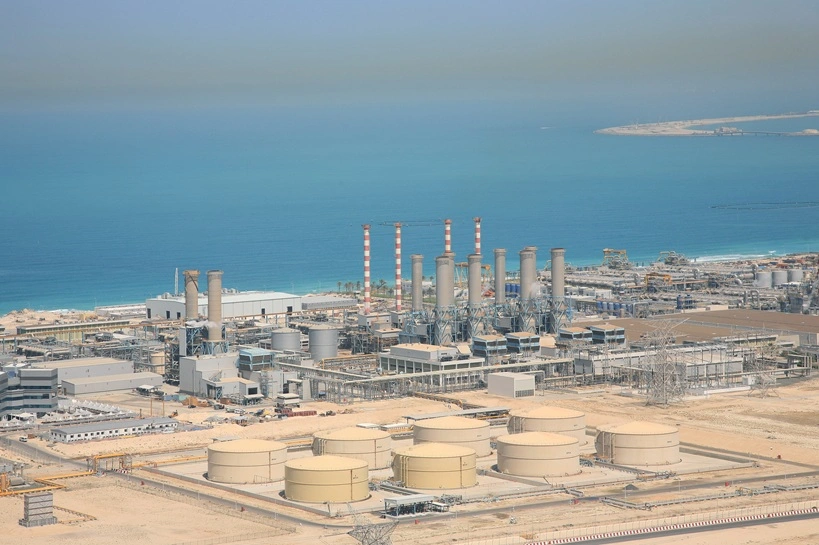
Fears of attacks on desalination plants resurfaced after Yemen’s Houthi rebels launched drones and missiles at Saudi desalination plants at Al-Shuqaiq in 2019 and 2022 – though they did no lasting damage, as Figure 4 shows.

Figure 4: Saudi desalination plants at Al-Shuqaiq (source: https://www.vega.com)
A Saudi-led coalition has struck back at water infrastructure in Yemen, according to the Pacific Institute, which tracks water-related conflicts.
Moreover, Israel has hit water infrastructure in the Gaza Strip, according to the Pacific institute.
Concerns for the security of Gulf desalination systems rose from the outset of the Iran war. Within the first days of the conflict, reports circulated that the Fujairah F1 power and water complex in the UAE and the Doha West power and water station in Kuwait had been damaged by missiles or falling debris from intercepted drones, although operations continued uninterrupted at both facilities.
Then on March 7, 2026, Iran accused the US of attacking a desalination plant on Qeshm Island in the Strait of Hormuz. Claiming that the strike impacted water supplies to 30 villages, as Figure 5 shows, Iran’s Foreign Minister Abbas Araghchi warned, “the US set this precedent, not Iran.” [9]
Just 24 hours later, Bahrain said that an Iranian drone had caused material damage to one of its desalination plants near Muharraq, as Figure 6 shows.
The Bahraini Ministry of Interior argued that an Iranian drone had hit one of the country’s desalination centers, but without affecting water supplies.

Figure 5: Desalination plant on Qeshm Island in Iran (source: Financial Times)
However, attacks on desalination plants in the Gulf have been limited so far, but “the first side that dares to attack water triggers a war far more enormous than the one we have today,” water economist Esther Crauser-Delbourg told AFP earlier in March.
After Trump threatened to attack Iran’s energy infrastructure, Iran responded with threats to hit back at the Gulf’s energy and water infrastructure, saying that it would cause “irreversible damage.”

Figure 6: Desalination plants near Muharraq, Bahrain (source: Financial Times)
Considering the facts that there are some attacks on desalination plants in the Gulf and that “The US set this precedent, not Iran,” as Iran’s foreign minister, Abbas Araghchi. said, We can expect that Iran will attack desalination plants in the Gulf if the US carries out military strikes on its energy infrastructure, including oil terminals in Kharg Island.
Moreover, the last decade, in particular, has seen a “significant erosion in the norms” around attacking water infrastructure, David Michel, a senior researcher specializing in water security and environmental conflict, said. Russia has conducted more than 100 attacks on Ukraine’s water infrastructure during its invasion and Israel has destroyed water and sanitation facilities in Gaza.
It “has unfortunately become a trend,” said Marwa Daoudy, professor of international relations at Georgetown University. “Water has joined the long list of targets and weapons of war.”
Iran has not carried out a concerted attack on the Gulf’s desalination facilities, but experts fear tit-for-tat attacks on infrastructure could push it to do so, especially as it does not have the same military might as the US and Israel — it might see water infrastructure attacks as a way to inflict pain on the Gulf and push the region to lobby for an end to the war.
“This Iranian regime has shown that if its survival is at risk, it will not hesitate to escalate into water infrastructure, especially if Israel and the US decide to attack very critical infrastructure of Iran,” said Nader Habibi, professor of the economics of the Middle East at Brandeis University.
IV. The Impacts of attacks on desalination plants in the Gulf region by Iran
If desalination plants across the Gulf region are attacked by Iran, what would be the impacts?
Gulf countries have long recognized the risks the desalination systems pose for regional stability: if major desalination plants were knocked offline, some cities could lose most of their drinking water within days.
Most Gulf countries only have water reserves to last about a week. Water experts have said that if any of these plants are struck and capacity taken out, the impact would be severe and quick.
Power plants need desalinated water for cooling, so electricity supply would be affected. It would particularly affect healthcare and the running of hospitals, and would likely have to cause industries and businesses to shut down for as long as there was a water shortage.
Water rationing would likely have to be introduced. There are concerns that this could lead to mass panic and civil unrest.
A 2010 CIA analysis warned that attacks on desalination facilities could trigger national crises in several Gulf states, and prolonged outages could last months if critical equipment were destroyed. [10]
More than 90 percent of the Gulf’s desalinated water comes from only 56 plants, the report stated, and “each of these critical plants is extremely vulnerable to sabotage or military action.”
A leaked 2008 US diplomatic cable warned the Saudi capital of Riyadh “would have to evacuate within a week” if either the Jubail desalination plant on the Gulf coast or its pipelines or associated power infrastructure were seriously damaged. [11]
Saudi Arabia has since invested in pipeline networks, storage reservoirs and other redundancies designed to cushion short-term war disruptions, as has the UAE. But smaller states such as Qatar, Bahrain, and Kuwait have fewer backup supplies.
As shown above, analysts have warned that any disruption to water infrastructure could trigger a major escalation in the war, given the potential civilian and economic impact.
US think tank, CSIS (The Center for Strategic and International Studies), analyzes the impacts of attacks on desalination plants in the Gulf region by Iran in the following three topics: [12]
1. A strategic vulnerability of six Gulf states
For the countries in the Gulf region, extensive desalination systems constitute indispensable critical infrastructure. Desalination plants fulfill 77.3 percent of total water demand in Qatar, 67.5 percent in Bahrain, 52.1 percent in the UAE, 42.2 percent in Kuwait, 31 percent in Oman, and 18.1 percent in Saudi Arabia. Desalination plants are particularly important for meeting drinking water needs. Qatar extracts 99 percent of its drinking water supplies from its network of desalination facilities, and Bahrain over 90 percent. For Kuwait, Oman, Saudi Arabia, and the UAE, the figures are 90 percent, 86 percent, 70 percent, and 42 percent, respectively. Cities such as Dubai, Doha, Manama, and Kuwait City would not be possible without desalination facilities. Qatar and Bahrain, particularly, also depend heavily on desalination for industry, too, devoting more than half their desalinated water production to sectors such as petrochemicals and data centers. Damage or disruptions to the region’s desalination infrastructure could compromise crucial water resources for industry, business, and thousands or even millions of people across the Gulf region.
Though the war in the Gulf region has not so far materially disrupted the region’s water supplies, the prospective risks are real. The desalination plants in the Gulf region are large, fixed, open-air industrial complexes. Mostly concentrated along the coast within 350 kilometers of the Iran Islamic Republic, they are as exposed to Iranian weapons as any of the civilian infrastructure that has yet been targeted, from oil and gas terminals to airports and hotels. Desalination plants are also essentially linear facilities, meaning that the seawater-to-freshwater transformation occurs through an ordered sequence of stages. Damage to sensitive parts of the system, such as high-pressure pumps or membrane buildings, could disable production entirely, potentially requiring several weeks to repair.
By the same token, the desalination infrastructure in the Gulf region is susceptible to multiple vulnerabilities, from its energy and seawater supplies to its distribution networks and operating systems. Desalination is an energy-intensive process, for instance. Due to that energy need, some three-quarters of desalination plants in the Gulf states are integrated power and water production facilities. Thus, freshwater output from these installations could be interrupted not only by strikes on the water treatment units but also on the energy plants and grid connections supplying them. Cut the water by cutting the power. Similarly, water produced by central desalination plants should then be distributed to consumers. Iran may attempt to degrade water systems in the Gulf region by targeting the pumping stations and pipelines that deliver desalinated water to users.
On a different register, desalination plants in the Gulf region require a continuous supply of incoming seawater. Iran might seek to incapacitate water systems in the Gulf region by blocking or fouling their saltwater intakes in the Persian Gulf. This scenario has unfolded before. In 1991, during the first Gulf War, Iraqi armed forces purposely destroyed most of Kuwait’s desalination capacity and dumped millions of barrels of oil into the northern Persian Gulf, thereby jeopardizing water intakes for plants in Kuwait and Saudi Arabia. After coalition forces retook the country, water shortages forced the Kuwaiti government to cut household water services to four days a week while relying on contracted tanker ships and hundreds of tanker trucks to deliver bulk water for the population. The Seawater Reverse Osmosis (SWRO) technologies predominating today’s desalination plants could be especially more vulnerable to clogged intakes and fouled filtration membranes than the thermal processes common in the 1990s. Tellingly, in 2008–2009, a massive “red tide” algal bloom shut down several installations in the UAE and Oman for up to two months due to this risk. [14]
Finally, industry analysts judge that desalination plants in the Gulf region could face Iranian cyber threats. Attackers may penetrate water providers’ IT networks, for example, or compromise their operating technologies or industrial control systems. Iran has actively targeted water sector infrastructure, utilities, and energy systems around the Gulf region (as well as in the US and Israel) for many years, and Iran has already launched aggressive cyber retaliation operations in the current conflict.
2. Gulf states’ sources of anxiety
The ultimate ramifications of any Iranian attacks on desalination systems in the Gulf region would depend upon the specific circumstances. Which country or countries are targeted? Which plants are hit? What is the nature and extent of the damage and the duration of the resulting disruption?
According to Naser Alsayed, an environmental researcher, the impact of a plant being attacked in the Gulf region, however, depends on the local scenario.
“For Saudi Arabia, which is the least dependent on desalination and has significant geographic space, facilities on the Red Sea provide resilience. The UAE has 45 days of water storage aligned with its 2036 water security strategy, so contingency plans are in place to manage potential disruptions,” Alsayed said.
“The effects are likely to be felt more acutely in smaller states that are highly dependent on desalination like Qatar, Bahrain, and Kuwait, which have minimal strategic reservoirs,” he noted.
Raha Hakimdavar, a hydrologist, told Al Jazeera that in the long-term, attacking these plants can also have impacts on domestic food production, which mostly uses groundwater.
“However, the pressures from competing needs can divert this water away from domestic production. This can be especially challenging because the Gulf region is also highly food import dependent and is facing potential food security challenges due to the compromising of the Strait of Hormuz,” said Hakimdavar, who is a Senior Advisor to the Deans at Georgetown University in Qatar and the Earth Commons.
The most important impact could well be psychological. The Gulf states have devoted decades to cultivating a business model premised on their reputation as islands of prosperity and stability even in seas of geopolitical turmoil. Iran’s continuing coercive capacity to precipitate potential water crises across the Gulf region prospectively casts this premise into question. “The real weapon is not the drone,” in the words of one analyst, “it is the insurance cancellation, the rerouted tanker, and the investor who pauses.” For insurers, investors—and inhabitants—potentially forced to envisage depending on tankers and trucks to bring vital water for their homes, hospitals, schools, and businesses, confidence in the continuing security of that business model could dry up long before the last water from their taps.
More than 40 years ago, a classified CIA analysis, made public in 2010, called out the security vulnerabilities created by the Gulf states’ dependence on desalination. The current conflict reveals with force that dependence has deepened and the vulnerabilities remain. When the guns fall silent, conceptions of their water security and of their national security in the Gulf states will likely stand transformed.
3. Iran’s weaponizing water
Deliberately striking at the Gulf states’ vital desalination systems would represent a significant escalation in hostilities. Article 54(2) of the 1977 Additional Protocol to the Geneva Conventions expressly prohibits attacking or destroying “objects indispensable to the survival of the civilian population, such as . . . drinking water installations and supplies. [15]” Targeting such essential civilian infrastructure violates international law and could constitute a war crime.
Yet Iran might come to calculate that threatening water supplies in the Gulf region could provide an effective asymmetric strategy for waging an existential struggle for regime survival. Iran can neither defeat the US and Israel militarily nor prevent them from striking Iranian territory at will. Instead, Iran has embarked on a campaign of both “horizontal” and “vertical” escalation.
Closing the Strait of Hormuz, throttling global energy and fertilizer markets, and unleashing missile and drone barrages at soft targets in the Gulf region and other countries all serve to widen the war’s scope and raise its stakes, increasing the costs of continuing conflict for governments, economies, and people far beyond the Persian Gulf. The goal is not military victory but strategic leverage in a war of political attrition in which Iran believes that it can outlast the US.
So far, the Gulf states have not been direct combatants in this fight and have not taken offensive military actions against Iran. Targeting their water sources could change that. But Iran may gamble that attacking critical water infrastructure could alternatively (or simultaneously) work to drive wedges between the Gulf governments that Iran views as helping enable the conflict and the US and Israeli governments prosecuting it, while also heightening pressures on capitals of the Gulf states to seek an end to a war they did not choose.
Whether deliberate Iranian attacks would succeed in substantially compromising water supplies in the Gulf region remains an open question. Desalination systems are widely distributed, with each country maintaining dozens to hundreds of installations. Damages even to multiple facilities could likely be largely compensated by production from others. Yet within these dispersed supply networks, each Gulf state also operates a number of mega complexes, some serving a million people or more. Successful attacks on these hubs could be far more disruptive. Likewise, drone and missile strikes pose the greatest threat to individual plants. Major weaponized oil spills, however, could potentially cripple whole city systems for hundreds of miles around. Without greater (unlikely) knowledge of remaining Iranian capacities and actual vulnerabilities in the Gulf states, the effective impacts from cyber risks can only be speculative. Extreme scenarios of concerted attacks integrating all three tactics – oil, drones, and cyberwarfare – while improbable, should not be dismissed as unimaginable.
Importantly, although the Gulf states have developed considerable production capacity for desalinated water, they have not, for the most part, established corresponding capacity for stockpiling against supply disruptions. The UAE, for instance, in 2017 unveiled its 2036 Water Security Strategy to increase water efficiency and boost national water storage. But realizing the initiative’s goal would provide water stores for just two days of national demand under normal conditions, potentially lasting up to 16–45 days under rationing for extreme emergencies. Saudi Arabia has also created strategic reservoirs furnishing modest water reserves. But Qatar, Bahrain, and Kuwait have insufficient storage capacity to buffer significant supply interruptions.
V. Conclusion
This paper dealt with what will happen in the Gulf region if Iran attacks desalination facilities of the Gulf. In doing so, this paper explained why desalination facilities in the Gulf region are so important. The paper argued that this is because water is scarce in the Gulf region due to the arid climate and irregular rainfall and because the Gulf states also have very limited natural freshwater resources.
And considering the facts that there have been some attacks on desalination plants in the Gulf region and that “The US set this precedent, not Iran,” as Iran’s foreign minister said, we can expect that Iran will attack desalination plants in the Gulf region if the US carries out military strikes on Iranian energy infrastructure, including oil terminals in Kharg island. Moreover, because the last decade has seen a “significant erosion in the norms” of attacking water infrastructure, there is a good possibility that Iran will attack desalination plants in the Gulf region.
Finally, this paper argued that Iranian attacks on desalination facilities in the Gulf region will have significant negative humanitarian, economic impacts on countries in the region, in particular smaller states that are highly dependent on desalination like Qatar, Bahrain, and Kuwait.
References
