
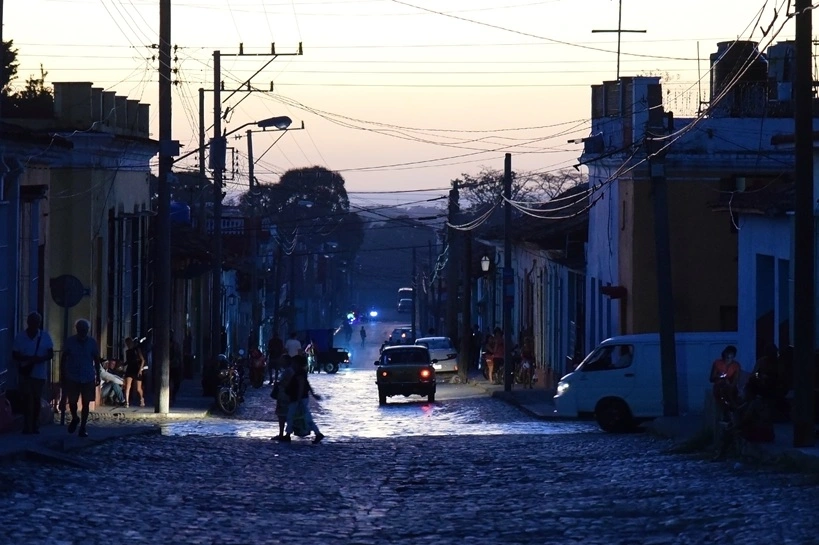

For many Cubans, blackouts have become part of their daily lives — sometimes lasting hours, sometimes most of the day. Traffic lights fail, transport slows, and fuel shortages disrupt everything from tourism to waste collection.
After Maduro’s capture in Venezuela, political winds shift across the Caribbean, and Cuba, that has spent decades resisting pressure from Washington, may be entering one of the most uncertain and difficult moments in its modern history. The Cuban crisis, this time feels sharper because it is no longer only a story of long-term economic weakness. It is now also a story of deliberate geopolitical pressure.
In recent months, President Donald Trump has repeatedly and openly suggested that Cuba’s government is nearing collapse and even floated the idea of a “friendly takeover”, According to reports by Al Jazeera, Trump said Cuba is “down to fumes” economically and energy-wise, warning that Cuba will either strike a deal with the United States or face further pressure. At times, this rhetoric grew even more when Trump claimed he expected to have the “honor” of taking Cuba in some way, and later he went further and suggested that “Cuba is the next”, language that has reignited tensions between Havana and Washington and stirred concern across the region.
This shift in tone matters because it fits in with the broader US emphasis on the Western Hemisphere, as reflected in the US NSS 2025. Therefore, it places Cuba inside a wider Trump-era pattern of pressure politics rather than treating the island as a frozen Cold War relic.
At the same time, even amid tighter US pressure, the Russian-flagged tanker Anatoly Kolodkin was allowed to dock at Matanzas on March 31st carrying 730,000 barrels of oil. It is true that a tanker is a temporary relief – as it might cover between 9 or 10 days of energy demand and will not change the logic of the pressure –, but it highlighted the unevenness of Washington’s pressure campaign.
BBC coverage and Will Grant’s analysis frame described the present moment as less like a routine sanctions dispute and more like a test of whether Cuba’s economic fragility can be converted into political leverage. In consequence, as the Cuban crisis keeps developing, the US now has seen a potential opportunity to open the Island, specifically under the US influence.
An Island Running on Empty
Cuba’s current predicament did not appear overnight. The island’s economy has struggled for decades under a U.S. trade embargo dating back to the early 1960s, which has limited its access to international finance, investment, and energy markets. However, some scholars, like Enrique Krauze, Mexican historian, in a recent interview in Latinus pointed out that Cuba was one of the most developed countries in Latin America before 1959, and that the “internal blockade” – government refusal to allow citizens to create businesses, own properties and/or speak freely – can be added as another true cause of the current situation in the Island.
Whatever the root of the crisis is, it exists and it is worsening day by day. As mentioned already, the energy crisis is now at its center. Cuba depends heavily on imported oil to power its electricity grid, transportation, and agriculture. Therefore, when shipments slow or stop, the entire economy stumbles.
According to reports on the unfolding crisis, U.S. pressure on oil shipments to Cuba has intensified in recent months (Figure 1), including measures threatening tariffs on countries that supply fuel to the island. The loss of Venezuelan oil supply — Venezuelan oil accounted for 61%, followed by Mexico (25%), Russia (10%) and Algeria (4%) of total imports by 2025 – has made the problem even more acute.
For years, Caracas supplied tens of thousands of barrels of oil per day to Havana in exchange for Cuban medical and security assistance. But the geopolitical upheaval in Venezuela (Maduro captured by the US Armed Forces), followed by new U.S. actions and tariffs threats to oil suppliers (Mexico paused oil shipments on Feb 9) to the island, have disrupted and worsen even more the scenario in Cuba.
Therefore, the consequences have been immediate. Blackouts have spread across the country, transportation has slowed, and industries, like tourism, already weakened by the pandemic-era, have come under severe strain. Moreover, economic growth in Cuba hasn’t recovered since the pandemic in 2020. (Figure 2)
Outside Cuba, international organizations, like Handicap International, have warned that shortages threaten food production and essential services, raising fears of a humanitarian emergency if fuel supplies are not restored. On the other hand, ordinary Cubans have been living and experiencing the crisis everywhere, for example, longer lines for food, rising prices, waste piling up on the street corners and growing uncertainty about the future.

Figure 1: Cuban crude imports. Source: S&P Global Commodities at Sea

Figure 2: Cuba’s GDP. Source: AS/COA
Washington’s Escalating Pressure
As outlined in its 2025 National Security Strategy (NSS), the White House has framed its Cuba policy as part of a broader effort to encourage political change on the island and reassert U.S. influence in the Western Hemisphere. President Trump has repeatedly suggested that Cuba’s communist government is nearing collapse, at times hinting at a “friendly takeover” or declaring that “Cuba is the next,” sparking international concern. In parallel, U.S. officials have reportedly explored legal actions against Cuban government figures and expanded investigations into alleged state-linked crimes, adding a judicial dimension to the broader sanctions and pressure campaign.
At public events and in interviews, Trump also suggested that Cuba might accept a U.S.-brokered transition, noting that Secretary of State Marco Rubio — himself the son of Cuban immigrants — was involved in high-level discussions regarding the island’s future. Together, these measures reflect a multifaceted U.S. approach combining intense rhetoric, sanctions, diplomatic isolation, and efforts to restrict energy supplies, all aimed at exerting maximum pressure on Havana.
Supporters of Washington’s strategy argue that the Cuban government has maintained power through repression, external patronage, and economic mismanagement and that external pressure could finally open the door to a political reform or change in the Cuban government. While, on the other hand, critics warn that tightening sanctions amid an economic collapse risk worsening humanitarian conditions without guaranteeing meaningful political change.
Havana’s Defiant Response
Cuba’s government has rejected the notion that it is on the verge of surrendering to U.S. demands. President Miguel Díaz-Canel and other officials have accused Washington of deliberately trying to “strangle” the Cuban economy by blocking oil shipments and intensifying sanctions.
In public statements, Cuban leaders have emphasized that while they are willing to engage in dialogue, negotiations must respect the country’s sovereignty and independence. They have also warned that attempts at coercion will be resisted.
Historically, such rhetoric reflects a pattern that has defined U.S.–Cuba relations for decades. Since Fidel Castro’s revolution in 1959, the island has faced numerous attempts at economic isolation and political pressure from Washington. The embargo, originally designed to weaken the revolutionary government, instead became one of the defining features of Cuban politics and a recurring instrument to rally domestic support. The current crisis therefore carries echoes of the past, but it also has a different critical point: Cuba now faces pressure with less external support than it had years ago.
A Geopolitical Moment
Unlike during the Cold War, Cuba today cannot rely on a superpower nation like the Soviet Union to stabilize its economy. Russia and China do maintain diplomatic and economic ties with Havana, but their support has been limited, selective and transactional. The arrival of the Russian tanker in late March demonstrates that Moscow can still provide some support, but that temporal relief is nothing compared to the full support and massive subsidies once provided by Moscow during the Cold War era.
The broader geopolitical environment also matters. Even while managing crises elsewhere, Washington appears willing to devote renewed attention to reshaping political alignments in the Western Hemisphere, in short, limiting the presence of Russia and China in the region, aiming for an alignment of Cuba to the American strategic priorities.
In this context, the events in Venezuela and broader energy geopolitics have directly influenced U.S. policy toward the island. In simple words, shrinking oil flows increased Cuba’s vulnerability, which increased Washington’s leverage.
The Human Dimension
Geopolitical calculations tell only part of the story. The most immediate consequences of the crisis are being felt by the Cuban population. Across the island, families are coping with daily disruptions. Electricity outages affect refrigeration, cooking, and communications. Diesel shortages can halt public transportation making it harder for workers to reach jobs or for farmers to deliver products to markets. Hospitals and schools must adapt to intermittent power supplies. Water systems and rubbish collection are affected too.
These hardships have fueled frustration, especially among younger Cubans facing limited economic opportunities and rising pressure to emigrate. Even, in recent years, protests have erupted periodically across the island — an unusual development in a country where public demonstrations against the government are rare.
At the same time, many other Cubans remain wary of external pressure from Washington. The long history of U.S. intervention in Cuban affairs — from early twentieth-century military occupations to the failed Bay of Pigs invasion — continues to shape public attitudes.
For some, the current crisis raises difficult questions: Can economic reforms within the existing system provide relief? Would closer relations with the United States bring prosperity or simply new forms of dependency?
The Debate Over Sanctions
Outside Cuba, scholars and policy analysts are divided over the effectiveness of Washington’s strategy. Some argue that economic pressure has historically failed to achieve its objectives. Despite more than six decades of sanctions, Cuba’s political system has survived, adapting to new economic realities while maintaining centralized control. In addition, critics of the embargo say that sanctions often hurt ordinary citizens more than political elites and can even strengthen nationalist sentiment against the United States.
On the other hand, a different group says that the current crisis is fundamentally different from previous periods. Today’s Cuban economic crisis faces multiple simultaneous shocks: high currency exchange rates (as shown in Figure 3), declining tourism revenues (as shown in Figure 4), reduced foreign investment, demographic decline due to emigration (as shown in Figure 5), and the collapse of reliable oil supplies (previously shown in Figure 1). Under these conditions, sustained external pressure also plays a role and it is likely to have a greater impact than in the past.
Still, even those who support tougher policies acknowledge that sudden regime collapse could create instability across the Caribbean – because a humanitarian emergency or mass migration crisis would have consequences far beyond Cuba’s borders.

Figure 3: Informal Cuban Peso to US Dollar Exchange rate. Source: AS/COA

Figure 4: International Visitors to Cuba. Source: AS/COA

Figure 5: Resident population of Cuba. Source: AS/COA
Negotiation or Confrontation?
Whether this moment leads to negotiation remains unclear. On one hand, Washington appears to be pursuing a dual strategy: maintaining heavy economic pressure while leaving the door open to some potential agreements. Meanwhile, Havana continues to emphasize that dialogue must happen “from a position of equals.”. For Cuban leaders, the central issue is sovereignty: any agreement perceived as external interference could undermine the government’s legitimacy. At the end, these visions and position remain wide while trying to find a solution.
A turning point or another chapter?
Cuba may be entering more than another cycle of crisis. Energy shortages, economic decline, and mounting U.S. pressure have created a moment in which the island’s future feels unusually exposed. If conditions worsen, Havana could face a choice between negotiating from weakness or tightening control at home. At the same time, Washington may see this instability not just as leverage, but as an opening to shape Cuba’s political direction more directly — whether through pressure, negotiation, or a broader attempt to bring the island back under U.S. influence.
In Havana, daily life still runs on improvisation, as Cubans adapt to blackouts and scarcity much as they have in past periods of hardship. But this crisis feels different because it is unfolding under the shadow of a more explicit U.S. ambition. Cuba is not only confronting economic collapse; it is confronting a moment in which economic weakness may translate into intensified external pressure over its political future.
References
