

Introduction
Five years after the political transformation of July 2021, Tunisia stands at a critical crossroads. Political power has become concentrated in the presidency, while many of the economic and social problems that existed before 2021 remain unresolved.
Tunisian president, Kais Saied, did not create Tunisia’s structural economic crisis; he inherited it. But this historical fact does not resolve the central question raised by his political project. It makes that question more precise: did the concentration of political power produce the stronger and more capable state that it promised? The evidence indicates that it has not.
Tunisia has become more centralized politically without demonstrating a comparable transformation in economic or institutional capacity. This is the central paradox of the post-2021 period: political authority has been concentrated, but the state’s ability to resolve its structural problems has not increased proportionally.
Political Consolidation and the Erosion of Institutions
Since July 25, 2021, Saied has dismantled much of the institutional architecture created after 2011. Parliament was dissolved, judicial independence was substantially weakened, and mechanisms capable of constraining presidential authority were progressively reduced. The result is a political system in which decision-making is far more concentrated in the presidency.
But concentration of decision-making should not be confused with state capacity. A government can remove institutional obstacles to its decisions without becoming more capable of delivering economic growth, investment, employment or effective public services.
This distinction is fundamental. If the old system was condemned for being incapable of acting, the new system must ultimately be judged by what its greater political authority has delivered. So far, the evidence does not demonstrate a comparable transformation in state performance.
Centralization is evidence of concentrated authority. It is not, by itself, evidence of a stronger state.
Economic Strain and the Limits of the “Strong State”
Saied inherited an acute economic crisis. But he also inherited a political argument about how that crisis should be overcome. His project presented a more centralized state as an alternative to the fragmentation and paralysis associated with the post-2011 political order. That creates a clear test. Did political centralization solve the structural economic problems that preceded it? It has not.
The point is not that Saied caused every economic problem Tunisia experienced after 2021. The problems were already deeply rooted. The point is that the political model introduced after 2021 has failed to demonstrate that concentrating power produced the economic transformation used to justify that concentration.
The World Bank recorded growth of approximately 2.4 percent during the first nine months of 2025. Yet unemployment remained at 15.2 percent by the end of 2025, while public debt stood at approximately 82.2 percent of GDP. The recovery is real, but it does not amount to a structural transformation of the Tunisian economy.
The country’s financing constraints have also remained severe. The breakdown of the IMF-supported reform program in 2023 did not create Tunisia’s structural crisis, but it occurred against a background of already significant financing pressures and reduced the scope for a conventional externally supported reform path.
The distinction matters. The post-2021 record is not evidence that Saied created Tunisia’s economic crisis. It is evidence that political centralization has failed to resolve the crisis it was presented as a solution to.
This conclusion has also been made by former U.S. Ambassador to Tunisia Joey Hood, who argued in 2026 that Tunisians had seen no economic benefit from the consolidation of political power while political freedoms had deteriorated.
The problem is therefore deeper than a disappointing growth rate. Political authority was concentrated. Economic capacity was not. The centralized model has succeeded far more clearly in changing who controls the state than in transforming what the state is capable of delivering.
When Economic Failure Becomes a Political Problem
The economic consequences of centralization become politically more important because responsibility has become easier to locate.
Before 2021, citizens could attribute failure to parliament, governments, political parties, coalition disputes or institutional fragmentation. After 2021, political authority has become considerably more concentrated around the presidency.
This changes the accountability equation. When political power is concentrated, political responsibility becomes concentrated as well. This does not mean that every economic failure or public-service problem can be personally attributed to Saied. It means that the political system can no longer rely indefinitely on institutional fragmentation as an explanation for persistent failures.
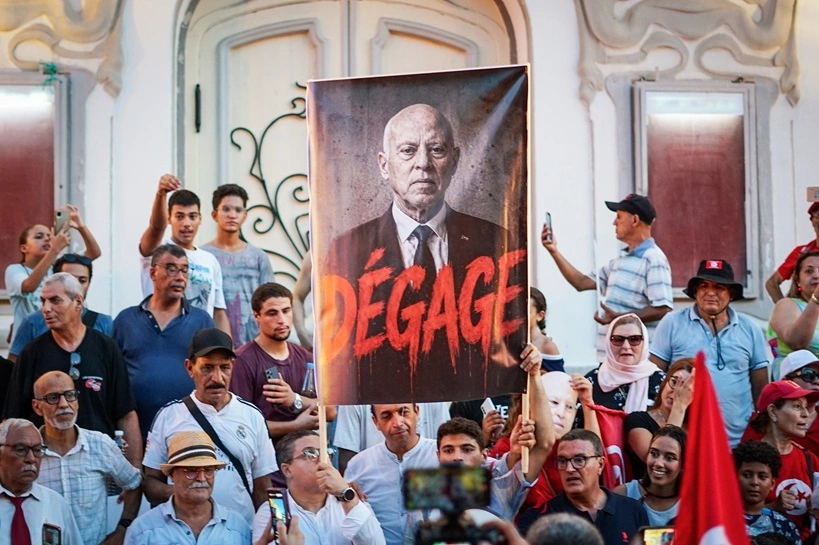
Recent protests in 2026 have demonstrated how economic and political grievances can once again converge. Demonstrations have focused on economic hardship, unemployment, public services and shortages, reviving grievances that were central to Tunisia’s political crisis before 2021.
The significance is structural. The old system could be blamed for paralysis. The new system must increasingly be judged by performance.
This is the accountability paradox of centralization: the more authority a political system concentrates, the more difficult it becomes to separate political control from responsibility for political and economic outcomes.
Washington vs. Brussels — A Fragmented Western Bargain
The West does not speak with one voice on Tunisia. Washington and Brussels share concerns about Tunisia’s political trajectory, but their strategic interests are not identical. That difference is essential to understanding why pragmatic cooperation has continued despite democratic deterioration.
Brussels: Tunisia as Europe’s Southern Border Partner
For Brussels, Tunisia’s immediate strategic value is closely connected to migration management, border control and the stability of Europe’s southern Mediterranean frontier.
The European Union has continued practical cooperation with Tunisia on migration and border management while European institutions and political actors have simultaneously expressed concern about democratic backsliding and human-rights conditions.
This is not necessarily a contradiction in European policy. It is a strategic trade-off. Europe has an immediate interest in maintaining Tunisia’s cooperation in controlling migration flows across the central Mediterranean. As a result, democratic concerns have not displaced the practical importance of migration cooperation.
Washington: Tunisia as a Security Partner
Washington approaches Tunisia through a different strategic lens. Security cooperation, counterterrorism and regional stability remain central to the relationship.
Joey Hood’s assessment of Tunisia’s strategic importance for the United States explicitly argues for building on existing security cooperation and strengthening Tunisia’s role as both a security and economic partner. His earlier Senate testimony also described Tunisia as a long-standing U.S. partner and Major Non-NATO Ally.
This does not mean Washington endorses Saied’s political model. It means that security cooperation operates according to a strategic logic that is not identical to democratic conditionality.
The distinction is therefore clear: Brussels needs Tunisia as a partner in migration and border management. Washington values Tunisia as a security and regional-stability partner. Both relationships can therefore continue even while Tunisia’s democratic trajectory deteriorates.
Democracy remains a Western concern. But it is not the only criterion governing Western engagement. This is the pragmatic dimension of Tunisia’s external position.
Its political system can become more centralized while the country remains strategically useful to its principal Western partners. The result is not a unified Western endorsement of Saied. It is a fragmented Western bargain in which democratic concerns coexist with security, migration and regional-stability priorities.
The Stability Paradox
Tunisia is not a failed state. Its institutions continue to function formally, its security forces maintain order, and the state retains substantial coercive and administrative capacity.
But political control should not be confused with state capacity. A state can suppress dissent without solving unemployment. It can prosecute critics without attracting sufficient investment. It can centralize decision-making without repairing infrastructure. It can reduce political competition without resolving the economic conditions that produce public frustration in the first place.
Tunisia has therefore not demonstrated a transition from a weak state to a strong state. It has demonstrated a different transformation: from a politically fragmented system toward a more centralized state whose political control has expanded faster than its demonstrated capacity to solve structural problems.
This distinction explains the Western dilemma. External cooperation can contain immediate threats. Migration cooperation can reduce pressure on Europe’s borders. Security cooperation can strengthen Tunisia’s role in regional counterterrorism and stability. But none of these can substitute for domestic economic and institutional capacity. That is the difference between stability management and state transformation.
Tunisia’s experience demonstrates why the two should not be confused. A country can be sufficiently stable for its external partners while remaining insufficiently functional for its own citizens.
Conclusion: The Limits of the Bargain
Saied’s presidency was presented as the solution to a paralyzed political system. Five years later, he has centralized power, but the structural problems that undermined Tunisia before 2021 remain.
The point is not that Saied created Tunisia’s economic crisis. He inherited it. The point is that his political project promised that a stronger and more centralized state could overcome it. It has failed to demonstrate that it can.
The transformation of political authority has been dramatic. The transformation of economic and institutional capacity has not been. This is the central failure of the post-2021 model: political centralization has been much more successful at concentrating authority than at transforming the state’s capacity to resolve the problems that made centralization politically attractive in the first place.
The Western dimension makes this dilemma more durable. Brussels has a practical interest in Tunisia as a partner for migration management and Europe’s southern border. Washington has a strategic interest in Tunisia as a security and regional-stability partner. Both can therefore maintain pragmatic cooperation without endorsing Saied’s political model.
Democratic deterioration remains a concern, but strategic utility continues to shape the practical relationship. This is why the choice facing the West is not simply between “stability” and “democracy.” That is a false dichotomy.
The real choice is between a form of stability based primarily on political control and a form of stability built on economic performance, institutional capacity and accountable governance.
Tunisia’s experience suggests that the first can exist without the second. But it also suggests that the first cannot indefinitely substitute for the second.
The central question is therefore no longer simply: Is Tunisia stable? It is: but, how long can political control substitute for state capacity before the unresolved structural crisis becomes the greater threat to stability itself?
References
