

The Logic of Iran’s Transit Balancing in the South Caucasus
In recent years, the South Caucasus has emerged as one of the most important arenas for redefining Iran’s regional connectivity strategy. Contrary to the view that Iran’s transportation and transit policy is merely a reaction to geopolitical competition or security considerations, the underlying logic of Tehran’s current approach can be understood within the framework of “transit balancing through route diversification.” In this context, rather than concentrating on a single corridor, Iran has sought to simultaneously develop two key transit routes across the South Caucasus. The first is the western branch of the International North–South Transport Corridor (INSTC) via the Republic of Azerbaijan, linking Iran with Russia and Belarus. The second is the Persian Gulf–Black Sea Corridor through Armenia and Georgia, providing Iran with access to the Black Sea and subsequently to Europe.
Conversely, both the International North–South Transport Corridor (INSTC) and the Persian Gulf–Black Sea Corridor enable Russia, Belarus, Azerbaijan, Armenia, and Georgia to access Iran’s nationwide road and railway network, the country’s ports on the Persian Gulf and the Gulf of Oman, and onward transit and commercial links to India and the Arab states. From Tehran’s perspective, these two corridors are not competitors but rather serve distinct and complementary functions. The Azerbaijan route provides Iran with the shortest overland connection to Russia and Belarus, while the Armenia route creates access to Georgia, the Black Sea, and Eastern Europe.
This dual-track approach has become increasingly significant in light of the geopolitical developments of recent years, which have fundamentally reshaped the transportation landscape of Eurasia. The implementation of the Iran–Eurasian Economic Union (EAEU) Free Trade Agreement in May 2025 has enhanced the economic importance of Iran’s northern transit routes. At the same time, rising tensions in the Persian Gulf, the Strait of Hormuz, and the Gulf of Oman — particularly amid the current confrontations between Iran and the United States and Iran’s maritime blockade — have prompted Tehran to place greater emphasis on developing alternative overland routes through the South Caucasus, the Caspian Sea, and Central Asia. From this perspective, Iran’s northern corridors are no longer viewed merely as economic and transportation projects; they have become instruments for strengthening economic resilience, reducing vulnerability to disruptions in maritime transport, and decreasing excessive dependence on southern routes. Consequently, Iran’s transit policy in the South Caucasus constitutes part of a broader strategy aimed at establishing a multilayered network of trade routes capable of providing greater geopolitical flexibility during times of crisis.
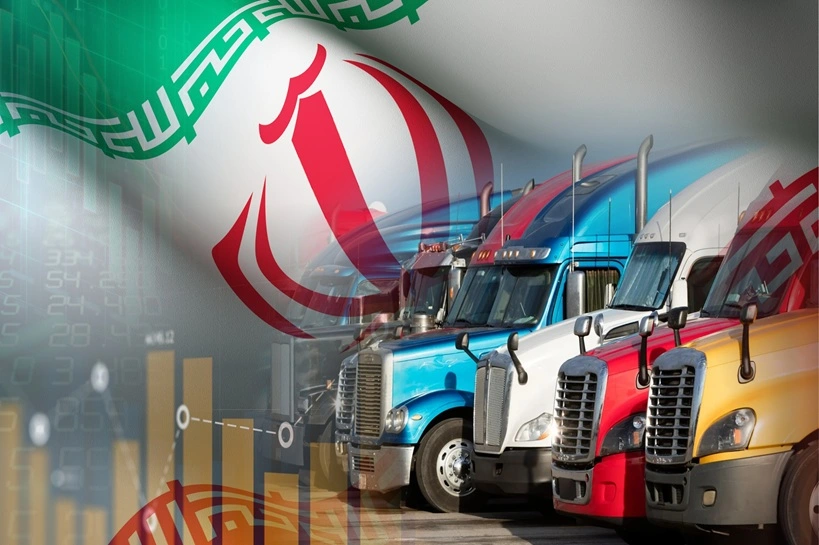
Iran’s balancing strategy in the South Caucasus is also reflected in the distribution of trade flows and border transit capacities with Azerbaijan and Armenia. Approximately 150,000 trucks cross the Iran–Azerbaijan border annually, while the volume of truck traffic across the Iran–Armenia border is estimated at around 80,000 trucks per year. These figures demonstrate that, under current conditions, neither route can fully replace the other.
For this reason, one of Iran’s main concerns regarding initiatives such as the Zangezur Corridor — which has been pursued following the Armenia–Azerbaijan peace agreement under the designation of the “Trump Route” — is not solely rooted in political and geopolitical considerations, but is also closely linked to geoeconomic concerns and Iran’s geographical position within the South Caucasus transportation network. Tehran is concerned that any threat to, or disruption of, the Iran–Armenia common border would weaken one of Iran’s most important transit options in the South Caucasus. From Iran’s perspective, preserving a direct overland connection with Armenia constitutes an integral component of its policy of route diversification and of preventing excessive dependence on a single transit corridor. Consequently, Iran’s transit policy in the South Caucasus is aimed at preserving multiple connectivity options and preventing Iran’s transit network from becoming excessively vulnerable to geopolitical developments.
Infrastructure Diversification: Simultaneous Development of Iran’s Transit Routes with Azerbaijan and Armenia
Iran’s transit strategy in the South Caucasus has not remained confined to diplomacy and political agreements. Rather, in recent years it has been accompanied by a series of infrastructure projects along both the Azerbaijani and Armenian axes. By simultaneously developing transportation infrastructure on both routes, Iran seeks to strengthen its position in both the International North–South Transport Corridor (INSTC) and the Persian Gulf–Black Sea Corridor. This approach reflects Iran’s recognition of the importance of “network resilience” in the evolving geopolitics of Eurasian transportation, whereby the security and sustainability of foreign trade are ensured not through reliance on a single route, but through the establishment of a network of parallel and complementary corridors.
Along the Azerbaijan axis, Iran has undertaken numerous initiatives in recent years to enhance its border and transportation capacities. Iran has five border crossings with the Republic of Azerbaijan: Astara–Astara — the most important and busiest land crossing between the two countries and a key gateway on the International North–South Transport Corridor (INSTC); Bilasuvar–Bilasuvar; Jolfa–Nakhchivan; Khoda Afarin–Aghband; and Poldasht–Shahtakhti, which connects Iran with the Nakhchivan Autonomous Republic. One of Iran’s most significant initiatives has been the construction and inauguration of a new bridge over the Astarachay River at the Astara–Astara border crossing. The project was designed to increase the capacity for truck traffic, reduce congestion at the existing crossing, and facilitate the movement of goods along the western branch of the International North–South Transport Corridor (INSTC).

Another major initiative is the Aras Corridor, also referred to as the Kalaleh–Jolfa Corridor, which has been proposed as an alternative to the Zangezur Corridor, or the Trump Route. This 107-kilometer project, currently under construction, includes both railway and highway infrastructure. It will connect Aghband, in Azerbaijan’s Zangilan district, to the Nakhchivan Autonomous Republic via Iranian territory, passing through Jolfa.

In practice, this route will replace the existing 350-kilometer transit route from Bilasuvar, in Iran’s Ardabil Province, to Jolfa in Nakhchivan. Following the First Nagorno-Karabakh War and the disruption of direct road and rail links between mainland Azerbaijan and the Nakhchivan exclave, the route passing through northwestern Iran became the main transit corridor connecting mainland Azerbaijan with Nakhchivan and, subsequently, Turkey.

Despite these initiatives, one of the most significant challenges facing the Iran–Azerbaijan transit route remains the absence of a fully integrated railway connection between the two countries’ rail networks following the First Nagorno-Karabakh War. Although the road route is currently operational, Iran’s rail connectivity with the South Caucasus continues to face serious constraints. At the Astara border crossing, due to the lack of a direct operational railway link between the Iranian and Azerbaijani rail systems, containers and rail cargo must undergo a time-consuming process of unloading and reloading. In practice, freight is transferred from Azerbaijani trains onto trucks before entering Iran’s domestic transportation network, with the same procedure repeated in the opposite direction. This situation increases logistics costs, slows the movement of goods, and limits the effective capacity of the International North–South Transport Corridor (INSTC).
For this reason, the completion of the 164-kilometer Rasht–Astara railway, the only missing railway link within Iranian territory along the International North–South Transport Corridor (INSTC), has become one of Tehran’s highest priorities in its cooperation with Russia. Iran hopes that, with Russian participation and investment, this approximately 164-kilometer railway section will be completed, thereby creating a continuous rail connection from the Persian Gulf to Russia and Northern Europe. From the perspective of both Iran and Russia, the realization of this project represents not merely a transportation initiative but also a strategic geoeconomic infrastructure project that will expand bilateral trade while reducing dependence on maritime routes vulnerable to political and security developments.

Alongside the Azerbaijan route, however, Iran has also been actively pursuing the development of the Armenian axis. Although Iran and Armenia share only a 40-kilometer common border, with a single border crossing at Norduz–Meghri, the Iran–Armenia–Georgia route plays a significant role in Iran’s policy of route diversification within the framework of the Persian Gulf–Black Sea Corridor. This multimodal corridor begins from the Gulf and southern Iran, heads northward across the country, and then proceeds to Armenia, from where it reaches the Georgian ports of Poti and Batumi in the Black Sea. From there, Roll on–Roll off (Ro-Ro) ships cross the Black Sea to Bulgarian ports (Burgas and Varna), after which cargo proceeds again by road to Greece and beyond in the European Union.

One of the greatest weaknesses of Iran’s transit route through Armenia lies in the limitations of the country’s road infrastructure, particularly in the mountainous Syunik Province. In practice, the only road connection and transit route between Armenia and Iran is the Yerevan–Meghri highway, which extends to the Iranian border. This 400-kilometer route passes through mountainous terrain and is relatively narrow, making the movement of heavy trucks particularly difficult and slow during the winter months because of snow and icy conditions. A substantial portion of the route consists of two-lane roads with numerous sharp bends and steep gradients. During the winter season, heavy snowfall, icy road conditions, and landslides frequently reduce traffic speeds, increase transportation costs, and occasionally result in the temporary closure of sections of the route. Consequently, the completion of Armenia’s North–South Highway, the construction of the Kajaran Tunnel, and the modernization of the country’s southern transport infrastructure are of strategic importance not only for Armenia itself, but also for enhancing the efficiency of the Persian Gulf–Black Sea Corridor and strengthening Iran’s overall transit capacity.
Accordingly, in the road transportation sector, Iran has played an active role in recent years in the development of Armenia’s transport infrastructure to address this major transit bottleneck more rapidly. Iranian companies have participated in several key sections of Armenia’s North–South Highway, a project whose construction began in 2009 with the objective of connecting Shirak Province in the north, bordering Georgia, to Syunik Province in the south, bordering Iran. The project is scheduled for completion in 2030, followed by an additional two years for addressing technical deficiencies. The North–South Highway has been divided into five sections. While the northern segments around Yerevan and Gyumri are approaching completion, substantial portions of the highway in southern Armenia remain under construction. The mountainous terrain of southern Armenia has made the construction of highways and tunnels both costly and time-consuming. Consequently, Iranian engineering and construction companies are participating in the development of several sections of the highway in Syunik Province, with the Kajaran–Agarak (Aghvani) section and the Kajaran Tunnel being of particular strategic importance.

Once completed and operational, Armenia’s North–South Highway will reduce the road distance between Armenia’s borders with Iran and Georgia from approximately 560 kilometers to around 460 kilometers. As a result, the highway is expected to significantly shorten transportation times and reduce logistics costs. According to estimates published by Armenian media outlets, the transit time for Iranian goods passing through Armenia will decline from approximately nine hours to around five hours. At the same time, the transportation cost per ton per kilometer is expected to decrease by approximately US$1.5–2.0. In this context, construction is also underway on a second bridge over the Aras River at the Norduz–Meghri border crossing between Iran and Armenia. Once completed, the new bridge is expected to increase bilateral trade capacity, facilitate the movement of goods, and enhance transit flows.
In the railway sector, given that the proposed Marand–Norduz–Meghri–Yerevan railway has remained unimplemented over the past decade, Iran hopes that the implementation of the peace agreement between Armenia and Azerbaijan will create an opportunity to restore the Jolfa–Nakhchivan railway. Originally constructed 109 years ago, this railway represents the most economical and logistically efficient route connecting Iran to the South Caucasus and, subsequently, to Russia. Unfortunately, following the First Nagorno-Karabakh War, railway connections were severed not only between mainland Azerbaijan and Nakhchivan and between Armenia and Azerbaijan, but also between Iran and the South Caucasus, bringing to an end nearly seven decades of uninterrupted rail connectivity. Consequently, the restoration of the Soviet-era railway network in the South Caucasus, particularly the Jolfa–Nakhchivan–Yerevan route, as well as the Jolfa–Nakhchivan–Meghri–Zangilan–Baku–Moscow route, would constitute one of the fastest and most cost-effective railway projects in the region. More than 35 years after the disruption of these connections, such a project would once again enable direct rail connectivity among Iran, Armenia, Georgia, Azerbaijan, and Russia, fully aligning with Iran’s overarching transit objectives in the South Caucasus: the diversification and balancing of transit routes.

Despite these infrastructure developments, operational challenges continue to constitute one of the greatest obstacles to the expansion of Iran’s transit role in the South Caucasus. Customs-related difficulties, lengthy border inspection procedures, limited terminal capacities, and long queues of trucks during peak periods have reduced the speed of cargo movement and increased transportation costs. These problems are particularly evident at Iran’s busiest border crossings with Azerbaijan, especially the Astara–Astara crossing, highlighting that the development of physical infrastructure must be accompanied by customs reform, the digitalization of border management, and closer coordination among the relevant authorities.
Conclusion
Overall, Iran’s infrastructure policy in the South Caucasus is founded on a fundamental principle: no single route should become Iran’s sole option for connectivity with northern Eurasia and Europe. The simultaneous development of the Azerbaijan and Armenia routes reflects an effort to establish a balanced transit network through which Iran can maintain multiple connectivity options in the face of geopolitical shifts, sanctions, regional crises, and potential disruptions to maritime routes. More broadly, Iran’s transit approach in the South Caucasus can be understood as part of a wider strategy aimed at enhancing the country’s geoeconomic resilience and reducing its vulnerability to regional political and security developments. Tehran does not regard the Azerbaijan route as a substitute for the Armenia route, nor vice versa. Rather, it considers both corridors to be complementary components of a multi-route transit network capable of securing Iran’s access to Russia, Belarus, the Eurasian Economic Union (EAEU), the Black Sea, and European markets.
The simultaneous development of the International North–South Transport Corridor (INSTC) through Azerbaijan and Russia, together with the Persian Gulf–Black Sea Corridor through Armenia and Georgia, demonstrates Iran’s efforts to strike a balance between geopolitical imperatives and economic opportunities. Within this framework, projects such as the Rasht–Astara railway, the expansion of border crossings with Azerbaijan, the modernization of Armenia’s transportation infrastructure, and the potential restoration of historic railway routes such as Jolfa–Nakhchivan should be viewed as technical infrastructure projects. Instead, they are strategic instruments for consolidating Iran’s position within the emerging architecture of Eurasian regional connectivity. The success of this strategy, however, will depend on overcoming operational bottlenecks, improving customs coordination, completing the remaining railway infrastructure, and preserving the geopolitical balance in the South Caucasus. At a time when competition over transport corridors has become one of the defining features of the emerging Eurasian order, Iran seeks to avoid becoming dependent on any single transit route by maintaining simultaneous access to both the Azerbaijan and Armenia corridors, thereby reinforcing its role as a strategic bridge linking the Persian Gulf, the South Caucasus, Russia, and Europe.


