

The end of the Cold War allowed the United States to consolidate its hegemony through a narrative that combines the development of capitalism, globalization, and democracy, accompanied by the use of its military capabilities to influence the geopolitical landscape. In this context, globalization must be viewed from two complementary perspectives: as the opening of markets, the elimination of trade barriers, the offshoring of production, and the expansion of markets; and as a process of accumulation that concentrates economic benefits in a small percentage of the population through the financial sector, speculation, and monopolies. From the perspective of international political economy, this transformation modified the material conditions and, consequently, the political relations between states, transnational corporations, and international organizations, which constitutes the starting point for understanding the current conditions of the international system. Throughout these years, U.S. influence also depended on the international role of the dollar, the size of its market, its transnational corporations, and the expansion of foreign investment.
The U.S. benefited from that unipolar era. However, the economic and political strain associated with rising debt, increased military spending, and the strengthening of other countries is fostering a new geopolitical realignment. In this context, China and Russia are key players in the transition to a multipolar world, which does not imply the disappearance of U.S. influence, but rather the formation of a system where a still-dominant power coexists with new centers of economic, political, military, and technological power. In the current scenario, the possibility of a confrontation arises between two forms of organization of the international system: a multipolar model where cooperation and multilateralism have a key place, and a model of spheres of influence that has as its central focus hierarchical power relations, which seeks to protect the hegemony of the U.S. in world affairs.
China and Russia appear to be the main counterweights to the U.S. model of hegemony. Their strategic partnership has been strengthening since the late 1980s through political agreements, trade, cultural ties, military and technological cooperation, and the advocacy of a multipolar international system.[1] This strategy has been further complemented by international forums such as the Shanghai Cooperation Organization and the BRICS. Furthermore, multipolarity is linked to the existence of multiple centers of power and to improved conditions for diversifying relations among countries of the Global South.
Latin America occupies a central place in this process. However, the U.S. maintains a dominant position, while China increases its commercial presence and Russia strengthens its diplomatic ties. Therefore, the region becomes a space where economic, political, security, and sovereignty interests converge. At the same time, there are limits to Latin American autonomy given the historical pressure from the U.S., competition among powers, and political and economic tensions within each country. Latin America is, therefore, a space for negotiation, but also for geopolitical competition. The 2025 National Security Strategy establishes that U.S. objectives for Latin America will be guided by the “Trump Corollary to the Monroe Doctrine,” which, broadly speaking, aims to keep other powers out of the hemisphere by realigning the countries of the region with U.S. interests.
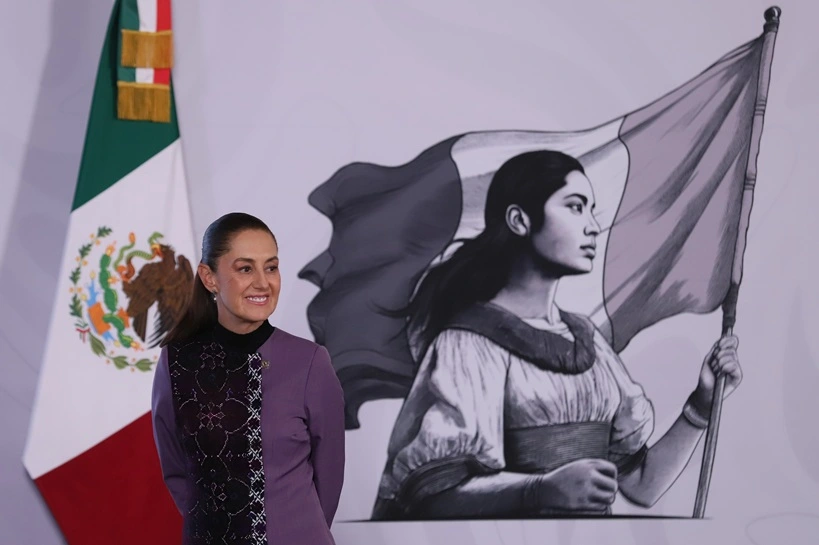
Within this context, Mexico acquires particular importance because it occupies a crucial place for U.S. security and the economy due to its geographic location, the size of its economy, its integration with North American markets, and its cultural ties with Latin America. Since Donald Trump’s return to the U.S. presidency in 2025, the Mexican government, led by Claudia Sheinbaum, has faced significant pressure related to irregular migration, the fight against organized crime, and the pursuit of greater trade benefits for the U.S. This situation demonstrates that the historical bilateral relationship combines economic interdependence with an asymmetrical power dynamic.
During the 1980s and 1990s, some U.S. production shifted to Asia and certain Latin American countries in search of labor, raw materials, tax advantages, and new markets. In Mexico, this process began earlier than elsewhere through the “maquiladora industry,” developed by the National Border Program in 1965 and formalized in 1970. Geographic proximity, political ties, and the signing of the North American Free Trade Agreement (NAFTA) contributed to strengthening the relationship between Mexico and the U.S.
This form of integration yielded benefits for U.S. companies, but also social problems in Mexico, such as precarious employment, wealth concentration, and a productive structure subordinated to the demands of foreign markets and capital. In 2023, 83% of Mexican exports came from the manufacturing sector. Of total exports, the U.S. received $472,218 million of dollars, Canada $17,720 billion, and China $9,151 billion. Mexican manufacturing trade is characterized by high intra-sectoral and intra-company concentration. The country has significant export capacity, but faces challenges in strengthening national production chains and expanding the local benefits of its integration into international markets.
Mexico continues to receive foreign currency through remittances, tourism, and some primary-export sectors and agriculture. For example, in 2022, 72.1% of total foreign currency earnings from Mexican agri-food exports came from 10 types of products: beer (US $6,083 million), tequila ($4,085 million), berries ($3,789 million), avocados ($3,368 million), beef ($2,238 million), tomatoes ($2,143 million), sweet biscuits ($1,182 million), confectionery ($1,138 million), peppers ($1,124 million), and sugar ($1,012 million). Mexico’s main agri-food market that year was the U.S. with $35.437 million, followed by Japan ($1.186 million) and Canada ($894 million).
One of the main challenges of Mexican foreign policy is how to leverage its relationship with the United States without being constrained by its influence. Historically, Mexican foreign policy has been based on the principles of non-intervention, self-determination of peoples, peaceful resolution of conflicts, legal equality of states, and the pursuit of peace through cooperation. In Mexico’s recent history, at least five stages of foreign policy can be distinguished: the nationalist period that ended with World War II; the period of stabilizing development; the transition to neoliberalism; the alignment with the United States; and the Fourth Transformation (4T).
The debt crisis and the Washington Consensus spurred reforms that deepened economic openness to foreign investment and alignment with the U.S. market, while simultaneously distancing Mexico from Latin American integration processes. Mexico’s economic conditions fostered the alignment of its foreign policy with U.S. interests both in the region and in other parts of the world. Later, under the presidency of Andres Manuel Lopez Obrador, a “discreet foreign policy” was proposed based on the improvement in domestic policy. The recovery of the traditional principles of non-intervention and peaceful resolution of conflicts was also observed, along with a policy focused on migration issues, regional cooperation, consular protection, and feminist foreign policy.
The so-called “Second Floor of the Fourth Transformation,” led by Claudia Sheinbaum, appears to be continuing the foreign policy foundations of the previous administration. The National Development Plan (2025-2030) outlines issues centered on sovereignty, industrialization with domestic content, infrastructure development, strengthening state-owned enterprises, and greater regional integration. Furthermore, the Sectoral Program for International Relations establishes that the Secretary of Foreign Affairs will be a tool for promoting the Second Floor of the Fourth Transformation. According to the program, the diversification of political, economic, and cooperation ties aims to expand opportunities for national development. Mexico’s participation in the United Nations (UN) focuses on human rights, the protection of migrants, and the rights of indigenous peoples. Mexico also participates in multilateral forums such as CELAC, the OAS, and the G20 to address issues of social inclusion, climate change, migration, and development. Similarly, it meets with MIKTA countries and fosters relations with the European Union through projects such as the Global Gateway and the Modernized Global Agreement.
Mexico’s Secretary of Foreign Affairs, Roberto Velasco, participated in the General Debate of the 81st session of the UN General Assembly on September 25, 2016. During his address, he mentioned the principles that guide the Mexican government: generating shared well-being, strengthening competitiveness, developing national capacities, and upholding sovereignty. He also emphasized, in a clear reference to the U.S., that “international cooperation is necessary to address shared challenges based on four principles: respect for sovereignty and territorial integrity, shared but differentiated responsibility, mutual respect and trust, and cooperation without subordination.” This message reflects the importance that Mexican foreign policy places on the bilateral relationship.
During her visit to New York, Velasco also participated in the UN LGBTI Core Group Roundtable, a CELAC Ministerial Meeting, and a discussion with the Council on Foreign Relations. He also held a meeting with Ukrainian Foreign Minister, Andriy Sybiha, and later met with Russian Foreign Minister, Sergey Lavrov. During the meeting with Lavrov, they exchanged views on regional and international issues, with an emphasis on their interaction at the UN, the G20, APEC, and other multilateral forums. They also reaffirmed Mexico and Russia’s commitment to the principles and norms of international law and to the joint search for solutions to global problems. The high-ranking representatives seek to maintain political dialogue, increase economic cooperation, and expand humanitarian and cultural ties. As we can see, it is likely that relations between Mexico and Russia will not improve under the current administration, but neither will they deteriorate significantly.[2]
In the current geopolitical context, breaking with Washington would be very risky for Mexico; however, the emergence of a multipolar world and the aggressive U.S. National Security Strategy against Mexico and the rest of Latin America make diversifying economic and diplomatic relations with other countries crucial. This would entail simultaneously managing interdependence with the U.S. and openness to other actors, so that Mexico has better negotiating leverage, while at the same time consolidating its own productive and commercial base.
In this regard, the Interoceanic Corridor of the Isthmus of Tehuantepec is a strategic project. Its objective is to connect the Gulf of Mexico with the Pacific Ocean via railways, highways, industrial parks, and port infrastructure, including Salina Cruz, Coatzacoalcos, Puerto Chiapas, and Dos Bocas. The project can foster development in southeastern Mexico, connect different regions of the country, and improve Mexico’s links with Asia and Europe. It could also increase Mexico’s relevance compared to other interoceanic connection projects and transform it into an economic hub for Central America. The corridor’s importance demonstrates the increasing interconnection between foreign policy and infrastructure, especially in a context of regional competition for trade routes.
On the other hand, some Latin American countries maintain strong trade ties with the U.S., while others have sought to diversify their relationships without breaking with Washington. In this respect, Mexico faces a particularly complex situation because its productive and commercial structure is deeply integrated with the U.S. A foreign policy in a multipolar world would have to combine preserving existing relationships with a diversification strategy that increases the capacity for sovereign decision-making. Afterall, in today’s international context, power is not solely held by governments; transnational corporations, financial institutions, and global production chains also play a role. Therefore, Mexican foreign policy requires improvement in its economic dimension through strengthening production linkages, technological capabilities, and reducing vulnerabilities stemming from excessive trade concentration with U.S. Mexico possesses a strategic position that can become a source of greater negotiating power if it integrates its international relations with a national development strategy.
Mexico’s foreign policy in a multipolar world must be framed as an exercise in balancing its relationship with the United States and the emergence of new centers of power. Integration with North America will remain a fundamental component of Mexican reality, but multipolarity opens avenues for diversifying diplomatic, commercial, technological, and financial ties. Strengthening Latin American cooperation, strategically leveraging the Interoceanic Corridor of the Isthmus of Tehuantepec, developing stronger national production chains, and actively participating in multilateralism appear to be elements that can broaden Mexico’s negotiating position.
The true challenge lies in capitalizing on its geographic and economic position to increase its relative autonomy, without ignoring its interdependence with the United States or allowing competition among great powers to limit its national objectives. However, the most immediate problem to solve is the lack of concrete actions to strengthen ties with other countries. The Presidency of the Republic and the Secretary of Foreign Affairs of the 4T uphold a vision oriented primarily toward the north, with occasional glances toward the other side of the Atlantic and a largely symbolic attention to Latin America. The Pacific, meanwhile, appears as something distant, unfamiliar, and even risky, given the predominant weight of the U.S. in Mexican foreign policy.
Notes & Footnotes

