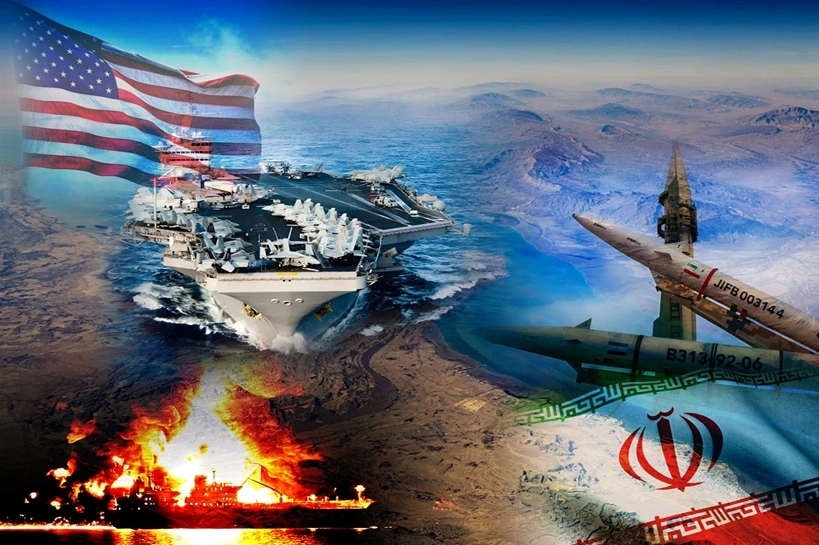

In the corridors of power in Tehran, bold strategic calculations are taking shape. For decades, the Islamic Republic’s strategic doctrine rested on a simple assumption: absorb the first blow, then defend itself with all its might, while consistently polishing a rhetoric that war had been imposed on it. Under these sensitive circumstances, however, the regime is beginning to view that doctrine with doubt. Following last year’s surprise war and this year’s devastating conflict, including the Twelve-Day War with Israel and the subsequent 40-day war involving the United States, Iran’s leadership was targeted, and a profound vulnerability was exposed. That vulnerability has led the regime to conclude that waiting for another attack could make it far more difficult to control the situation. (Wikipedia, n.d.-b).
The Shattered Defense: Military Vulnerability and the Loss of Deterrence
In the opening moments of the 12-Day War, Israeli airstrikes targeted a significant portion of Iran’s senior military commanders. Israel claimed to have killed about 30 Iranian commanders and 11 nuclear scientists. The psychological impact was immense. The regime’s highest-ranking military officials, the very people who were supposed to coordinate Iran’s defense, were targeted before they could issue a single order. (Reuters, 2025).
After the security and military gaps within the Islamic Republic became apparent to Israel and the United States, a coordinated U.S.-Israeli attack on Feb. 28, 2026, used multi-ton bunker-buster bombs to destroy the compound where Iran’s leadership was based, killing Ayatollah Ali Khamenei, the Supreme Leader of the Islamic Republic. For Tehran, the lesson from two short but powerful wars was brutally clear: if it remains committed to its previous strategy of not initiating a war, it will be caught off guard again. This time, the very body and structure of the regime may be targeted, with its adversaries unwilling to accept anything less than its collapse. (Al Jazeera, 2026).
This fear is not merely hypothetical. Reports indicate that the United States has given Israel the green light to launch a preemptive attack against Iran independently. At the same time, the Islamic Republic is aware that, as time passes, its adversaries may develop more security-related cases against it and under these circumstances, if Israel strikes first, Tehran loses the justification it might otherwise use to attack Gulf states hosting American military bases, claiming its attacks are retaliation for an initial assault. By striking first, Iran would seize control of the narrative and present its actions as a defensive necessity in response to an imminent threat. Thus, the preemptive attack is the only way to prevent being caught off guard again is to surprise the enemy before it acts. (Informat.ro, 2026).
Economic Strangulation and a Naval and Air Blockade
Iran’s economic situation is dire inside the country. The country’s currency is depreciating almost every day. Its foreign currency reserves may be sufficient only for a few months. The United States has imposed some of the most severe maritime and air sanctions in history against Iran, while land-based routes are gradually facing tighter restrictions. According to statements by U.S. Treasury officials, Iran faces a situation in which it has “no oil on the water” for the first time in history. Only about 20 million barrels of crude oil remain aboard tankers outside the blockade, near Singapore, Malaysia and China. The Treasury Department’s “Operation Economic Outcast” has targeted Iran’s shadow fleet and, by sanctioning 17 vessels, has disabled most of the country’s savior maritime infrastructure. (Klein, 2026; U.S. Department of the Treasury, 2026).
From Tehran’s perspective, this economic strangulation is itself an act of war. The regime’s survival depends on its ability to sell oil, and that ability is being systematically dismantled. The naval blockade is enforced by an American carrier strike group, and the USS George Washington is currently deployed in the Arabian Sea. However, the USS Theodore Roosevelt is heading toward the U.S. Central Command area of operations, while the USS George H.W. Bush and the destroyer USS Delbert D. Black have left the region ‘en route’ to Thailand. (CBS News, n.d.).
For the Islamic Republic, this creates a limited and fleeting window of opportunity. Confronting one destroyer is easier than facing three. Therefore, Tehran may conclude that it is better to launch a preemptive attack against targets in and around southern Iran before the deployment of additional aircraft carriers is completed, in an attempt to break the naval blockade. The logic is simple: strike now, while the enemy’s forces are not yet in their strongest possible position.
The Domestic Imperative: Rallying a Divided Public
Iran’s economic crisis is not merely a foreign policy problem. It is a ticking time bomb inside the country. With oil revenues declining and sanctions exerting increasing pressure, the regime may face a new wave of public protests driven by worsening economic conditions. The memory of the protests in early 2026, which brought the Islamic Republic to the brink of a serious crisis, remains fresh.
So, launching an attack may be the best way to prevent such a scenario. By rallying public opinion around national unity and the threat posed by an external enemy, the government could attempt to suppress or postpone future protests. Paradoxically, war may become the regime’s most effective tool for domestic survival. (Wikipedia, n.d.-a).
This is not unprecedented. Authoritarian regimes often use external conflicts to divert public attention from domestic grievances. In Iran’s case, however, the stakes are much higher. The regime is not merely unpopular; it faces a legitimacy crisis exacerbated by brutal policing and economic collapse. A preemptive attack, presented as a bold act of resistance against American and Israeli aggression, could rally a segment of society that might otherwise join the protest movement. It is a gamble, but from the regime it may be the only gamble capable of allowing it to manage several fronts simultaneously.
US Midterm Elections and the Hope for Political Turmoil
The timing of a potential Iranian attack may also be influenced by the U.S. midterm elections, scheduled for Nov. 3, 2026. Tehran may see this period as an appropriate opportunity to advance its strategy. The Islamic Republic could intensify volatility in international markets and increase economic uncertainty by launching attacks while global markets are open. Such a conflict would drive up Brent crude prices and ultimately increase diesel prices in the United States. Tehran could then attempt to hold the Republican Party responsible for the resulting economic problems and hope that the party loses the upcoming elections to the Democrats. Tehran’s calculation is that a Democratic victory in America could reduce the threats of war for them. (BBC.com, 2026).
This is a politically complex strategy. Such calculations reflect Tehran’s understanding that American domestic politics can be exploited in pursuit of Iran’s strategic objectives. If a preemptive attack could shift the outcome of the midterm elections in favor of the Democrats, it might ultimately lead to a less hawkish U.S. approach toward Iran or even create conditions that could result in the impeachment of President Donald Trump.
The Houthis and the Strait of Hormuz
Iran’s strategic calculations also involve its regional proxy forces. The Houthis, widely regarded as one of Iran’s most effective proxies, have announced a naval blockade of Saudi ships in the Red Sea and are preventing Saudi vessels from leaving through the Bab el-Mandeb Strait. These actions have imposed significant financial, infrastructural and human costs on Saudi Arabia and disrupted maritime security in one of the world’s most important strategic chokepoints. (CBS News, n.d.).
Conclusion
Taken together, these factors provide what the Islamic Republic considers a seemingly rational basis for contemplating preemptive attacks. Such a strategy could pursue several objectives simultaneously: reducing the damage caused by potential surprise attacks from hostile countries, ensuring that it does not lose control over the management of the war, breaking the economic blockade and disrupting the political and economic environment in the United States. In the hope of contributing to a Republican defeat in the midterm elections and ultimately creating conditions that could lead to Trump’s impeachment.
For many, this logic may appear reckless and even suicidal. However, the calculations of a regime that has lost its Supreme Leader, senior commanders and economic lifeline are different. Waiting for another attack means facing an assault on the very foundations of the regime. By contrast, striking first, even with limited chances of success, offers a possibility of survival. The Islamic Republic is not acting from a position of strength. It is making its calculations out of desperation and out of this desperation it may conclude that the only way to save itself is to start a war it cannot be certain of winning.
References