

Introduction and Context
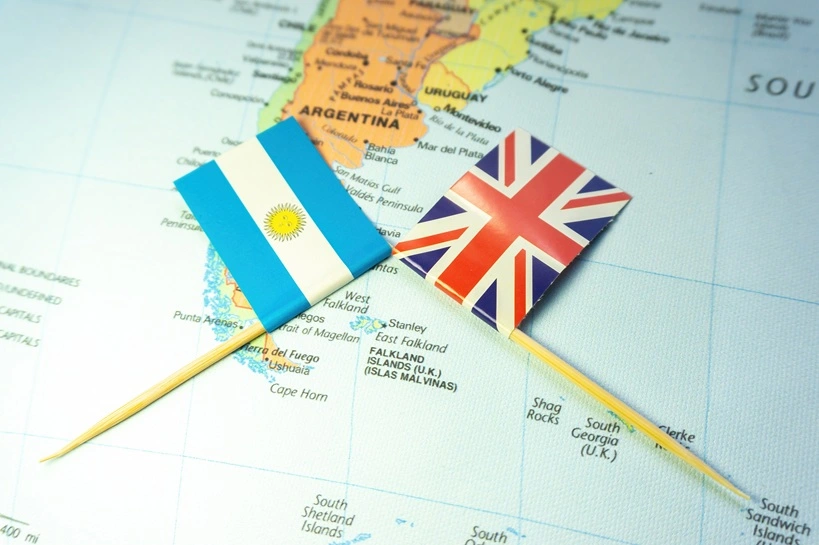
The Falklands/Malvinas [1] lie in the South Atlantic, roughly 480 kilometers (300 miles) off the Argentine coast and some 13,000 kilometers from Britain (Irish Independent, 2024). The archipelago has two main islands, East and West, and several hundred smaller ones (Bytheway, 2013). About 3,500 people live there, most of them in the capital, Stanley (Ortega, 2026a). The islands are a self-governing British Overseas Territory: elected local institutions run domestic affairs, while the United Kingdom is responsible for defense and foreign policy (Bytheway, 2013).
The history is contested at almost every stage. British accounts emphasize settlement in the 1760s and a continuous British presence since 1833. Argentine accounts hold that Argentina inherited the islands from Spain at independence in 1816 and that Britain took them by force in 1833 (Bytheway, 2013; Ljungquist, 2012). Several powers once made claims; according to one commentator, Argentina is the only one that never renounced its own (Bytheway, 2013).
Legally, the dispute sets two principles of international law against each other. Argentina invokes territorial integrity, which underpins the United Nations’ push for decolonization. The United Kingdom and the Islanders invoke self-determination, the right of a people to decide its own political status (Ljungquist, 2012; Kapogianni & Loefflad, n.d.). Each side regards the other’s principle as inapplicable, which is why negotiation has proved so difficult.
In 1982 the dispute became a war. Argentina’s military government invaded in April, and a British task force retook the islands after 74 days. About 649 Argentine servicemen, 255 British servicemen and three Islanders died (Irish Independent, 2024). The consequences were lasting on both sides. In Argentina, defeat contributed to the collapse of military rule, and the 1994 constitution later committed all governments to pursue the claim (Ljungquist, 2012). In Britain, the 1983 Nationality Act gave the Islanders full British citizenship (Ljungquist, 2012).
Analysts increasingly describe the dispute as having three parties rather than two: Argentina, the United Kingdom and the Islanders themselves (Ljungquist, 2012). In a 2013 referendum, 99.8% of voters chose to remain a British Overseas Territory, on a turnout of 92%; only three people voted against (Mavrokefalidis, 2026). Argentina does not accept that the referendum settles the sovereignty question. Its officials have argued that self-determination cannot apply to a population they describe as implanted rather than native (Benwell & Pinkerton, 2020). Researchers who have worked in both societies also note that the Islanders’ caution toward Argentina is shaped by more than 1982, including covert filming, symbolic “incursions” and rhetoric that has at times denied the Islanders’ existence (Benwell & Pinkerton, 2020).
 Figure 1: Map of the Falkland/Malvinas. By Eric Gaba (Sting – fr:Sting) – Own work. CC BY-SA 3.0, via Wikimedia Commons. https://commons.wikimedia.org/w/index.php?curid=1893860
Recent Developments
For much of the last decade the trend was toward cautious cooperation. After the election of Mauricio Macri in 2015 and the United Kingdom’s Brexit vote the following year, the two governments discussed fisheries data exchange, the identification of Argentine war dead and an additional flight link to the islands. The Falkland Islands Government responded more guardedly than London did (Benwell & Pinkerton, 2020). A September 2024 cooperation package followed, but by mid-2026 its main promises, including a flight from São Paulo and the fisheries-data exchange, had reportedly not materialized (Model Diplomat, 2026). Javier Milei, who took office in December 2023, initially signaled patience. In a 2024 interview he said Argentina would pursue the islands through a “framework of peace” and a long-term negotiation (Irish Independent, 2024).
However, oil has changed the calculation. Rockhopper Exploration found oil in the North Falkland Basin in 2010, and the Sea Lion field has been the center of attention ever since. Navitas Petroleum, listed in Tel Aviv, holds 65% of the project and Rockhopper 35%. The partners took a final investment decision in December 2025, with first oil targeted for 2028 and a first phase of about 50,000 barrels a day, at an estimated cost of roughly 2.1 billion US dollars (Oilprice.com, 2025). Resource estimates vary widely depending on whether they count recoverable barrels or total oil in place, but figures in recent reporting range from about 315 million barrels recoverable to 1.7 billion barrels (Mavrokefalidis, 2026; Oilprice.com, 2025).
 Figure 2: Oil and gas exploration zone in the Falkland/Malvinas. Source: https://www.reddit.com/r/MapPorn/comments/uya975/oil_and_gas_reserves_in_the_falklands_or_malvinas/
In addition, the international setting has also shifted. In 2025 the United Nations Special Committee on Decolonization again took up the question, and Argentina’s foreign minister addressed it (United Nations, 2025). A regional declaration backing Argentina’s claim was also adopted at the Organization of American States that year (MercoPress, 2025). In 2026 the United States became part of the story. Britain’s refusal to join the American-led war against Iran strained relations with Washington, and a Pentagon email reported in April floated reconsidering the traditional U.S. position on the islands as one way to pressure allies that stayed out (TRT World, 2026). When asked in an interview whether the United States would come to Britain’s aid in a Falklands conflict, President Trump did not answer directly and complained about British support in Iran (LBC, 2026).
In Argentina, Milei seized on this. In a televised address on September 3rd, he said the “winds of change” favored Argentina, repeated that the islands are Argentine “historically and legally”, announced sanctions on oil companies working around the islands, and promised funding for a naval base in Tierra del Fuego (Associated Press, 2026; CNBC, 2026; MyJoyOnline, 2026). Days later his government announced a criminal complaint against Navitas, several of its subsidiaries and executives. It also named Rockhopper and the Canadian firm Eco Atlantic on a list of “companies to sanction” (CP24, 2026). The companies say their licenses were validly granted by the Falkland Islands Government with UK backing and that they do not expect a material impact on the project (CP24, 2026). It remains unclear whether an Argentine court will open an investigation. Trade press has since reported that the service company Halliburton ruled out taking part in Sea Lion after contacts with Argentina about legal and sanctions risk (Oilprice.com, 2026).
London answered quickly. Foreign Secretary Ed Miliband said the UK’s position is “unwavering” and that the Islanders’ right of self-determination is paramount (Mavrokefalidis, 2026). Defense Minister Wes Streeting said Milei’s remarks reflected Argentine domestic politics more than the islands themselves (CNBC, 2026). Also, a UK minister told the House of Commons that oil production is a commercial decision for the Falkland Islands Government and the companies (MyJoyOnline, 2026). While, former prime minister Boris Johnson argued that Milei is unlikely to use force, given his admiration for Margaret Thatcher, yet still urged London to send reinforcements as a precaution (Barrientos, 2026).
The British Perspective
The core of the British position is that sovereignty follows the wishes of the people who live on the islands. According to a historian cited by To Vima, self-determination has been central to British thinking about the islands since long before 1982, and the 2013 referendum strengthened it (Mavrokefalidis, 2026). Falkland Islands legislators make a related point: asking Britain and Argentina to negotiate the islands’ future over their heads is, in their view, itself a colonial approach (Model Diplomat, 2026). One of them told an American audience that the dispute “is about the Falkland Islands”, meaning the Islanders’ rights rather than British or Argentine ambitions (Bytheway, 2013).
In addition, British commentators add a historical argument. They point out that Argentina never populated the islands before the 1830s and that geographic proximity, if accepted as a basis for sovereignty, would unsettle many territorial arrangements around the world (Mavrokefalidis, 2026). Those who hold this view see the UN’s own emphasis on self-determination as supporting the British case.
Moreover, strategy and economics also matter. Militarily, analysts describe RAF Mount Pleasant as the decisive asset: whoever holds the airfield controls access to the islands (Mavrokefalidis, 2026). British documents describe the islands as a platform for the UK’s Antarctic presence (Ortega, 2026a). Economically, the territory is largely self-financing, apart from defense. Fishing licenses generate most of its income, and Sea Lion offers a second pillar (Ortega, 2026a).
However, the British position has weaknesses that its own analysts acknowledge. Defense capacity has been a recurring concern since the Royal Navy lost its aircraft carriers earlier this century (Ljungquist, 2012). The deployment of about 1,200 troops and modern air defenses is intended to make an attack too costly to attempt, and retaking the islands would be far harder than holding them. More recently, the shifting U.S. stance has become the main source of anxiety. Academic observers in the UK warn that Washington could use the islands as leverage over London even without formally changing its neutrality on sovereignty (Mavrokefalidis, 2026). Critics of the self-determination argument, for their part, note that the current population descends largely from settlers, which makes the case different from that of an Indigenous people (Blair, 2016).
The Argentine Perspective
Argentina’s claim rests on inheritance, on the circumstances of 1833 and on geography. Argentine officials say the islands passed to Argentina from Spain and that Britain has occupied them illegally since 1833 (Ljungquist, 2012; CNBC, 2026). The claim is written into the 1994 constitution, and no Argentine government can drop it without a constitutional change. That makes the issue a state policy rather than the preference of any one party (Ljungquist, 2012).
Argentina’s response to the self-determination argument is that the principle was meant for colonized peoples, not for a population installed by the occupying power. It sees the United Nations’ calls for negotiation as support for this view. For decades the UN Decolonization Committee has urged both countries to negotiate peacefully, and Latin American states consistently back Argentina’s position in that forum (Model Diplomat, 2026). For example, the 2025 OAS declaration over this matter was unanimous (MercoPress, 2025). Since the return to democracy in 1983, Argentine governments have framed their policy as diplomatic rather than military, and Argentina does not treat the 1982 war as a precedent that settled the matter (Ljungquist, 2012).
For Argentina, economic arguments have become more prominent. Argentine analysts argue that the British presence rests on a network of resources and interests: fishing licenses, oil and strategic access to the Antarctic. One Argentine analyst cites government figures showing that fishing accounts for about 58% of the islands’ output and that license fees brought in roughly 49 million US dollars in a recent year, with most of the catch exported to Spain (Ortega, 2026a). From this viewpoint, oil exploration under UK-issued licenses is unlawful exploitation of resources in waters Argentina claims. Argentine law has long required state permission for hydrocarbon activity, and since 2011 and 2013 it has carried criminal penalties of five to ten years (Ortega, 2026b).
Another consideration is domestic politics that are shaped by time. One Argentine analyst argues that defending the claim is a dependable source of popular support, and that the debate was reignited by a flag Argentine footballers displayed after the 2026 World Cup semi-final victory over England (Ortega, 2026b). At home, Milei faced pressure from the opposition, which accused him of neglecting the claim (Associated Press, 2026), and a RUSI analyst notes that his government’s popularity has fallen since May (Mavrokefalidis, 2026). Argentine commentators are divided on how far the shift goes. Some regard his Sea Lion measures as a serious change in policy; others note that the Ushuaia naval base and the sanctions law were projects of earlier governments, and that the same administration had called sovereignty discourse outdated only weeks earlier (Ortega, 2026b).
Outcomes and Possible Scenarios
Most analysts see five broad paths. None is certain, and several can happen at once.
- A managed freeze with louder rhetoric. This is the baseline in much of the British commentary: Argentina sounds firm, London answers firmly, and neither moves. Professor Michael Clarke argues that the issue “will not change” whatever Milei or Trump say (Mavrokefalidis, 2026). Argentina’s frustration, plus an election year ahead, would keep the rhetoric high. The underlying structure, with its constitutional claim on one side and a referendum result on the other, remains intact.
- Legal and commercial pressure on Sea Lion. Peter Clarke of the Royal United Services Institute calls the sanctions approach “fairly low-risk but high-reward”: Argentina cannot seize the field, but it can make contractors, insurers and lenders nervous about doing business there (Mavrokefalidis, 2026). The Halliburton report suggests this is already happening (Oilprice.com, 2026). Sea Lion’s backers say their licenses are valid and project work continues (CP24, 2026). If delay or cancellation resulted, Argentina could present it as a political success, and the Islanders would lose a major source of future revenue. If the project proceeds on schedule, it would show that the pressure has limits.
- A change in U.S. policy. Washington’s formal position has been neutrality on sovereignty, with recognition of British administration in practice. A call for negotiations, or a refusal to back British responses to sanctions, would be a major diplomatic setback for London even without any military change (Mavrokefalidis, 2026). Newcastle University’s Matthew Benwell says it is not yet clear whether President Trump’s remarks would turn into policy. The outcome depends heavily on the wider UK-U.S. relationship, including Iran, defense spending and other territorial questions.
- A return to practical cooperation. Earlier episodes show this is possible. Argentina and Britain agreed on joint statements in 1999 and 2016 and on a package in 2024, though implementation lagged each time (Benwell & Pinkerton, 2020; Model Diplomat, 2026). Argentina also withdrew from an oil-sharing arrangement in 1995, which shows how fragile such deals can be (Ljungquist, 2012). A new round would probably begin with fisheries, flights and conservation rather than sovereignty, and it would need to reassure the Islanders, who are wary of Argentine outreach (Benwell & Pinkerton, 2020).
- Military escalation. Most experts consider this unlikely. Argentina is not threatening an invasion, its armed forces have been constrained by budget cuts, and Britain keeps a deterrent force centered on Mount Pleasant (Mavrokefalidis, 2026; Ortega, 2026b). The risk lies less in deliberate attacks than in an incident at sea, a misread signal or domestic pressure on either side after a diplomatic defeat.
Therefore, indicators to watch include the UN Decolonization Committee’s 2026 session and resolution, any formal statement by the U.S. government, contractor decisions around Sea Lion, whether an Argentine court takes up the Navitas complaint, and the Argentine and British defense announcements that follow.
Conclusion
The Falklands/Malvinas question is not simply a leftover of 1982. It combines a legal clash between two respected principles, the memory of a war, national identity on both sides and, increasingly, real money. The British position rests on the Islanders’ expressed wishes and a credible military deterrent. The Argentine position rests on a historical and constitutional claim, regional diplomatic backing and a belief that self-determination cannot settle a question about territory. Each side can point to international law, and neither is likely to accept the other’s reading.
However, what has changed in 2026 is the setting. The oil project is moving toward production, Argentina has turned to legal and economic tools, and a United States that once stayed neutral has become unpredictable. These changes create openings for both escalation and bargaining. They also raise the stakes for the Islanders, who are central to the British argument yet rarely at the table when the great powers speak.
For the foreseeable future, the most realistic expectation is a continued deadlock with periodic spikes, rather than either a settlement or a war. The most useful questions are practical: whether pressure on the energy sector alters the commercial case, whether Washington moves from remarks to policy, and whether either government sees more value in managing the dispute than in using it politically. Which principle should prevail is a question that this analysis leaves to its readers.
Notes & Footnotes
References
