

I. Introduction
Yemen’s Houthis have entered the Iran war by launching strikes on Israel on March 28, 2026, it was the first time the Iran-backed militia had intervened in the US-Israeli-led war against Iran.
Brigadier-General Yahya Saree, a military spokesperson for the Houthis, announced on March 28, Saturday the Iranian-backed group’s first attack on Israel. On March 29, Sunday, he said the Houthis had carried out a “second military operation” against Israel using cruise missiles and drones and said the Houthis would continue carrying out military operations in the coming days until Israel “ceases its attacks and aggression”.
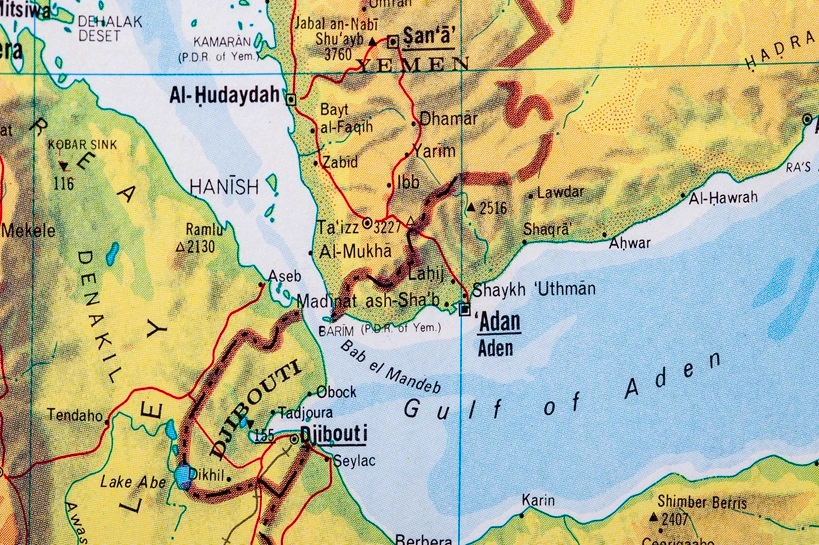
Some analysts have warned their arrival could open another front in the conflict – the potential blockade of Bab al-Mandeb, a strait that presents another chokepoint in the global commodities trade, as Figure 1 shows.

Figure 1: Map of the Bab al-Mandeb Strait
The Houthis’ warning raises the prospect of a broader regional war, in particular given the group’s ability to block Bab al-Mandeb and strike targets far beyond Yemen.
This paper attempts to answer a very important question “what will happen to global oil price if the Houthis close Bab al-Mandeb. In doing so, this paper first explains what joining of the Houthis in the Iran war means and then deals with the possibility of blocking the Bab al-Mandeb by the Houthis. The paper finally examines the effects of blocking the Bab al-Mandeb on global oil prices.
II. Why does the joining of the Houthis in the Iran war matter?
The Houthis are a Yemeni political and military group that emerged in the 2000s and control much of northern Yemen. This group is named after its founder, Hussein al-Houthi, and draws from the Zaydi branch of Shiite Islam.
Although they are backed by and allied with Iran, the Houthis are not a straightforward proxy, and they often prioritize their own domestic interests. And although Iran has supplied it with sophisticated ballistic missile technology, the group has also developed the capability of assembling and manufacturing its own weaponry inside Yemen.
The Houthis rose to prominence after capturing Sanaa in 2014. That sparked a brutal civil war against the internationally recognized government and a Saudi Arabian-led bombing campaign. The Houthis proved remarkably resilient against the air campaigns, which relied on US support and killed about 9,000 civilians.
Houthi attacks over March 28-29, 2026, in the Red Sea and Gulf of Aden have raised fears from some market analysts that they may attack ships and vessels in this waterway as they have in past years.
Neither the Houthis nor Iran has commented on whether there is a plan to close the Strait of Bab al-Mandeb, one of the world’s busiest maritime routes.
But on March 28, Mohammed Mansour, the Houthis’ deputy information minister, told local media that the group is “conducting this battle in stages, and closing the Bab al-Mandeb strait is among our options.” [1]
With tensions already high around the Strait of Hormuz, the possibility that Yemen’s Houthi movement could close Bab al-Mandeb is sending shock waves through energy markets and global supply chains. The Houthi group has a history of attacking ships and vessels in the Red Sea and the Bab al Mandeb Strait.
Initially limited to Yemen, the wars or conflicts involving the Houthis have expanded to critical maritime zones, including the Red Sea, Arabian Sea, Gulf of Aden, and Northwestern Indian Ocean, resulting in more than 300 conflicts between October 2023 and December 2024 (See Figure 2). Within the Red Sea alone, Houthi forces have carried out 201 attacks on commercial vessels during this period, resulting in 12 fatalities.
In a broader context, Houthi forces have been involved in over 2,300 conflicts across the MENA region since October 2023, resulting in a total of 1,467 lost lives. The expansion of Houthi military activity has been accompanied by intensified arms smuggling into Yemen, facilitated by covert ship-to-ship transfers or smaller vessels like dhows that evade detection. These routes, often linked to maritime networks in Iran, persist in the Gulf of Aden and Red Sea. Key Yemeni ports such as Hodeidah and Salif remain central to these smuggling operations, enabling the delivery of weaponry to Houthi-controlled areas while prompting international interception efforts.

Figure 2: Reported conflict events in the MENA involving Houthi forces, November 17, 2023 to December 31, 2024 (source: ACLED, https://acleddata.com; World Bank staff estimates)
The Houthi group has since faced two bombing campaigns by Biden and Trump administrations.
Joe Biden, Trump’s predecessor, carried out airstrikes against Yemen on January 10, 2024, in direct response to unprecedented Houthi attacks on international maritime vessels in the Red Sea.
Those strikes failed to deter the Houthis and only stopped when a ceasefire was brokered between Israel and Hamas in January 2025.
The Houthis resumed their attacks when Israel imposed a blockade on aid and food entering Gaza in March 2025.
The Trump administration also launched bombing campaigns in April 2025 to stop the Houthis attacks, which ended when Trump struck a deal with the Houthis in May to end airstrikes if the group stopped attacks on shipping. The deal did not include an agreement to stop attacks on Israel, which had continued until an eventual ceasefire was reached in Gaza.
After striking a truce with the Houthis, Trump said of the group: “We hit them very hard. They had a great capacity to withstand punishment.” [2] “You could say there’s a lot of bravery there,” he added.
Regarding Houthis attacks on ships and vessels in the Red Sea, in November 2023, Houthi group launched a sustained wave of attacks on commercial shipping transiting the Red Sea and the Bab al Mandeb Strait. The Houthis initially claimed that it was targeting vessels linked to Israel amid the Gaza war. Over the following months, the Houthis expanded their military operations, using explosive-laden drones, anti-ship missiles, and fast attack boats to strike or harass merchant vessels from a growing list of countries.
By early 2024, major shipping companies had begun diverting traffic around southern Africa to avoid the Red Sea, sharply increasing transit times and costs. The Houthis attacks continued intermittently into 2024 as well as 2025, including high-profile incidents that damaged or sank commercial vessels and prompted repeated US airstrikes on Houthi positions. The Houthis’ Red Sea military campaigns disrupted a shipping corridor critical to global trade and energy flows, forcing widespread rerouting and contributing to higher freight and fuel costs worldwide.
Now, with the Houthis openly joining the Iran war, a renewed campaign against shipping could have a similar-or greater-impact, particularly given the already strained energy market.
Much depends on whether the Houthis expand their involvements beyond missile strikes and begin targeting commercial ships and vessels again.
Shipping firms and several governments are closely monitoring the current situation, weighing whether to reroute vessels or deploy additional naval protection. Any escalation at sea would significantly intensify market volatility.
III. Will the Houthis close the Bab al-Mandeb?
One week into the Iran war, the Houthis have not come to Iran’s defense but have warned in official communications that their “fingers are on the trigger.” The Houthis’ apparent inaction has been a surprise for those who see them as simply an Iranian proxy or a trigger-happy militia. [3]
Now the Houthis decided to insert themselves into the Iran war. However, neither the Houthis nor Iran has commented on whether they will block the strait of Bab al-Mandeb.
Iran is pushing the Houthis to prepare for a renewed military campaign against Red Sea shipping, contingent upon any further escalation by the US in its war on Iran, according to European officials familiar with the matter.
Leaders of the Yemen-based Houthis are weighing options for more aggressive action after carrying out ballistic missiles at Israel, the European officials said.
There are divisions within the Houthis’ leadership about how aggressive to be and that was partly why the group entered the Iran war only a month into it, the officials said. [4]
In an announcement on March 28, 2026, the Houthis said they would continue military operations until US-Israeli attacks on Iran and its proxy groups, including Hezbollah in Lebanon, stop.
They specifically did not say they would target tankers or other vessels transiting the Red Sea.
There are three scenarios for Houthi involvement in the Iran war according to Allison Minor at the Atlantic Council. [5] One of three scenarios proposed by Minor is to resume attacks against commercial shipping in the Red Sea.
The lowest-risk option for the Houthis would be to resume attacks on Israel. While the vast majority of Houthi drone and missile attacks against Israel during the Gaza war were failed or intercepted to reach their target, the group has demonstrated that it can penetrate Israeli airspace. Indeed, Houthi strikes on Israel have inflicted dozens of casualties and damaged Ben Gurion Airport. This scenario would invite renewed Israeli airstrikes on Yemen, which were economically and militarily costly for the Houthis group but also help rally popular domestic support.
Israeli strikes against Hudaydah Port were especially damaging for the Houthis, as the port is an essential lifeline for the import-dependent country and a source for illegal Houthi oil revenues. At the same time, the Houthis have demonstrated considerable resilience to air strikes, having now withstood heavy air campaigns for most of the past decade. While an Israeli strike killed some political leaders in Sanaa, Houthi military leadership and the true power brokers within the movement remain untouched.
The second option would be for the Houthis to resume attacks against commercial shipping in the Red Sea, which could potentially threaten their relationship with Saudi Arabia. Disrupting commercial shipping is far easier for the Houthis than conducting military strikes on Israel, given their strategic location along the Bab al-Mandeb maritime chokepoint. The Houthis sank multiple commercial ships during the Gaza war using a combination of missiles, drones, and manned and unmanned boats. And the risks posed by their attacks nearly halted passage through the Red Sea and Suez Canal in 2023. Attacking the Red Sea would be both more impactful and far riskier for the Houthis in 2026.
With the Strait of Hormuz effectively closed due to the ongoing Iran war, Saudi Arabia is depending on its facilities along the Red Sea to maintain some oil exports – most of which are going to Asia and would typically transit south toward Yemen. Absent the Red Sea route, oil flows in the Gulf region could grind to a halt after a couple more weeks of Iran war. Given this, Saudi Arabia is likely to communicate to the Houthis that attacks on Red Sea shipping are now a red line and could invite a Saudi military response. The Houthis have a tendency to test red lines, so they could carry out minor Red Sea attacks and then pull back if they determine doing so would break their détente with Saudi Arabia. Alternatively, the Houthis could seek to exploit heightened Saudi fears over disruptions in the Red Sea to draw new concessions from Riyadh.
The third and most consequential option would be for the Houthis to resume attacks on Saudi Arabia and/or the United Arab Emirates (UAE). This could potentially unfold in combination with attacks in the Red Sea and ground offensives inside of Yemen aimed to seize control of Yemen’s oil and gas resources and weaken the internationally recognized Yemen government. In doing so, the Houthis would effectively reignite the Yemen war. If the UAE or Saudi Arabia decides to respond militarily to Iran’s attacks on economic and civilian infrastructure in both countries, the Houthis could use that retaliation to argue that it was the Gulf countries that broke the détente, not the Houthis. If the Houthis decide to go this route, they will have been driven primarily by their calculations over the situation inside of Yemen, not the Iran war.
It is uncertain which scenario unfolds. However, the Houthis have a long history to attack ships and vessels in the Red Sea, as this paper has explained above.
Therefore, there is a high possibility that the Houthi would attack ships and vessels sailing in the Red Sea and, furthermore, could blockade the Bab al-Mandeb Strait. The actions of the Houthi will depend on the situations in the US-Iran war, such as the US attacks on Iranian energy facilities and power plants, as well as Iran’s stance and the details of agreements between the Iranian regime and the Houthi.
IV. The impact of the closure of the Bab al-Mandeb Strait
1. The importance of the Bab al-Mandeb Strait
The Strait of Bab al-Mandeb sits at a critical crossroads between continents, separating Yemen on the Arabian Peninsula from Eritrea and Djibouti in the Horn of Africa.
It forms a narrow maritime link between the Suez Canal to the north and the Gulf of Aden and Indian Ocean to the south – a route that underpins trade between Asia and Europe.
Stretching about 100 kilometers (62 miles) in length and narrowing to roughly 30 kilometers (19 miles) at its tightest point, the Bab al-Mandeb strait funnels vast volumes of global commerce.
As Figure 3 shows, Perim Island divides it into two channels: a shallower eastern passage for local vessels and a deeper western lane used by international shipping.

Figure 3: Perim Island & Bab al-Mandeb strait (source: http://www.dreamstime.com/ illustration/perim.html)
Millions of barrels of oil, liquefied natural gas (LNG) and container cargo transit the strait every day, making it one of the world’s most sensitive maritime choke points.
Its Arabic name, “Gate of Tears,” reflects both centuries of deadly navigation hazards and a legend of a deadly earthquake that split between Asia and Africa.
While the Bab al-Mandeb strait has long connected Arabia, East Africa, and South Asia, its global importance surged after the opening of the Suez Canal in 1869, which created a direct maritime route into Europe through the Mediterranean, avoiding the need to sail around Africa.
How important is Bab al-Mandeb for global energy?
The Bab al-Mandeb is one of the world’s most important energy choke points.
As Table 1 shows, in 2023, 9.3 million barrels per day of crude oil and petroleum liquids passed through the Bab al-Mandeb strait – nearly 12% of seaborne-traded oil worldwide, according to the US Energy Information Administration (EIA). Only the Strait of Malacca, with 24 million barrels per day, and the Strait of Hormuz, at 21.8 million, moved more crude oil in 2023. However, after attacks by the Houthi in the Red Sea in the 2023-24, flows of crude oil and petroleum liquids through the Bab el-Mandeb strait significantly dropped to 4.2 million barrels per day in the first half of 2025, as Table 1 and Figure 4 show.
Table 1: Volume of crude oil and petroleum liquids transported through world chokepoints, 2020-first half 2025(1H25)


Figure 4: Flows of crude oil and petroleum liquids through the Bab al-Mandeb & other chokepoints (source: EIA)
Prior to 2024, most exports of petroleum and natural gas from the Persian Gulf to Europe and the Atlantic coast of North America passed through the Suez Canal or the SUMED pipeline as well as the Bab al-Mandeb and the Strait of Hormuz. However, after the Houthi group launched attacks on commercial ships transiting the Red Sea started in November 2023, some vessels began taking longer, more costly routes around the Cape of Good Hope, which avoids the Bab al-Mandeb as well as the Suez Canal.
About 4.9 million barrels per day of crude oil and petroleum liquids transited the Suez Canal and the SUMED pipeline in 1H25, and an estimated 4.2 million barrels per day also transited the Bab al-Mandeb. Both volumes were approximately half of the flows in 2023, as Table 2 shows.
Table 2: Volume of crude oil, condensate, and petroleum products transported through the Suez Canal, SUMED pipeline, and Bab al-Mandeb Strait, 2020-1H25

Saudi crude oil and condensate volumes flowing via the Bab el-Mandeb also declined by more than 50% from 2023 to 2024; However, Saudi volumes transiting Suez and SUMED declined only 10% as Saudi Arabia increased exports via the East-West crude oil pipeline and Red Sea terminals.
In the first half of 2025, Russia moved more crude oil and condensate through the Suez Canal and the Bab al-Mandeb than any other country. After the Ukraine war began in February 2022, most of Russia’s exports from the west of the country shifted from Europe to Asia, mainly India. Russian oil vessels have rarely been targeted by the Houthi group attacks in the Bab al-Mandeb, and volumes of Russian crude oil and condensate passing through the Suez Canal and the Bab al-Mandeb in 2024 and the first half of 2025 were little changed from 2023.
LNG flows via the Bab al-Mandeb were near zero in 2024 and the first half of 2025 (See Table 2). LNG flows through both the Suez Canal and the Bab al-Mandeb declined significantly in 2024 as ships avoided the strait of Bab al-Mandeb due to security concerns and high insurance rates. Since 2023, LNG flows through the Suez Canal are almost entirely for delivery to Egypt or Jordan.
The threat posed to shipping through the Bab al-Mandeb from Yemen is real. In 2016, missiles were fired by the Houthi group at a US Navy warship near the Bab al-Mandeb. Houthi forces also have deployed mines along Yemen’s coast and used a remote-controlled boat packed with explosives in an unsuccessful attack on the Yemeni port of Mokha in July 2017. The Houthis have also launched several unsuccessful naval attacks on ships in the Red Sea, including gunboats damaging a Saudi oil tanker near the port of Hodeidah in April 2018.
Shortly after the outbreak of the Gaza war in 2023, the Houthi group began to launch missiles and drones at Israel. It has also fired merchant vessels in the Red Sea, particularly in the Bab-el-Mandeb, the southern maritime gateway to the Suez Canal, damaging the global economy. The group declared that it would not stop attacks until Israel stopped the Gaza war.
The Houthis declared any Israel-linked ship was a target for attack, including UK and US warships, but they also attacked the vessels and ships of countries with no connection to Israel. The Houthis have attacked 178 vessels throughout their two-year blockade, according to the NGO Armed Conflict Location and Event Data, sinking four ships and killing nine sailors. To avoid being attacked, hundreds of commercial vessels were rerouted to sail around South Africa. [6]
That flow dropped sharply in 2024 to about 4.1 million barrels per day after Houthi attacks on shipping disrupted traffic. The impacts extended beyond the strait itself. Flows through the Suez Canal and the Suez-Mediterranean Pipeline dropped from 8.8 million to 4.8 million barrels per day.
Red Sea attacks by the Houthi have drawn military responses from a number of countries, including the US. In January 2024, the UN Security Council adopted Resolution 2722, condemning the Houthi attacks and affirming freedom of navigation. [7] The US-led Operation Prosperity Guardian was launched to protect Red Sea shipping. From 12 January 2024, the US and UK-led coalition forces launched air, and missile strikes against the Houthis, while other countries are independently attacking Houthi vessels in the Red Sea. On 3 May 2024, Houthi general Yahya Saree said, “We will target any ships heading to Israeli ports in the Mediterranean Sea in any area we are able to reach.” [8] On 6 May 2025, US president Donald Trump announced a cessation of US strikes as a result of a bilateral ceasefire between the US and the Houthis. The Houthis halted their attacks on international shipping and in Israel after the Gaza peace plan took effect on 10 October 2025. Some major shipping companies, such as Maersk, have since resumed their Red Sea routes, while others have held off due to the volatile situation. On 28 February 2026, in response to attacks on Iran by the US and Israel, the Houthis threatened to escalate the conflict, and on 28 March, it finally resumed their attacks on Israel amidst the Iran war.
2. The impact of the closure of the Bab al-Mandeb strait
What could happen if the Houthis closed the Bab al-Mandeb Strait?
Bab al-Mandeb is one of the world’s most critical routes for seaborne commodities, especially Gulf oil destined for Europe, as well as goods heading toward Asian markets.
With tensions already high around the Strait of Hormuz, the possibility that the Houthi could block Bab al-Mandeb is sending shock waves through energy markets and global supply chains.
According to the US Energy Information Administration (EIA), the Strait of Hormuz used to ship an average of 20 million barrels of oil per day. The effective closure of the Strait of Hormuz during the current Iran war has choked global oil supply and exports through alternative routes still leave the world supply short by about 13 million barrels per day – a gap with no clear replacement. This is because About 7 million barrels per day of that loss is being made up through other means, such as the Bab-el-Mandeb Strait, Fujairah in the UAE and the release of strategic reserves, according to Kpler.
As Figure 5, two of the most important alternatives to the Strait of Hormuz are the United Arab Emirates’ ADCOP pipeline, which feeds the export terminal at Fujairah and Saudi Arabia’s East-West pipeline, which terminates at the Red Sea port of Yanbu.

Figure 5: Two of the most important alternatives to the Strait of Hormuz (Source: ABC News & Kpler)
As Figure 6 shows, crude oil & condensate flows in March 2026 through Bab al-Mandeb hit more than 4 million barrel per day, the highest since October 2023, as Saudi Arabia ramped up oil exports via the Yanbu port due to the actual closure of strait of Hormuz.

Figure 6: Crude oil and condensate transit via the Bab al-Mandeb Strait in 2026 by origin ports, kbd (source: Kpler)
Kpler data in Figure 6 shows 3.97 million barrels per day of crude oil has transited the Bab al-Mandeb Strait so far in March 2026 – a sharp increase from 2.95 million barrel per day in February and marking the highest level since October 2023, before the Houthis began targeting passing vessels. Of this, 1.75 million barrels per day was loaded from Saudi Arabia’s port of Yanbu, while the bulk of the remainder, 1.79 million barrel per day, was Russian crude bound for Asia.
Saudi Arabia has ramped up crude exports via its Red Sea infrastructure as the Strait of Hormuz has effectively been closed for a month. 3.23 million barrels per day of crude oil has been loaded until March 26, the highest level on record. Before the Iran war, the Yanbu port typically shipped around 750–850 thousand barrels per day of crude. The route is critical for Saudi Arabia to sustain large-scale production – while most other producers in the Gulf region are forced to significantly trim output amid mounting inventory pressure – and for buyers to retain access to roughly a third of non-Iranian Middle Eastern crude oil.
Saudi oil giant Saudi Aramco has notified its key Asian clients that all April-loading cargoes will be lifted from the Yanbu port, with Chinese refiners set to receive around 1.33–1.36 million barrels per day and Indian refiners 766–833 thousand barrels per day. Kpler’s vessel tracking also shows nearly 30 tankers waiting offshore Yanbu to load, underscoring refiners’ urgency to secure supplies and ease the imminent feedstock crunch.
Notably, crude loadings from the Yanbu port are so far bound for China (933 thousand barrels per day), Egypt (720 thousand barrels per day), India (702 thousand barrels per day) and Myanmar (143 thousand barrels per day), with the latter flowing to PetroChina’s Yunnan refinery via pipeline. Despite heightened concerns over supply shortages and an active search for spot cargoes, South Korea and Japan have lifted only 98 thousand barrels per day and 53 thousand barrels per day of Saudi crude from Yanbu, respectively. Market participants told Kpler that South Korea and Japan appear to have been cautious about routing crude oil via the Bab al-Mandeb Strait even before the Houthis’ announcement.
If the Houthis were to disrupt oil traffic through the Bab al-Mandeb Strait, Asian countries would further lose access to already constrained Middle Eastern crude supplies. Shipowners could reroute westward via the Suez Canal and then around the Cape of Good Hope to deliver Saudi crude oil to Asia. However, this voyage would take nearly 50 days – more than double the transit time via the Red Sea and effectively reduce prompt availability in the market – and would significantly raise costs due to higher freight rates and increased fuel consumption. It would also require further repositioning of the global tanker fleet, as VLCCs are unable to transit the Suez Canal, thereby reducing overall market efficiency.
It remains unclear how the Houthis will define “hostile” countries and whether Russian oil carriers could also come under threat. Kpler data shows that while overall crude flows through the Bab al-Mandeb Strait declined in 2024 and 2025 after the Houthi attacks, Russian crude shipments have remained broadly stable at around 1.9 million barrels per day, in line with pre-attack levels. As Russian exports are already being undermined by intensifying Ukrainian attacks in recent weeks, any disruption in the Red Sea would further constrain flows to Asia, particularly India.
That said, the Houthis’ entry into the Iran war marks a significant escalation and adds upward pressure to oil prices. The threat alone is enough to deter some shipowners from lifting Saudi crude from Yanbu, pushing up prices for Oman and Murban, which are loaded outside the Strait of Hormuz, as well as differentials for African and US crude oil in the new trading cycle.
Under these gloomy situations for oil markets, risks of oil flows via the Bab al-Mandeb Strait could further tighten crude oil supply as Houthis enter the Iran war.
Two of the world’s most critical maritime routes, the Strait of Hormuz and Bab al-Mandeb, are currently being held at risk by Iran and its proxies as the Iran war drags into a second month, amplifying pressure on global trade and energy flows. The escalation introduces fresh upside risks to the oil market and is set to deepen the supply squeeze in Asia.
While global oil prices have already surged around $110 per barrel, JP Morgan analysts say that problems with the passage of oil through the Bab-el-Mandeb Strait could add $20 a barrel to global oil prices. And some oil analysts warn that a full disruption of both chokepoints, the Bab-el-Mandeb Strait as well as the Strait of Hormuz, could push oil prices toward $150, threatening nearly 25–30% of global seaborne oil supply. Other experts fear oil prices could surge to $150-$200+ a barrel if both chokepoints are closed for prolonged periods. [9]
While Bab al-Mandeb might not handle as much oil as the Strait of Hormuz, it’s another key chokepoint for the oil market. If it also closes to tanker traffic, it will upend Saudi Arabia’s partial workaround, further exacerbate the oil supply shock and undoubtedly send oil prices much higher. That would benefit oil companies that primarily operate outside these key chokepoints, like ConocoPhillips and Occidental. However, it would likely inflict significant damage to the global economy. These factors make Bab al-Mandeb an important area to monitor.
Shipping companies are already reacting. Major carriers such as Maersk, Hapag Lloyd, and CMA CGM have suspended many routes through the Red Sea corridor, rerouting vessels around Africa. The shift is dramatically increasing shipping times and costs.
V. Conclusion
This paper attempted to answer a critical question, “What impact will a blockade of the Bab al-Mandeb Strait have on global oil prices?” as the Houthis entered the Iran war through attacks on Israel. To this end, this paper first explained the significance of the Houthis participation in the Iran war, and then examined the possibility of blockading the Bab al-Mandeb Strait by the Houthis.
Considering past experiences of the Houthis attacking vessels in the Red Sea after November 2023 in a long period of time, this paper argued that the possibility of closing the Bab al-Mandeb Strait by the Houthis is good. Finally, this paper claimed that if the Houthis close the Bab al-Mandeb Strait, the crude oil exports of Saudi Arabia and Russia, which have been expanding their exports by bypassing the Strait of Hormuz, will face difficulties. As a result, global oil prices, which have recently been fluctuating around $110 per barrel, could rise to $150-$200.
References
