

Chapter 1 — Definition and Importance of Ammunition
Ammunition refers broadly to all forms of projectiles launched or delivered by weapon systems such as firearms, missiles, and rockets, together with their propellants, fuzes, and explosive charges. The term is not limited to individual bullets or artillery shells. In modern warfare, its scope has expanded considerably to include precision-guided munitions, loitering munitions, and even hypersonic missiles.
Ammunition is not simply the flower of a weapon system; it is the soil that allows the weapon system to flourish. No matter how sophisticated a military’s self-propelled howitzers or tanks may be, without ammunition to fire, they are little more than scrap metal.
From a military perspective, ammunition is not merely a consumable item but a key indicator of war-sustaining capability. Wartime ammunition stockpiles are among the most practical measures of how long and how intensely a country can continue fighting. For this reason, a nation’s ability to produce, stockpile, and supply ammunition is regarded as a fundamental measure of the strength and resilience of its defense industrial base.

Figure 1. Cross section of firearms cartridge
- Primer: When the firearm’s firing pin strikes the primer located at the center of the base of the cartridge, the primer ignites.
- Propellant: The flame produced by the primer ignites the propellant inside the cartridge case. The propellant burns very rapidly, generating a large volume of hot, high-pressure gas.
- Projectile: As gas pressure inside the cartridge case rises rapidly, it pushes the projectile — the component most able to move — forward. The projectile leaves the cartridge case, travels through the barrel, and exits the muzzle.
- Cartridge Case: The cartridge case serves as the container that holds the projectile, propellant, and primer together as a single unit. At the moment of firing, the case expands inside the chamber, helping prevent high-pressure gas from escaping rearward. After the pressure drops, the spent case remains in the chamber.
- Rim: The rim at the bottom of the cartridge is the part engaged by the firearm’s extractor to pull the spent cartridge case out of the chamber.
In simple terms, the firing sequence is: the firing pin strikes the primer → the primer ignites → the propellant burns → high-pressure gas is generated → the projectile is propelled forward → the remaining cartridge case is extracted and ejected.
A bullet, also referred to as a projectile, is a solid projectile fired from a firearm such as a gun or cannon. It is generally made primarily of metal. The velocity of a bullet is approximately 300 m/s. A projectile fired from a gun is commonly called a bullet or round, while one fired from a cannon is generally referred to as an artillery shell or projectile.
“Wars Are Won with Bullets” — The Strategic Value of Ammunition
There is a well-known military saying: “Amateurs talk tactics; professionals talk logistics.” Looking back through history, the outcome of wars has often been determined less by brilliant strategy than by superiority in ammunition and supply. One of the decisive factors behind Germany’s retreat on the Eastern Front during the Second World War was the Soviet Union’s overwhelming artillery-shell production, while the rapid decline of the Japanese Navy after the Battle of Midway was also driven in large part by the enormous industrial and military production capacity of the United States.
In modern warfare, the strategic value of ammunition has become even greater. As precision-strike capabilities have advanced, a single munition can now achieve effects that once required dozens of soldiers, while drones, missiles, rockets, and other forms of munitions increasingly shape the course of the battlefield. Artillery ammunition, in particular, remains the backbone of firepower in modern ground warfare, and superiority in ammunition supply at the front often translates directly into tactical initiative.
The Ukraine War and the Reality of Ammunition-Intensive Warfare
The war triggered by Russia’s invasion of Ukraine in February 2022 once again demonstrated to the world the strategic importance of ammunition. During the early stages of the war, Ukraine was consuming approximately 6,000–10,000 155mm artillery shells per day, while Russia at times fired more than 50,000 rounds a day. According to European intelligence estimates, Russia’s annual artillery-shell production reached approximately 3 million rounds, around 2.5 times the combined production of the United States and Europe, estimated at roughly 1.2 million rounds. This enormous disparity in production capacity was reflected directly on the battlefield and became one of the factors behind Russia’s gradual gains on the eastern front.
Perhaps even more striking was the fact that even the United States — the world’s most powerful military nation — found its stockpiles of basic conventional artillery ammunition under severe pressure, leading Washington to urgently seek assistance from its ally South Korea amid what became widely described as an “ammunition shortage.” U.S. Chairman of the Joint Chiefs of Staff Mark Milley warned during a congressional hearing that if war were to break out on the Korean Peninsula, ammunition consumption would exceed expectations, publicly acknowledging the seriousness of conventional ammunition stockpile requirements.
Modern warfare was once expected to be dominated by multibillion-dollar stealth aircraft and unmanned systems. Yet as the war in Ukraine became prolonged, an unexpected reality emerged across the global security landscape: even a superpower equipped with overwhelmingly advanced weapons cannot sustain a long war without a reliable supply of ammunition from the rear.
South Korea’s Ammunition Industry — The Hidden Force Behind K-Defense
It was at this moment that South Korea began to attract greater attention. While many major countries had focused heavily on expensive advanced weapons and allowed conventional ammunition-production capacity to decline, South Korea had spent decades maintaining its ammunition factories and strengthening its conventional forces in response to the threat posed by North Korea’s long-range artillery.
In 2023, while maintaining its principle of not directly supplying lethal weapons to Ukraine, the South Korean government responded to allied demand through a plan to lend 500,000 rounds of 155mm artillery ammunition to the United States.
Behind the high-profile export success of South Korea’s defense industry — symbolized by the K9 self-propelled howitzer, K2 main battle tank, and FA-50 light combat aircraft — stood a strong domestic ammunition-production base, including Poongsan, one of the world’s leading ammunition manufacturers. This is why South Korea has increasingly been described as playing the role of a “vast arsenal” supporting the security of the liberal democratic bloc.
While tanks, self-propelled artillery, and combat aircraft have placed K-Defense in the international spotlight, ammunition has quietly supported its competitiveness from behind the scenes as an often-overlooked hidden force.
This article examines the history, technology, and future of that hidden pillar of South Korea’s defense industry.
Chapter 2 — The History of South Korea’s Ammunition Industry
Foundational Period (1950s) — The Painful Lesson of the Korean War
At dawn on June 25, 1950, North Korea launched a surprise invasion of South Korea, beginning the Korean War. The conflict left the Republic of Korea with many hard-earned lessons. Among the most painful was the stark reality that a country unable to produce even a single round of ammunition for itself cannot fully determine its own destiny.
In the opening stages of the war, South Korean forces were overwhelmed by North Korea’s T-34 tanks. Lacking sufficient rifles and ammunition, the Republic of Korea Armed Forces were pushed back as far as the Nakdong River defensive perimeter and had to rely heavily on ammunition supplied by the United States and other UN forces for survival. During the three-year war, virtually all of the ammunition used by the South Korean military came through U.S. support.
After the war, South Korea’s leadership came to understand a fundamental lesson: without the ability to produce ammunition domestically, neither genuine self-reliant defense nor an independent military strategy would be possible.
Yet in the 1950s, South Korea was still struggling simply to survive amid the devastation of war. It had virtually no ammunition-production infrastructure and lacked both the technical workforce and the capital needed to build one. With postwar reconstruction as the country’s overriding priority, the domestic production of ammunition appeared to be a distant dream. Nevertheless, the seeds of that ambition had already been planted by the traumatic experience of the Korean War.
Drive for Self-Reliance (1970s) — Park Chung-hee’s Decision and the Beginning of Ammunition Independence
From the late 1960s into the early 1970s, South Korea’s security environment began to change rapidly. In January 1968, North Korean commandos attempted to raid the Blue House, and shortly afterward North Korea seized the U.S. Navy intelligence ship USS Pueblo. In 1969, U.S. President Richard Nixon announced the Nixon Doctrine in Guam, stating that countries facing threats other than nuclear attack would have to assume primary responsibility for their own defense. The announcement also signaled a reduction in U.S. troop levels in South Korea. At the same time, U.S. grant-based military assistance to South Korea gradually declined and was effectively discontinued by 1971.
These developments pushed the Park Chung-hee government into action. In 1971, President Park appointed Oh Won-chul, then an assistant minister at the Ministry of Commerce and Industry, as Senior Secretary for Economic Affairs and tasked him with developing South Korea’s defense industry. Full-scale defense-industrial development began the following year, in 1972.
The objective was simple but ambitious: by 1976, South Korea would establish the research, development, and mass-production systems required to domestically produce basic weapons and ammunition. From 1977 to 1981, these systems would move into mass production and operational deployment, and from 1982 onward, South Korea would begin developing independent weapons systems. It was, in effect, a three-stage roadmap toward defense self-reliance.
During this period, a company that would become one of the central players in South Korea’s ammunition industry emerged. Founded in 1968 as a non-ferrous metals company, Poongsan was designated as South Korea’s first defense-industry company in 1973. Guided by the principle of ‘saeop boguk’ — serving the nation through industry — Poongsan began concentrating its capabilities on the mass production and localization of military ammunition.
It started with small-caliber ammunition and gradually expanded into medium- and large-caliber artillery rounds. This marked a historic turning point: a country that had once depended on imported ammunition for every round it fired had begun producing its own.
Growth Period (1980s–1990s) — A Leap in Domestic Production
By the 1980s, South Korea’s ammunition industry had entered a period of full-scale growth. Building on the expansion of the heavy and chemical industries under the Fourth Five-Year Economic Development Plan, and supported by policies promoting advanced industries under the Fifth Five-Year Economic and Social Development Plan, the country rapidly broadened the foundations of its defense industry and expanded the scope of indigenous weapons development and localization.
One of the most significant achievements of this period was the domestic production of artillery ammunition. Production capabilities expanded from 105mm towed-artillery rounds to 155mm howitzer ammunition, while critical ammunition components — including fuzes, explosive fills, and propellant charges — were progressively localized.
The quality of South Korean ammunition also improved to levels capable of meeting U.S. military MIL-SPEC standards, laying the foundation for future exports.
During the same period, Hanwha, formerly Korea Explosives, began developing independent production capabilities in explosives and propellants, while the Agency for Defense Development (ADD) intensified research into indigenous ammunition design technologies.
South Korea was beginning to move beyond simply reproducing foreign ammunition designs. It was building the capability to design ammunition tailored to the specific tactical requirements of the South Korean military.
In the 1990s, even as the Cold War came to an end, North Korea’s threat evolved in increasingly asymmetric ways. South Korea therefore continued expanding its ammunition stockpiles and production capacity.
The development and operational deployment of the K9 self-propelled howitzer in 1999 sharply increased demand for 155mm ammunition, leading to a significant expansion of domestic 155mm production capacity. The capacity built during this period would later become one of the foundations that enabled South Korea to emerge as a major source of ammunition during the war in Ukraine.
Expansion Period (2000s–Present) — Precision Munitions and the Rise of an Export Industry
From the 2000s onward, South Korea’s ammunition industry began moving beyond the production of conventional rounds and into the new field of precision-guided munitions.
Precision weapons incorporating advanced technologies such as GPS, laser guidance, and inertial navigation dramatically improved accuracy compared with conventional ammunition and emerged as a key technology reshaping the character of modern warfare.
One representative achievement of this period was the development of the K315 extended-range 155mm projectile. While the range of the previous mainstay K307 round was approximately 40 kilometers, the K315 combined base-bleed technology, which reduces drag at the rear of the projectile, with rocket-assisted propulsion (RAP). This hybrid propulsion approach extended its range to approximately 54 kilometers.
Combined with the K9 self-propelled howitzer, such ammunition significantly strengthened South Korea’s long-range artillery capabilities.
A major transformation also took place in exports. In 2008, Poongsan became the first South Korean defense company to surpass US$100 million in defense exports, and it ranked first among South Korean defense exporters for five consecutive years from 2006 to 2010.
In 2012, its defense exports exceeded US$200 million, establishing Poongsan as one of the leading companies in the rise of K-Defense. By 2020, its export markets had expanded to 32 countries, including countries in the Middle East and Africa, while its product range had diversified substantially — from small-caliber ammunition to anti-aircraft ammunition, mortar rounds, howitzer shells, tank ammunition, and naval gun ammunition.
The war in Ukraine, which began in 2022, became a decisive moment that brought international attention to the true strategic value of South Korea’s ammunition industry. The fact that even the United States, the world’s most powerful military, faced ammunition shortages and turned to South Korea for support highlighted the importance of the production capacity that South Korea had quietly built over several decades.
Today, South Korea’s ammunition industry is accelerating the development of next-generation technologies, including intelligent smart munitions, ultra-long-range glide projectiles, and loitering munitions, positioning ammunition as a new growth engine for K-Defense.
Timeline of the Development of South Korea’s Ammunition Industry
Table 1. Key Milestones in South Korea’s Ammunition Industry

Chapter 3 — Small-Arms Ammunition
Small-arms ammunition is the most basic type of ammunition used directly by individual soldiers on the battlefield. Although small in size, it is consumed at the very front line of combat, and a country’s ability to produce and stockpile it is one of the most fundamental measures of its basic defense capability.
3.1) 5.56mm — The Heart of the K2 Rifle and a Link to NATO
At the core of South Korea’s small-arms ammunition inventory is the 5.56×45mm NATO cartridge. It is currently used across several of the Republic of Korea military’s standard weapons, including the K2 rifle and K2C1, the K1A submachine gun, and the K3 light machine gun.
South Korea’s history with 5.56mm ammunition began with licensed production in the 1970s. Poongsan successfully produced the KM193 5.56mm cartridge for the M16A1 under license, marking one of the first major steps toward the domestic production of small-arms ammunition. South Korea later transitioned to the NATO-standard SS109 cartridge, designated M855 by the U.S. military and K100 by the South Korean military. Compared with the earlier M193, the SS109 uses a slightly longer projectile with improved aerodynamic characteristics, providing better performance at longer ranges.
There was also a strategic reason for selecting the 5.56mm NATO standard during the development of the K2 rifle. Standardization was intended to make it easier for South Korea to receive ammunition support from the United States in wartime, placing logistical interoperability within the ROK-U.S. combined operational framework at the forefront.
Today, 5.56mm ammunition is produced domestically by Poongsan and is also exported alongside Korean-made firearms to countries including Nigeria and Iraq.
3.2) 7.62mm — The Intermediate Backbone of Firepower
The South Korean military primarily uses 7.62mm ammunition for sustained medium-range fire support and precision sniping. Representative weapons chambered for this ammunition include the K14 sniper rifle and the K16 general-purpose machine gun, which replaced the aging M60 machine gun.
The 7.62×51mm NATO cartridge uses a larger and heavier projectile than the 5.56mm round, giving it significantly greater effective range and penetration. It is effective for long-range precision fire, engaging lightly armored vehicles, and suppressing enemy positions.
The K16 general-purpose machine gun is employed by infantry platoons and companies, as well as on tanks, armored vehicles, and helicopters, providing a key layer of intermediate battlefield firepower.
7.62mm ammunition is also produced domestically by Poongsan and is sold overseas in sporting-ammunition variants for the civilian market.
3.3) 9mm — The Standard Handgun Cartridge
The 9×19 mm Parabellum cartridge is the standard ammunition for the K5 pistol and is used in secondary weapons carried by officers, non-commissioned officers, and special operations personnel.
The 9mm cartridge is NATO’s standard handgun caliber and one of the most widely used handgun cartridges in the world. South Korea adopted the same standard in part to maintain interoperability with U.S. and NATO forces.
It is used for short-range engagements, close-quarters combat, security duties, and ceremonial or protective missions. Poongsan produces the ammunition domestically while also exporting civilian and sporting variants.
3.4) 12.7mm — The King of Heavy Machine-Gun Ammunition
The 12.7×99mm (50 BMG) cartridge is the standard ammunition for the K6 heavy machine gun and delivers the greatest firepower among South Korea’s small-arms ammunition categories.
The K6 heavy machine gun is employed in a wide range of roles, including defensive positions, vehicle-mounted fire support, attacks against lightly armored vehicles, and engagement of low-flying aircraft.
With its substantial penetration and range, 12.7mm ammunition has an effective range of more than approximately 1,800 meters. Its capabilities extend beyond conventional small-arms fire, providing limited anti-armor and anti-aircraft capability as well.
Poongsan domestically produces a broad range of 12.7mm ammunition, including anti-aircraft variants, and these products are also included in its export portfolio.
Table 2. Comparison of Small-Arms Ammunition


Figure 2. Small-Arms Ammunition Types
Domestic Production and Stockpiles
South Korea’s small-arms ammunition production is effectively centered on Poongsan. As the country’s only comprehensive ammunition manufacturer supplying most of the ammunition used by the South Korean military, from small-caliber cartridges to large-caliber artillery ammunition, Poongsan operates major production facilities in Busan for small-caliber ammunition and Angang in Gyeongju, North Gyeongsang Province, for medium- and large-caliber ammunition.
In terms of stockpiles, the military’s official principle is to maintain approximately 60 days of wartime ammunition reserves, while in practice it is understood to maintain more than 30 days’ worth at stable levels. Major firepower ammunition such as 155mm artillery shells, as well as small-arms ammunition, is believed to be maintained in sufficient quantities.
However, a significant portion of stored ammunition requires periodic inspection for aging and defects, as well as replacement and maintenance. To manage these stocks more efficiently, the military is pursuing the introduction of a smart ammunition logistics system.
From an export perspective, South Korean ammunition also provides a strong foundation for the country’s broader defense exports. Poongsan exports dozens of types of sporting and military small-arms ammunition to markets across North America, the Middle East, Europe, and other regions.
Ammunition exports have also become a key component of “package exports” linked to Korean-made weapon systems such as the K2 rifle, K16 machine gun, and K9 self-propelled howitzer.
Ultimately, South Korea’s small-arms ammunition industry is a representative example of a sector that began with licensed production in the 1970s and went on to achieve both full domestic production capability and export-oriented industrialization, demonstrating one of the strongest foundations of the broader K-Defense industry.
Chapter 4 — Artillery Ammunition
Artillery is the king of modern ground warfare. Infantry may locate the enemy, and tanks may create the breakthrough, but it is ultimately artillery that delivers the decisive firepower. And the effectiveness of artillery is determined not only by the number and performance of its guns, but also by the quality and quantity of its ammunition. The history of South Korea’s artillery ammunition is therefore also the history of the qualitative advancement of South Korean military power.
4.1) 105mm — A Long-Standing Partner of Towed Artillery
The 105mm round is one of the longest-serving types of artillery ammunition in the history of the South Korean military. South Korea’s use of 105mm artillery began with the American M101A1 howitzer and later continued with the development of the domestically produced KH-178 towed howitzer. Until the introduction of the KH-179 155mm towed howitzer, the 105mm system remained a core component of divisional artillery.
Some 105mm systems remain in service with mobilization divisions and units operating in mountainous terrain. More recently, M101-series 105mm guns have been mounted on trucks and modernized as the K105A1 self-propelled howitzer, which is used to support infantry brigades and reserve forces.
A variety of 105mm ammunition is produced domestically, including high-explosive (HE), smoke, illumination, and training rounds. In export markets, South Korean 105mm ammunition also meets demand in developing countries due to its competitive price and reliable quality.
4.2) 155mm — The Core of South Korean Artillery Ammunition and the Heart of the K9
The true centerpiece of South Korea’s artillery ammunition inventory is the 155mm round. It has been a key caliber since the days of the K55 and KH-179, and the introduction of the K9 dramatically elevated its importance. Continuous advances in range and destructive power have helped South Korea develop artillery firepower at a world-class level.
Where South Korean artillery once achieved ranges of approximately 18–24km with conventional high-explosive rounds and around 30km with rocket-assisted projectiles (RAP), the introduction of the K9 and new generations of ammunition expanded effective firing ranges dramatically to approximately 40–60km.
4.2.1) K307 — Base-Bleed High-Explosive Round: The Beginning of the Range Revolution
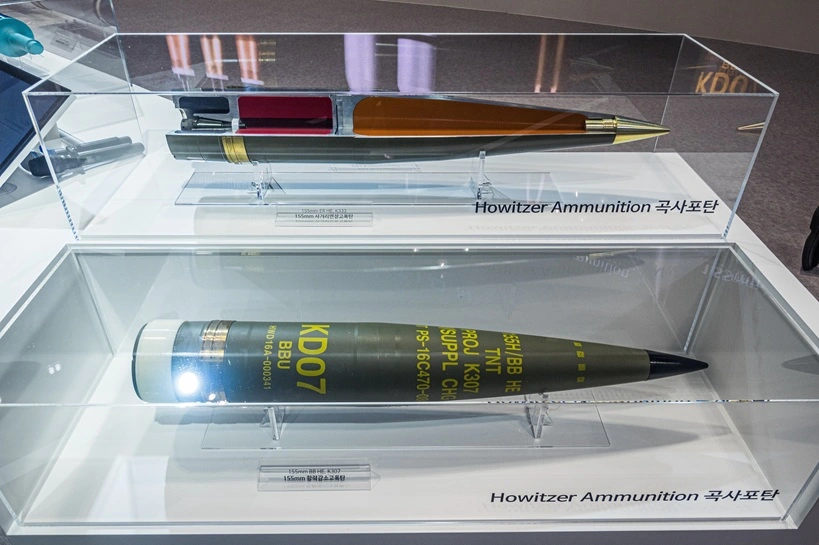
The K307 is a high-explosive projectile equipped with a gas generator at its base to reduce aerodynamic drag. When fired from the K9 self-propelled howitzer, it can reach a maximum range of approximately 40km.
Base Bleed (BB) technology works by using a gas generator at the rear of the projectile to reduce the low-pressure wake and aerodynamic drag created behind the shell during flight. This technology increases range by approximately 30 percent or more compared with conventional high-explosive projectiles, without requiring a separate rocket motor.
The K307 remains one of the South Korean military’s principal 155mm high-explosive rounds and is stockpiled and operated in large quantities. It has also attracted attention as an export ammunition product.
4.2.2) K310 — DPICM: A Dual Anti-Armor and Anti-Personnel Threat
Developed using the base-bleed technology applied to the K307, the K310 belongs to the DPICM (Dual-Purpose Improved Conventional Munition) family and carries dual-purpose submunitions inside the projectile.
Compared with the earlier K305 DPICM, the K310 DPICM-BB (Base Bleed) carries fewer submunitions, but each individual submunition is heavier. As a result, both lethal area and penetration capability are increased. Its lethal area is approximately 5,100m², around 1.5 times greater than that of the earlier round.
Its penetration capability has also increased from approximately 7.6cm to 10cm, providing sufficient performance to defeat many of the tanks and armored vehicles operated by North Korea. The K310 has a range of approximately 36km.
In other words, a single K310 round can engage both enemy infantry spread over a wide area and armored targets, making it a highly versatile artillery munition. However, DPICM-type cluster munitions remain internationally controversial because of the risks posed by unexploded submunitions, which can impose restrictions in some export markets.
4.2.3) K315 — Extending the Range to 54–60km
The K315 is South Korea’s latest 155mm extended-range artillery projectile, combining Base Bleed (BB) with Rocket-Assisted Projectile (RAP) technology.
During early testing in 2020, the projectile demonstrated a range of approximately 54km. Subsequent military operational testing reportedly achieved a maximum range of around 60km, approximately 50 percent greater than that of the K307.
After receiving a combat-suitability assessment in August 2023, the system proceeded through the establishment of defense specifications and completion of system development. Initial production began in 2024, and field deployment has been underway since March 2026, beginning with frontline and maneuver corps of the Republic of Korea Army.
4.2.4) Excalibur — The Era of Precision Guidance
The M982 Excalibur, developed by Raytheon in the United States, is a GPS-guided 155mm precision munition whose compatibility with the K9 self-propelled howitzer has been demonstrated.
Where conventional high-explosive artillery shells may have a circular error probable (CEP) measured in tens or even hundreds of meters, Excalibur achieves an extremely high level of precision, with a CEP of less than 5 meters. Its maximum range is approximately 40–57km.
The munition is particularly suited to precision strikes against enemy facilities in densely populated urban environments where minimizing civilian casualties is a priority. During the war in Ukraine, Excalibur attracted international attention for precision strikes against Russian command posts and logistics concentration points.
South Korea has also accelerated the development of domestically produced GPS-based precision-guided artillery ammunition and guidance fuzes as interest in precision artillery has grown.
Table 3. Evolution of South Korea’s 155mm Artillery Ammunition


Figure 3. Artillery Ammunition Types
The Link Between Self-Propelled Howitzer Exports and Ammunition Exports — An Inseparable Relationship
The remarkable export success of the K9 self-propelled howitzer is not simply the achievement of a single weapons platform. Exports of self-propelled artillery are inevitably accompanied by demand for ammunition as part of the broader package. This has become one of the strongest growth engines for South Korea’s artillery-ammunition exports.
When Poland signed contracts for 672 K9 self-propelled howitzers, it also pursued large-scale procurement of 155mm ammunition. Other K9 operators — including Egypt, Australia, Finland, Norway, and Estonia — have likewise introduced ammunition alongside the platform or pursued discussions on local production and supply-chain cooperation.
This has established what can be described as a “self-propelled howitzer–ammunition package export” model.
The strategic significance of this structure is considerable. Once a country purchases the K9, it may continue purchasing compatible ammunition for decades. The howitzer itself is largely a one-time procurement, whereas ammunition creates a long-term, recurring export market.
If thousands or tens of thousands of training rounds and wartime reserve rounds are supplied each year, the resulting demand can provide South Korea’s ammunition industry with a stable and sustained market.
The importance of this model has become even more apparent since the outbreak of the war in Ukraine. Western countries that transferred large quantities of 155mm ammunition and self-propelled artillery to Ukraine have sought to replenish depleted stockpiles, contributing to increased emergency orders and long-term supply agreements involving South Korean ammunition manufacturers.
Ultimately, by combining with the globally successful K9 platform, South Korea’s artillery-ammunition industry is evolving from a supplier of consumable rounds into a key component of the global 155mm artillery supply chain.
From 105mm towed-artillery ammunition to advanced 60km-class hybrid-propulsion extended-range rounds, the 70-year development of South Korean artillery ammunition continues to advance into a new generation of long-range and precision firepower.
Chapter 5 — Missile and Rocket Munitions
If artillery ammunition represents the core of tactical firepower in modern warfare, missiles and rockets represent the core of strategic firepower. In response to the threat posed by North Korea’s long-range artillery and ballistic missiles, South Korea has steadily developed its own missile and rocket capabilities and has today emerged as a missile power attracting international attention.
5.1) K136 Kooryong — The Starting Point of South Korea’s Multiple Rocket Launcher Capability
The history of South Korea’s multiple-launch rocket systems begins with the K136 Kooryong. In the 1970s, after North Korea deployed the Soviet-designed BM-21 multiple rocket launcher (MRL), South Korea began searching for an effective countermeasure. To respond to the North Korean artillery threat, South Korea developed the K136 Kooryong in 1978.
Beginning in the 1980s, the Kooryong was deployed with the Republic of Korea Army, temporarily helping restore a degree of balance with North Korea’s artillery forces.
Capable of launching a salvo of 36 130mm rockets, the Kooryong was designed as an area-saturation weapon capable of delivering concentrated fire over a wide area in a matter of seconds. For decades, it served as one of the key components of South Korean artillery firepower.
However, it lacked GPS guidance, resulting in relatively low accuracy, while its range was also limited. The system developed to overcome these limitations was the K239 Chunmoo.

Figure 4. K136 Kooryong, version K30 (130mm, range 23km), version 33 (131mm, range 36km)
5.2) K239 Chunmoo — The Crown Jewel of K-Defense Missile Exports
The Chunmoo multiple-launch rocket system was developed to replace the aging K136 Kooryong in the Republic of Korea Armed Forces. Development began in 2009, was completed in 2013, and the system entered operational service in 2015.
One of the Chunmoo’s greatest strengths is its ability to operate multiple types of ammunition from the same launcher.
The system can launch three principal classes of rockets and missiles:
- 130mm: maximum range of approximately 36km
- 239mm: approximately 80km
- 600mm: approximately 290km
A single launcher can carry:
- 40 × 130mm rockets (unguided)
- 12 × 239mm rockets (guided)
- 2 × 600mm missiles (ballistic)
The Chunmoo uses electrically driven actuators rather than hydraulic cylinders and incorporates a digital control system capable of moving elevation and azimuth simultaneously. This reduced firing-response time from approximately 93 seconds to 16 seconds.
The design is therefore optimized for “shoot-and-scoot” tactics, allowing the launcher to fire and rapidly relocate before enemy counter-battery fire can arrive.
The Chunmoo is one of the Republic of Korea Army’s principal assets for countering North Korea’s approximately 5,500 multiple-launch rocket and rocket-artillery systems, and around 200 launchers are currently deployed operationally.
Future development of the system is also attracting considerable attention. The vehicle-mounted KTSSM-II tactical surface-to-surface guided weapon is intended to extend the range of the existing KTSSM-I from approximately 180km to 290km and integrate the tactical ballistic missile system with various mobile launch platforms, including systems based on the K239 Chunmoo. Development began in 2023 and is scheduled for completion by 2032.
Export Achievements
The Chunmoo has achieved remarkable export success. On October 19, 2022, Poland signed a framework agreement for 288 Chunmoo MLRS launchers, mounted on Polish Jelcz 8×8 chassis and integrated with Poland’s TOPAZ battle-management system, together with the supply of 80km- and 290km-class precision-guided missiles.
The Polish export version was designated HOMAR-K. Through the first and second executive contracts, initial systems were rapidly delivered and deployed, becoming a key component of Poland’s eastern defenses.
In December 2025, a third executive contract was also signed to establish local production in Poland of the 80km-class CGR-080 Chunmoo guided rocket. A joint venture established by Hanwha and Poland’s WB Group is building local production facilities, with deliveries of Polish-produced guided rockets scheduled to begin in 2030.

Figure 5. K239 Chunmoo, 130mm rocket, 239mm guided rocket, 600mm ballistic missile
5.3) Hyunmoo Ballistic Missiles — The Core of Strategic Deterrence
The Hyunmoo missile family goes beyond the conventional concept of ammunition and represents one of the central pillars of South Korea’s strategic deterrence capability.
5.3.1) Hyunmoo-2 — A Core Tactical Ballistic Missile
The Hyunmoo-2 is a family of short-range ballistic missiles (SRBMs) with ranges of approximately 300–800km, giving South Korea the capability to strike targets across North Korea.
It combines GPS and inertial navigation system (INS) guidance to achieve precision-strike capability and is currently one of the principal missile systems operated by South Korea’s Missile Command.
5.3.2) Hyunmoo-3 — A Core Long-Range Land-Attack Cruise Missile
The Hyunmoo-3 is a family of long-range land-attack cruise missiles (LACMs) with reported ranges of approximately 500–1,500 km, depending on the variant, giving South Korea the capability to conduct precision strikes against strategic targets at considerable distances.
It combines GPS and inertial navigation system (INS) guidance with low-altitude cruise flight to improve accuracy and survivability, and forms an important part of South Korea’s long-range precision-strike capability.
5.3.3) Hyunmoo-4 — The Emergence of an Ultra-Heavy Warhead
The Hyunmoo-4 substantially increased warhead weight to more than 2 tonnes, specializing in the destruction of North Korean underground tunnels and hardened military facilities through a bunker-buster role.
The South Korean government stated that if the Hyunmoo-4’s two-tonne warhead were accelerated to approximately Mach 10, the resulting impact could generate an effect comparable to roughly 1,000 tonnes, or 1 kiloton, of explosive force.
The concept is intended to achieve an exceptionally powerful conventional strike against deeply buried targets without using a nuclear weapon.
5.3.4) Hyunmoo-5 — The World’s Heaviest Conventional Missile Warhead
The Hyunmoo-5 has a warhead weighing approximately 8–9 tonnes and a total missile weight of around 36 tonnes, giving it one of the heaviest conventional missile warheads in the world.
Development and testing were reportedly completed in 2023. The missile was also publicly displayed that year during the Armed Forces Day ceremony and the first major military parade held in a decade, carried inside a container on a TEL (Transporter-Erector-Launcher).
According to officially disclosed specifications, the missile carries a warhead weighing up to approximately 9 tonnes and has a range of at least 300km. It is classified as a short-range ballistic missile designed primarily as a bunker-buster for attacking extremely deep underground facilities in North Korea.
However, experts have suggested that through the trade-off between warhead weight and range, the system could potentially be adapted into a much longer-range missile approaching the performance of an intermediate-range ballistic missile.
The military reportedly plans to deploy as many as 200 missiles with units under the Missile Command.
A decisive factor behind the development of the Hyunmoo-5 was the termination of the ROK-U.S. Missile Guidelines in 2021. On May 22, 2021, during a summit between President Moon Jae-in and U.S. President Joe Biden, the missile guidelines were terminated after 42 years.
The Hyunmoo-5 became the first South Korean ballistic missile developed after the removal of these restrictions.

Figure 6. Hyunmoo-5 Missile
Table 4. Comparison of the Hyunmoo Missile Family

5.4) Haeseong — The Pride of South Korea’s Anti-Ship Missile Capability
The Haeseong is an independently developed South Korean ship-to-ship cruise missile and one of the principal anti-ship weapons carried by Republic of Korea Navy surface combatants.
With a range of approximately 150–180km, it approaches enemy ships at an extremely low altitude of roughly 2–5 meters above sea level, using sea-skimming flight to reduce the likelihood of radar detection.
The missile combines inertial navigation with an active radar seeker to achieve high accuracy and is deployed aboard major South Korean warships, including Sejong the Great-class Aegis destroyers and Chungmugong Yi Sun-sin-class destroyers.
An air-launched variant, the Haeseong-II, has also been developed for operation from aircraft such as the FA-50, while further extended-range and supersonic variants are also being pursued.

Figure 7. Haeseong Cruise Missile
5.5) Cheongung — South Korea’s Patriot-Class Air Defense System Proven in Combat
The Cheongung is a South Korean medium-range surface-to-air guided missile system designed to protect major national and industrial facilities from enemy air attack. It is often described as South Korea’s equivalent of the Patriot system.
The system dramatically demonstrated its capabilities in combat in 2026. During Iranian retaliatory missile attacks against the United Arab Emirates amid the 2026 U.S.-Iran war, two Cheongung-II batteries were deployed in the UAE.
On March 3, the UAE Ministry of Defense announced that it had intercepted 161 of 174 ballistic missiles launched by Iran. South Korean lawmaker Yoo Yong-won stated that the two Cheongung-II batteries deployed in combat fired approximately 60 interceptor missiles, achieving a reported interception rate of 96 percent.
For cruise-missile attacks, Cheongung-II was reportedly used exclusively and successfully intercepted all eight incoming missiles, achieving a 100 percent interception rate in those engagements.
This combat performance gave a major boost to the Cheongung-II’s export prospects. Already exported to the UAE and now proven under combat conditions, the system has attracted growing interest from countries across the Middle East and other regions and is increasingly evaluated alongside major air-defense systems such as Israel’s Iron Dome and the U.S. Patriot.

Figure 8. Cheongung Surface-to-Air Guided Missile
Table 5. Evolution of South Korea’s Missile and Rocket Forces

Conclusion of Chapter 5 — South Korea’s Rise as a Missile Power
South Korea’s missile and rocket forces have undergone remarkable development, from the relatively basic K136 Kooryong multiple-launch rocket system introduced in 1978 to today’s Hyunmoo-5 with its exceptionally heavy conventional warhead and the Cheongung-II, which reportedly achieved a 96 percent interception rate in combat.
The termination of the ROK-U.S. Missile Guidelines in 2021 was a particularly important turning point for South Korea’s missile industry. Since then, South Korea has been able to pursue independent strategic missile development without previous restrictions on missile range and warhead weight.
The export of 288 Chunmoo launchers to Poland, together with the export and combat validation of the Cheongung-II in the UAE, symbolizes South Korea’s transformation from a missile-importing country into a major missile exporter.
