
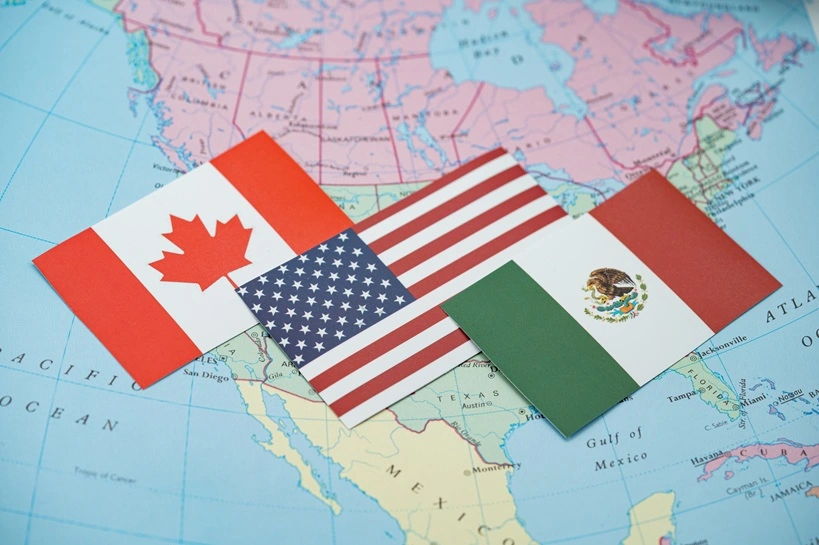

The US decision to forgo the automatic 16-year renewal of the T-MEC (‘Tratado entre México, Estados Unidos y Canadá’, known by its English acronym, USMCA) trade agreement with Mexico and Canada has become one of the most widely discussed economic events of recent weeks. Media headlines have created the impression that North America’s free trade agreement is effectively on the brink of collapse (reading them may immediately have you humming Europe’s old song “The Final Countdown”). In reality, however, this is not the end of the agreement but the launch of a different mechanism: annual reviews over the next ten years.
Meanwhile, the T-MEC remains in force, free trade among the three countries continues, and its preferential regime and rules of origin still apply. However, the very nature of the agreement is changing. While businesses previously perceived it as a relatively stable, long-term framework, uncertainty is now its defining characteristic, and North American integration is becoming a space of permanent, exhausting political negotiations and annual pressure.
A Bit of History
The North American Free Trade Agreement (NAFTA; in Spanish, ‘Tratado de Libre Comercio de América del Norte’, or TLCAN) entered into force in 1994 and remained virtually unchanged for more than a quarter of a century. Over that period, the global economy underwent the globalization of production and supply chains, China’s unprecedented economic growth, the development of e-commerce, and the technological transformation of industry.
In its original form, the TLCAN gradually ceased to reflect the new economic reality. Donald Trump made this very argument during his first presidential campaign in 2016, calling the agreement “the worst deal” for the United States. He accused Mexico and Canada of deriving disproportionate benefits. In his view, the two countries exploited the agreement for their own gain at the expense of American industry, and the United States should therefore withdraw from the TLCAN. This argument became one of the key slogans of Trump’s election campaign and helped mobilize some voters.
The threat of a US withdrawal from the North American Free Trade Agreement was quite real at the time. Donald Trump had already demonstrated his willingness to undermine international trade structures by withdrawing the country from the Trans-Pacific Partnership (‘Acuerdo de Asociación Transpacífico’). Ultimately, Mexico and Canada were forced to agree to renegotiate the agreement, resulting in the creation of the T-MEC. It was then that the so-called sunset clause – a procedure for periodically reviewing the agreement – was included in the text of the new agreement. Initially, Washington insisted that the T-MEC automatically terminate every five years. For businesses, this would have made long-term planning impossible. Mexico City and Ottawa were able to secure a compromise from the US: rather than terminating automatically, the agreement would be subject to a mechanism for regular assessment of its implementation. Formally, then, the discussion was not about starting negotiations from scratch each time but about auditing and adjusting individual implementation mechanisms. The T-MEC negotiation process began in 2017 and concluded at the end of 2018, with the updated agreement entering into force only in 2020. With Donald Trump’s return to the presidency in 2025, political logic once again began to prevail over legal logic, greatly complicating cooperation among the parties under the agreement.
Fasten Your Seat Belts: We Are Entering a Zone of Turbulence
The T-MEC essentially provides two possible paths: the parties can automatically extend the agreement for 16 years, or they can move to annual reviews for the next decade. Washington chose the latter. Although the partners had expected the United States to signal in advance that it did not intend to renew the T-MEC automatically – given the White House’s claims that both Mexico and Canada had violated a number of their obligations – the decision still came as an unpleasant surprise to the participating countries. The most prominent example of the claims against Mexico is the dispute over genetically modified corn. In 2023-2024, the United States challenged a Mexican decree restricting the use of this crop. In December 2024, the T-MEC arbitration panel ruled fully in favor of the American position, finding that Mexico’s measures were not based on a scientific risk assessment and were inconsistent with its obligations under the agreement. With respect to Canada, Washington argued that the distribution of tariff quotas on dairy imports deprived American producers of the promised access to the Canadian market.
However, this decision is part of the legal mechanism established by the agreement itself. Article 34.7 of the T-MEC stipulates that the treaty will remain in force for 16 years from its entry into force, from 2020 to 2036, unless the parties agree to extend or amend it. A joint review is held six years after the agreement enters into force. During this procedure, each country must indicate whether it is willing to extend the treaty for another 16 years. If all three states respond positively, a new 16-year term automatically begins on the date the six-year review is completed. If at least one party does not agree to an extension, the agreement does not terminate immediately. Instead, the joint commission begins meeting annually to assess the treaty’s implementation, discuss the parties’ grievances, and determine what changes could keep it in force. The parties retain the option to agree to extend the T-MEC at any subsequent annual meeting. If no consensus is reached, the treaty will remain in force until the initial 16-year period expires.
Thus, the annual review is not an automatic procedure for terminating the agreement but a regime of ongoing monitoring. Businesses, however, are acutely aware of the point at which legal stability gives way to bureaucratic casuistry and political uncertainty, a matter of fundamental importance to them. Even if tariff concessions are formally maintained, investors are still forced to monitor every commission meeting and consider the possibility of changes to individual provisions of the agreement.
The most sensitive issues will be rules of origin, labor standards, and trade dispute resolution. Companies need not only a duty-free regime but also the ability to understand in advance what share of components must be manufactured in North America, what documents will be required to confirm their origin, and what costs will arise if the requirements change. This is especially challenging for industries in which the production process spans several countries – primarily, of course, the automotive and electronics industries, where components repeatedly cross the borders of the treaty’s member states.
In this sense, the significance of the T-MEC goes beyond a simple tariff agreement. The document regulates a significant portion of the three countries’ economic relations, from digital trade and financial services to labor obligations and environmental standards. Therefore, any change to its provisions could affect not only exporters but also decisions about where to locate new production facilities. As explained in the official text of the T-MEC, the review mechanism was included as a means of maintaining the agreement’s relevance, not as a tool for annually revising every provision. Political practice, however, could give this procedure a different meaning. If one party begins to use commission meetings to put forward demands that are not directly related to the agreement’s implementation, the technical review will quickly become a tool of pressure. This is why the negotiations that began on July 20 are important not only for the specific concessions involved but also for defining the limits of permissible political influence on the trade regime.
More broadly, the US decision not to extend the T-MEC automatically reflects the new philosophy of American trade policy under Donald Trump. Constant pressure is intended to become a full-fledged instrument of control over partners, while trade is viewed less and less as a neutral economic activity and more and more as an instrument of industrial policy, technological competition, and geopolitical confrontation.
For businesses, the challenge lies in the changing rules of the game and growing uncertainty. Major investment projects in manufacturing, the automotive sector, energy, and high technology are planned 15-20 years in advance. Plant construction, supply chain organization, staff recruitment, and production localization all require long-term predictability. When the agreement is reviewed annually, investors are forced to consider the risk of constant changes in the terms of trade.
However, experts have not yet observed a large-scale outflow of investment from Mexico. On the contrary, foreign direct investment continues to grow. Markets also reacted calmly to the US decision: neither the currency market nor the stock market showed significant concern. The problem lies elsewhere. Uncertainty, of course, will not destroy the economy instantly, but over time it could seriously limit its long-term growth potential. Companies may become more cautious, investment decisions may be postponed, and businesses may begin to treat political risk as a constant factor. Thus, uncertainty could well become an element of economic policy.
Tariffs, More Tariffs, Interdependence, and the China Factor
Paradoxically, it was Washington’s pressure that ultimately increased the practical significance of the T-MEC for the other participating countries. After the US imposed unilateral tariffs, many companies were forced to comply much more strictly with the agreement’s rules: arranging shipments under the USMCA and adhering closely to its mechanisms became more cost-effective – and, in many cases, the only way to retain preferential treatment. In 2024, Mexico and Canada used T-MEC preferences in less than half of their trade; according to IMF estimates, the agreement’s utilization rate now exceeds 80%.
Tariffs have become part of the American industrial strategy. The introduction of tariffs outside the T-MEC framework has made compliance with its provisions much more profitable for businesses; the alternative has proved far more costly. The Trump administration’s rationale is simple: if a trade agreement exists, partners must strictly adhere to its provisions and production requirements. This primarily concerns rules of origin. Washington is striving for greater localization of manufacturing in North America, which, in turn, forms part of the White House’s broader industrial strategy.
Tariffs imposed under Section 232 of US law have been particularly burdensome for the automotive, steel, heavy equipment, and truck manufacturing sectors. These industries are currently experiencing the greatest pressure. Mexican exports of automobiles and metal products to the US are already declining. As Mexican Economy Minister Marcelo Ebrard noted, negotiations with the US are focused primarily on reducing tariffs on automobiles, steel, and aluminum, since their complete elimination is unlikely under the current circumstances. Mexico’s primary objective is to achieve the greatest possible reduction in existing tariffs.
Despite Washington’s political toughness, the termination of the agreement is unlikely. This is due to the depth of integration among the North American economies. Mexico has already become the United States’ largest trading partner, surpassing China and Canada. The United States is implementing a large-scale strategy to develop data centers, semiconductor manufacturing, and critical mineral resources. In these areas, Mexico retains a competitive advantage despite the overall uncertainty. Moreover, Mexican exports are closely linked to American production. According to Dartmouth College economist Alonso de Gortari, American value-added accounts, on average, for about 30 cents of every dollar in Mexican manufactured exports to the United States – in the form of components, technologies, materials, or services. In the automotive industry, this figure is about 40 cents per dollar of exports. Chinese exports to the United States have virtually no American content. This means that disrupting North American production chains would harm not only Mexico but also the United States itself.
American businesses understand this dependence very well. This is why institutional checks on presidential power remain in place in the United States. Many trade measures require consultation with industry groups, as well as debate and approval in Congress, and the American economy retains a strong interest in maintaining integration with Mexico and Canada.
In many ways, the current transformation of the T-MEC is linked less to a reconsideration of the trade agreement’s benefits than to the global rivalry between the US and China. Washington increasingly views North America as a unified manufacturing platform capable of competing with Chinese industry, particularly in critical infrastructure. Meanwhile, the Trump administration is seeking to change not the model of North American integration itself but the rules for distributing its benefits. To this end, it is using tariffs, threats to renegotiate the agreement, and other instruments of political and economic pressure to compel its partners to comply scrupulously with US requirements and increase the localization of production in the US, ultimately making the T-MEC more profitable for the United States while making its partners more manageable.
This is why many analysts believe that Mexico retains significant advantages in nearshoring – the relocation of production closer to the American market. Even amid uncertainty, the United States has an objective interest in developing North American supply chains. In this sense, the T-MEC is gradually evolving from a simple trade agreement into a tool of geoeconomic competition.
The “Wait-and-See” Strategy
The danger of a gradual weakening of the agreement remains. If annual reviews become a mechanism for extracting repeated concessions in Washington’s favor, the T-MEC could gradually lose its integrity. Each new review could alter rules of origin, tariff regimes, environmental requirements, or regulatory mechanisms for specific industries. The agreement may formally remain in place while its original architecture is gradually eroded. Therefore, Mexico’s key task is to prevent annual reviews from becoming an endless process of political pressure.
The most difficult problem for Mexican negotiators is Donald Trump’s unpredictability. Even if technical teams reach agreements with the US Trade Representative, the final decision still rests with the US president. His position can shift dramatically depending on the political situation – or simply his mood.
In this situation, Mexico is opting for a cautious and pragmatic approach. Claudia Sheinbaum’s administration is trying to avoid public confrontation while preserving room for negotiation. The key strategy is to avoid automatically accepting all American demands and to use time to its advantage. For Mexico, several upcoming political developments in the United States matter: the midterm elections, a possible shift in the balance of power in Congress, and the upcoming presidential campaign. Furthermore, Mexico City must consider another sensitive issue: relations with China. Washington increasingly insists on limiting the presence of Chinese components and investment in North American production chains. But Chinese supplies remain critical for Mexican industry. Overly stringent restrictions could harm Mexican companies themselves.
A New Stage of North American Integration
The coming years will be crucial in determining whether North America can maintain an integration model based on relatively stable rules or evolve toward a model of permanent negotiations marked by political asymmetries among its members. The agreement’s review is only the first stage of a process that could last throughout the next decade.
Therefore, the main risk lies not in the prospect of the T-MEC’s collapse but in the uncertainty that is already gradually becoming the new norm for North American integration. If this uncertainty becomes permanent, the region will lose one of the attributes that has underpinned its economic success for decades: stable and transparent business rules that encourage investment, innovation, and industrial development.
Despite this, the overall outlook still appears fairly optimistic. Current developments can be seen as the beginning of a new phase of integration, and it is difficult to imagine the disappearance of the T-MEC in ten years. The only way for the US to improve its competitiveness in its standoff with China is through cooperation with its allies, so winning this global trade battle without Mexico and Canada is impossible. Negative, alarmist scenarios appear more like media scaremongering. Trade flows, jobs, and production chains are already organized around the North American model, and sooner or later, more pragmatic leaders will come to power and create order out of today’s chaos.

