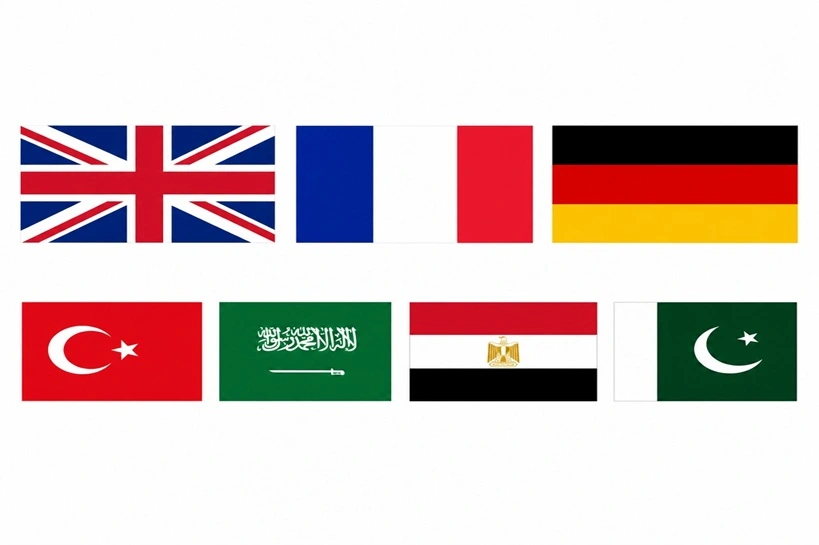

On 23 October, the E3 (the United Kingdom, Germany and France) and the R4 (Turkey, Saudi Arabia, Pakistan and Egypt) held their first-ever meeting in Istanbul. Turkey hosted the gathering, with Italy also present, bringing participation to eight states. The meeting aimed to strengthen coordination between European states and regional powers on security, maritime stability, and regional peace. Ministers evaluated growing security challenges in the Middle East, including the US-Israel war on Iran and Pakistan’s mediatory role in de-escalating tensions. In its own statement, the R4 also backed the Islamabad Memorandum of Understanding, the interim agreement Pakistan brokered between the US and Iran in June. This article examines the E3-R4 format structure, whether this bridge between Regional and European powers is transient or lasting, and what it can reasonably achieve. The format is needed, but so far it reads more like an intention than a structure.
What Was Discussed?
The meeting’s main discussion focused on freedom of navigation in the Strait of Hormuz and the Red Sea, critical routes for global energy and food, along with condemnation of Houthi attacks on Saudi Arabia. The two issues are linked. The UK Foreign Minister’s office says that traffic through Hormuz remains sharply down on pre-war levels, and because Iran’s closure of the strait forced Saudi Arabia to reroute its crude through the Red Sea, Houthi pressure at Bab el-Mandeb now threatens the kingdom’s most viable export route. The attacks have already forced Saudi Arabia to close its main airport and postpone a major investment conference.
Furthermore, the R4, in its separate statement, took the stance that Israeli occupation is the major source of instability in the Middle East and before the official session in Turkey, the R4 also held a separate meeting to discuss Jerusalem’s legal and historical status and efforts to end the ongoing violence in Palestine.
The European position was set out beforehand. According to the UK Foreign Minister’s office, Ed Miliband will press for a diplomatic solution to the Hormuz crisis, one that “restores full navigational rights and freedoms”. This is why the involvement of regional powers matters. Europe can articulate the principle of free passage, but the states that sit on or near these routes, and hold channels to Tehran, Washington and the Gulf, are the ones positioned to give it practical effect.
Two Groups, One Table
The E3 was not formed this year; the R4 was. The E3 dates to 2003 and Iran’s nuclear file. It worked to preserve the 2015 deal, then triggered the 2025 snapback of UN sanctions, a step analysts say reduced its leverage with Tehran. The R4 took shape only in March and offers what the E3 now lacks: access to Tehran, Washington and the Gulf. Its difficulty is internal, since three of its four members are parties to the Mecca Joint Defence Agreement, signed in August 2026 and which now sits uneasily with a mediating role. Membership is also unsettled, since Italy attends but belongs to neither group.
The joint press release records that the ministers agreed “to continue the dialogue in this format” to prevent conflict and advance regional peace and stability. It reflects the group’s aim to keep this bridge open, though the statement says nothing about how long or how often. It also commits the ministers to managing the security, economic and trade implications of regional tensions, but sets out no means of doing so. The Ministers’ own statement also called Israeli occupation the fundamental source of instability, and negotiated for a two-state solution in accordance with the UN resolutions.
In addition, one review states that the meeting has not yet created a new world architecture and has only revealed a direction. Hence, the deeper problem is that no implementation table is outlined. The format is nonetheless meant to continue to prevent conflicts in the region, but what is its scope, given its lack of permanence?
Why It Matters Now?
Security and freedom of navigation are back in the spotlight because of reported US and Israel’s plans for strikes against Iran’s nuclear capabilities. Despite such major talks, why are these issues at the forefront? Part of the answer lies in the absence of Washington, Tehran and Israel from the format, so the eight have a voice but limited direct leverage.
Both leaderships signal that open conflict could erupt at any time. Trump told a rally that the war could end soon, while also saying “We may do another little Epic Fury”, and on 31 October his Secretary of State said no decision has been made on fresh strikes and that Trump prefers a diplomatic solution. Iran, for its part, has drawn up plans to hit Gulf undersea cables if it is attacked, and a senior security official has warned that US-linked data centres across the Gulf could be targeted.
That is exactly why the E3-R4 format cannot afford to be transient or inconsistent. A confrontation between Iran, the US and Israel would threaten not only the stability of the Middle East but also the global food and energy chain. The R4 ministers also warned that disrupted sea lanes block flows of energy, fertiliser and food, hurting vulnerable populations in the region and beyond. Reports further say that this conflict is already triggering energy shortages and a cost-of-living crisis in Europe. That is the basis for the concern about a large-scale humanitarian crisis.
As host, Turkish Foreign Minister Hakan Fidan said while hosting the meeting that regional security first and foremost requires countries of the region to assume responsibility. He also said that none of the countries in the room supports another attack on Iran, the clearest shared position to come out of the meeting. That principle sits uneasily with a table that includes four European states but not Iran, the country most directly concerned. The British side also raised, before the meeting, that one state’s tactic is already being replicated across the region, visible in mounting pressure on chokepoints at Bab el-Mandeb and the Suez Canal. If instability spreads, it will engulf the whole region, which is why these talks must move from a shaky, inconsistent framework to one that actively engages the states concerned through dialogue and negotiation.
While ongoing talks can reduce tensions, they cannot compel states to commit. The Islamabad Memorandum helped reduce tensions and the fighting between the US and Iran, but it has not held, and mediators are still trying to bring both sides back to the table. It also came before Europe joined, so the E3’s added value is yet to be shown. Readings of Istanbul differ. One analysis sees it as evidence that Washington and Israel failed to build a regional coalition against Tehran, while the European Council on Foreign Relations argues that Europe should lead a coalition including regional states and Pakistan to press Washington and Tehran back to diplomacy, which is the kind of engagement this format could provide.
When Straits Matter Economically
The Istanbul meeting was as much about routes as about borders. When a strait like Hormuz or Bab el-Mandeb is threatened, the cost does not stay at sea: it hits oil and LNG prices, freight and insurance bills, and eventually the budgets of the states that import them. The Eurasia Review analysis explains this through weaponised interdependence: the idea that the same networks that make economies prosperous also give leverage to whoever controls their chokepoints. Maritime security is therefore a precondition for price stability, not just a naval problem, which is why the global food and energy chain keeps surfacing in what the eight say.
The same analysis suggests a sequence: recognise the vulnerabilities, build resilience, then coordinate. Istanbul sits at the first step. The participants see their exposure, but there is still no mechanism for shipping protection, logistics or energy resilience, which is the economic face of the missing implementation table. The Mecca agreement points in the same direction. It covers defence cooperation, intelligence sharing, logistical support and joint training. So, defence ties acquire industrial and investment weight where; Saudi Arabia brings capital; Turkey a defence industry and Pakistan military capability. That gives the R4 a depth that the E3 lacks, but it also sharpens the tension between mediating and being aligned.
What Would Make It Last?
On present evidence, what the format can reasonably achieve is limited to keeping the eight states talking and putting shared positions on record, such as opposition to another attack on Iran. It cannot yet compel the parties to promise regional stability. A format of this kind is nonetheless preferable to silence, but a commitment to meet again is not yet a plan. Its credibility will depend on scheduled follow-up, a clear link to the existing US-Iran mediation tracks, a workable economic-security agenda covering shipping, energy and logistics, and the eventual inclusion of Iran in the format.
References