
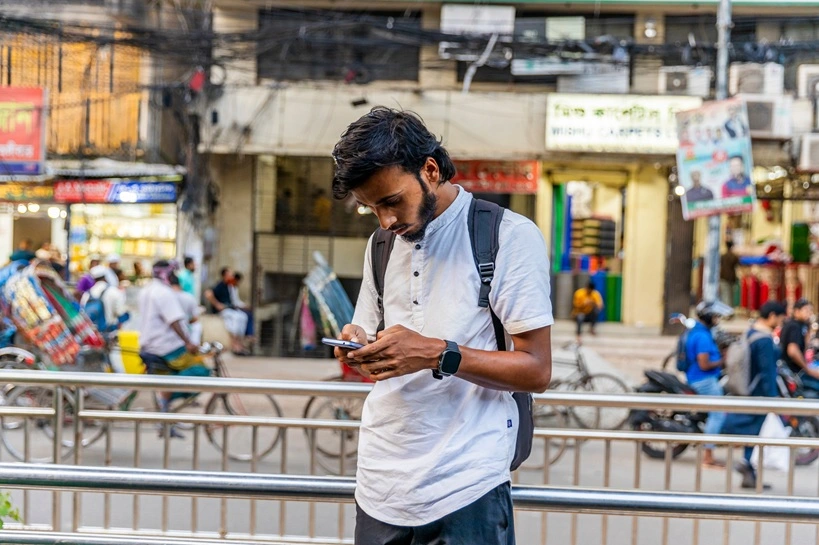

Bangladesh, like any other country, faces the emergence of a new problem regarding the issue of militant extremism and radicalization. That is the use of social media platforms to brainwash, recruit and radicalize people to join extremist militant and terrorist outfits. Since the last decade, social media platforms have been increasingly being exploited by terrorist outfits to radicalize people, especially young men. The spread of religious extremist ideas and narratives through deliberate misinterpretations of religious texts, memes, targeted disinformation and other ways have managed to radicalize lots of young men since last decade.
Bangladesh being a predominantly Muslim-majority country, has become the target of several radical terrorist outfits like the ISIS, Al-Qaeda, Taliban and other similar militant groups – looking to expand their operations through recruitment from this country. Since 2014, several Bangladeshi men have joined these transnational and global terrorist organizations and even fought in Syria, Iraq among others. The problem does not end there, the rise of Islamist extremism has also been affecting the very fabric of Bangladeshi society from within.
Bangladesh’s Digital Radicalization Problem
Social media platforms, especially Facebook in Bangladesh is being exploited by several transnational and local Islamist groups to spread their twisted narrative regarding religious texts. It is not only limited to spreading extremist propaganda, but also extends into spreading targeted disinformation to provoke communal tensions. The first recorded incident of Facebook being exploited by militant Islamist groups was seen during 2012 Ramu Violence – when local Muslim mobs led by extremists torched and attacked several Buddhist residential areas and temples in Cox’s Bazar’s sub-district Ramu. The violence also spread to other areas like Ukhia and Chittagong’s sub-district Patiya. Around 24 Buddhist temples and monasteries and 75 Buddhist houses were destroyed and vandalized by the mob. It all started when an unidentified person using a Buddhist name posted an image depicting the desecration of a Quran on the Facebook timeline of a local Buddhist man named Uttam Kumar Barua, while tagging his account which he used rarely. Since his account was public, it rapidly spread among the locals. Some people screenshotted the post and framed Uttam for hosting the image, considered blasphemous and derogatory for the Muslim community. Eventually, an angry mob targeting him, marched towards his house and the communal violence spread. After an internal probe, it was revealed that Uttam Kumar was innocent. Law enforcement alleged involvement of Rohingya Islamist insurgency operating from Myanmar behind the incident. [1][2] Since this incident, Facebook continued to increasingly become a hotbed for extremist narrative to thrive, through which radical Islamist groups started to groom potential people for their agendas. However, the fact that Bangladeshi social media had commonly turned into echo-chambers for extremist rhetoric, became crystal clear much later, after Afghanistan fell to Taliban in 2021. An investigation by VOX-Pol in the same year into Bangladeshi social media spaces found several accounts and pages celebrating and glorifying Taliban takeover. The article by VOX-Pol suggested that monitoring online spaces had become more important, since such extremist activities could spill over into real life. [3] Those warnings proved prescient. This growing extremism on social media was described by analysts as a “ticking time-bomb”, waiting to explode in a country which would inevitably struggle to maintain law enforcement and public safety after an uprising.
After the 2024 July Uprising that ousted Sheikh Hasina’s regime, the newly formed Interim Government struggled to stabilize the law-and-order situation. During this turbulent period, Bangladesh witnessed a surge in protests by Islamist groups such as Hizbut Tahrir, along with a series of mob incidents that several media outlets described as a “worrisome rise of extremism.” Many of these mobilizations were organized or amplified through radicalized digital spaces.
From Online Narrative to Offline Violence
Bangladesh was shaken twice within two months in 2025 by two acts of violence that were unrelated to each other. Meanwhile in 2026, the screening of the popular adventure-comedy movie ‘Bonolota Express’ in Brahmanbaria was halted. Now three of these cases, while appear completely different on the surface but were rooted in the same extremist logic and pattern.
In Sirajganj’s Chakbaruvengri village, a 22-year-old university admission candidate, Sajib Ali Molla, returned home from Dhaka displaying increasingly erratic behavior, according to his family. On the night of October 22, 2025, he entered his 85-year-old grandmother’s room and asked her a question: “Who is your Rabb (God)?” According to some Islamic theological accounts, this question is asked by angels Munkar and Nakir to the deceased person in the grave. When the elderly woman, half asleep and confused, failed to respond, he beheaded and killed her. Shortly afterward, Sajib posted religious slogans on Facebook and warned that “no one will be spared”. Investigators later found that he was exposed to extremist ideology during his stay in Dhaka. In this case, journalist Fardin Ferdous has argued that young people spend more time on the internet where they are exposed to growing religious extremist ideas on social media platforms, harboring an environment of intolerance and hatred. [4] [5]
Days later on December 18, in Bhaluka, Mymensingh, a very different but equally disturbing crime unfolded. Dipu Chandra Das, a Hindu garment worker, was lynched and burned by a mob after rumors spread accusing him of making derogatory remarks about Islam. Subsequent investigations found no evidence to support the accusation. If anything, later investigations discovered that the main instigators of the mob had personal animosity with Dipu, and they used religious sentiments to lynch him. [6] Misinformation, religious outrage, and mob psychology combined into a deadly force that bypassed law enforcement, due process, and basic humanity. Political parties and prominent Islamic scholars like Shaykh Ahmadullah were quick to condemn and criticize it.
In 2026, subsequently the same extremist pattern growing online led to the halt of Bonolota Express’ screening. The screening was scheduled to be held at Annada Government High School in Brahmanbaria, with permission from the school authority. Yet, under pressure from an Islamist organization called the Qawmi Chhatra Oikya Parishad, the screening was cancelled by the organizers on May 29 – in fears of a mob violence from the Islamist group. The organization rallied their cause on social media platforms like Facebook, mobilizing other Islamist groups against the movie’s screening. They accused the movie of spreading “obscenity and indecency”, calling it contrary to Islamic values. [7] These radicalized digital spaces were used for manufacturing opinion against the Bonolota Express movie, and the consent for creating a mob was then created and spread through several Facebook groups. Despite the fact that the movie does not contain nudity, explicit sex scenes nor anything derogatory against Islam, these extremist groups were still able to successfully establish their narrative against the movie—due to the speed and volatile nature of how disinformation spreads throughout the social media, taking advantage of the absence of proper fact-checking portals in Bangladeshi social media and misuse of religious sentiments to provoke the radical elements and other conservative Muslim groups. Ten cultural organizations in Brahmanbaria strongly condemned the cancellation, describing it as a sign of growing intolerance toward cultural activities and freedom of expression. [8]
Social media platforms are not just spreading the extremist rhetoric, but also actively becoming an aide for mobilizing and planning the violence in real life. It has set a precedent so dangerous that, now mobocracy could be easily organized through Facebook, WhatsApp and Messenger, using these tactics. Basically, extremist digital spaces have been normalizing the mindset of mobocracy since the last decade.
Bangladesh’s Online Extremist Ecosystem: Far-right wing, Conservative Islamism, Toxic Manosphere & Ethnic Chauvinism
In Bangladesh, the far-right spectrum is largely dominated by political Islamists and conservative Muslim groups. The rise of extremist militant exploitation of social media platforms has had major impact within the far-right wing – who have also started using social media platforms for the same purpose and the far-right have thus often become synonymous with extremist militant groups, due to the similarities between their ideologies. Some far-right groups have also been alleged to be linked to terror outfits like ISIS and Taliban. Most of the mob are being perpetrated by this growing conservative Islamist, far-right wing. This far-right wing dominated by predominantly Bengali Muslim men, have distorted ideas about women’s rights, much similar to Islamist terror groups. Thus, extremist and far-right online communities also fostered misogynistic narratives, due to the nature of their structure—which is basically a ‘toxic manosphere’.
This toxic manosphere also fueled online misogyny, normalizing slut-shaming women for having differing opinions and even going as far as to tagging them as ‘atheist/Islamophobe’. [9] Women and girls are constantly being objectified and slut-shamed by this radicalized manosphere, for choosing higher education, career, or for even something as simple as learning cycling or engaging in sports. This unprecedented rise of online misogyny in Bangladeshi digital spaces has eventually spilled over onto real life, much like how religious extremism did in post-uprising Bangladesh. [10] The real-life manifestation of this fostered digital misogyny came in the form of mob attacks against women and girls on several occasions. The first one came in form of an attack by a mob of far-right Islamists on women’s football venues on January 28, 2025, labeling women’s sports ‘indecent’ and ‘immoral’. [11] Following this incident, another mob identifying themselves as ‘Towhidi Janata’, a conservative Islamist movement, besieged Dhaka’s Shahbagh Police Station demanding release of Asif Arnob who moral-policed and sexually harassed a female student in Dhaka University campus. Both of these incidents were directly and indirectly fanned by the same extremist spaces on social media. In case of Asif Arnob, these extremist far-right wingers celebrated him on Facebook as a “pious Muslim” and mobilized as many as radicalized youth through social media to organize the mob. They also tracked down the victim’s Facebook account, slut-shamed her, threatened her to a point that she withdrew the complaint against Asif. [12] Now emboldened by these two incidents, extremist and far-right groups went on to stage three more misogynistic mob attacks in the same year.
In 2026, Brahmanbaria-2 constituency parliament member Rumeen Farhana announced a human chain and protest program on June 1, against the suspension of the Bonolota Express movie’s screening. Islamist supporters of the movie’s ban gave rape threats to Rumeen Farhana online. Extremist groups organized strings of slut-shaming content and rape threats against Rumeen, turning the social media platforms into extremist echo-chambers once again. These far-right extremist groups have also been engaged in mobocracy against other cultural activities, and other Muslim sects.
At the same time, such radicalized online spaces have also sheltered an ideology of Muslim-Bengali ethnic chauvinism, which dehumanizes non-Muslim indigenous ethnic minorities, particularly from Chittagong Hill Tracts. On January 15, 2025, during a peaceful protest by indigenous students in Dhaka, a right-wing Bengali Islamist group called ‘Students For Sovereignty’ brutally attacked them, injuring around 20, including female student activist Rupaiya Shrestha from Tanchangya ethnic group, who was also among the key student coordinators during July Uprising. [13] It was alleged that the group was backed by Islamist political party, Jamaat-e-Islami’s student wing Shibir. The planning of the entire attack was coordinated through social media platforms. The Muslim-Bengali chauvinist ideas are also currently being circulated by the newly-formed far-right political platform, BMRP (Bengali Muslim Revolutionary Party). On their Facebook page, they promote the ideals of a theocratic ethno-state led by Bengali Muslim men.
Transnational Security Risks
The implications of rise of Islamist extremism on Bangladeshi social media platforms have also spilled beyond the borders of Bangladesh – as many Bangladeshi young men, driven by online radicalization and subsequent extremist brainwashing, are joining and fighting for militant terrorist groups like the Tehreek-i-Taliban Pakistan (TTP) — a banned radical militant group waging insurgency against the Pakistani state in order to establish their own interpretation of Sharia (Islamic law) [14]. In some cases, some Bangladeshi men were also found trying to join the Afghan Taliban. [15]
Not only Bangladeshi young men were found travelling to Pakistan and Afghanistan to join such terrorist groups, but radicalization was also seen even among Bangladeshi diaspora and immigrant communities abroad. In April 2016, Singaporean authorities cracked down and arrested eight Bangladeshis for establishing a clandestine group calling itself “Islamic State in Bangladesh” (ISB) and intended to join ISIS as foreign fighters. When they believed reaching Syria would be difficult, they instead planned to return to Bangladesh, overthrow the government through violence and establish an Islamic state under ISIS’ self-declared caliphate. [16] In 2025, 36 Bangladeshi nationals between April and June 2025 were arrested by Malaysian authorities over alleged involvement with the self-proclaimed Gerakan Militan Radikal Bangladesh (GMRB), an ISIS-linked network. [17] All of them were radicalized through social media platforms, and were using WhatsApp, Telegram among others to fundraise and recruit more people for their operations.
This explains that digital extremist networks are operating from within both regional and global outreach, which not only risks Bangladesh’s internal security but also extends radical militant operations across the continent.
Policy Recommendations and Conclusion
Now whether in the form of isolated murder, organized mob violence or forced disruption of a light-hearted movie, these incidents reflect the same underlying trend: the translation of digital extremism into real-world harm. Prominent Bangladeshi Islamic scholars like Shaykh Ahmadullah condemned mob violence and extremism, while citing several Quranic verses and Hadith in arguing that mobocracy is forbidden in Islam. Yet, digital extremist spaces have managed to overshadow actual Islamic teachings, in order to establish their radical narrative.
Now, several factors contribute to why individuals are drawn to extremist ideologies online. These range from psychological to social, and to even financial. Lack of proper education, and empathy, issues related to poverty, loneliness and others have been the key factors behind such gravitation towards extremist rhetoric. Bangladesh is no stranger to the same issues. Some Islamic scholars argue that inadequate understanding of religious teachings has made segments of Muslim youth more susceptible to distorted narratives. If Bangladesh wants to secure its society and stability, it must address the underlying problem immediately. Social media should be strictly monitored for extremist content, and digital literacy among people has to be increased. Parents and teachers must make sure students and teenagers are not falling for problematic rhetoric online, because they are the largest demographic for targeted radicalization. The government must also heavily invest in its anti-terrorism infrastructure.
Unless Bangladesh seriously confronts the growing influence of online radicalization, not only would the country’s social cohesion and long-term stability face serious risk, but also will have serious implications for wider security and counter-terrorism operations in the wider Asian landscape.
References
