
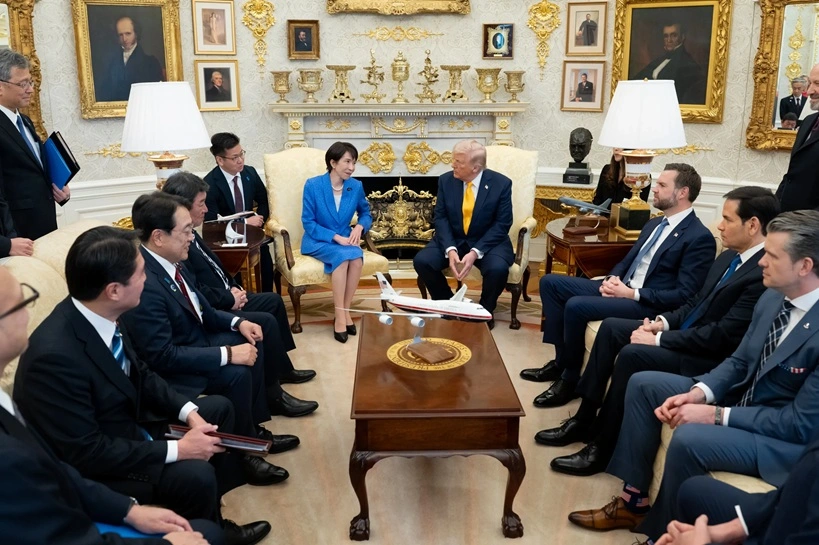
Between 18 and 21 March 2026, Japanese Prime Minister Sanae Takaichi made her first official visit to the United States. The Washington summit was the second Japan-US heads-of-government meeting, following Donald Trump’s visit to Tokyo in October 2025.
Takaichi’s image as a political heir to former Prime Minister Shinzo Abe – whom Trump regarded as a friend – combined with the American president’s earlier visit to Japan, during which the Japanese prime minister skillfully leveraged her personal rapport with Trump, created favorable conditions for the current visit. Trump had even endorsed Takaichi ahead of Japan’s parliamentary elections in February 2026, signaling his readiness to continue dialogue with her specifically.
The current summit was essentially timed to coincide with Donald Trump’s visit to China, and its main purpose was to convey Japan’s wishes and concerns to the American president in advance. It was expected that the two sides would discuss key issues in their bilateral relations – namely defense and economic cooperation – and reaffirm their shared views on the regional security architecture. However, the international upheavals of March 2026 brought to the forefront of the bilateral talks the question of whether Japan would dispatch Self-Defense Force ships to the Strait of Hormuz.
Iran in the Spotlight
Shortly before Sanae Takaichi’s arrival on March 14, 2026, Donald Trump took to social media to call on allies and partners to send ships to secure navigation in the Strait of Hormuz. However, after receiving no positive response, he abandoned the idea of external assistance only three days later. Whether this was a test of allies’ loyalty or simply an impulsive move is impossible to say with certainty, but it caused confusion in Tokyo. Although, according to the Japanese side, no specific request came from Washington, Takaichi’s team quickly began discussing possible responses to the crisis in the Strait of Hormuz.
At the White House meeting, Sanae Takaichi informed Donald Trump of Japan’s readiness to contribute to securing the Strait, but explained the legal restrictions on deploying the Self-Defense Force. At present, such a deployment is not possible, since participation in operations in combat zones is prohibited by Japan’s Constitution – except in the special case of recognizing a situation as an ‘existential threat’ to the country, which lawmakers do not believe applies here. For now, Tokyo is considering the possibility of sending ships for mine-clearing operations, but this could only take place after hostilities have ceased.
Moreover, participation in the operation would imply recognition of the legitimacy of U.S. and Israeli actions, yet the Japanese government has so far refrained from issuing any legal assessment of the strikes on Iran. Back in 2015, during parliamentary debates on new security legislation, Shinzo Abe stated that Japan would not support a state that carried out an illegal preemptive strike. On March 9, 2026, Sanae Takaichi reaffirmed the consistency of this position. Endorsing U.S. actions would mean disregarding the principles of the rule of law and backing unilateral attempts to alter the status quo, which she has demonstratively opposed. There are also reputational costs to sending Self-Defense Forces to the Strait of Hormuz: Tokyo and Tehran have maintained friendly relations resilient to crises surrounding Iran. Assisting the U.S. would mean Japan forfeiting this political capital.
It is clear that in the current situation Tokyo finds it advantageous to act cautiously, once again trying to maintain a balance. On the one hand, Japan condemned Iran’s strikes on neighboring countries, joined a multilateral statement on the Strait of Hormuz expressing readiness to contribute to safe passage through the strait, and, together with its partners in the G7, issued a declaration in support of allies in the Middle East. On the other hand, Japanese Foreign Minister Toshimitsu Motegi has maintained regular contact with his Iranian counterpart Abbas Araghchi, who recently told Japan’s Kyodo news agency that Iran was prepared to allow Japanese tankers to pass through the Strait of Hormuz.
Tehran is interested in drawing Japan to its side, and Sanae Takaichi has the option of following the path of her ‘mentor,’ Shinzo Abe, who made active diplomatic efforts during the Iranian crisis of 2020. Potential mediation by Tokyo between Tehran and Washington would earn Japan valuable political credit.
Outcomes for Japan: Reaffirming Japan-US Solidarity in the Indo-Pacific
A key theme of Sanae Takaichi’s visit to Washington was the desire to prevent any rapprochement between the United States and China. For Japan, the worst-case scenario would be the emergence of a ‘G2.’ Therefore, on the eve of the American president’s trip to China, Takaichi’s team considered it essential to demonstrate Japan-U.S. solidarity on regional issues and to ensure that, in his meeting with Xi Jinping, Donald Trump would not show excessive concessions toward Beijing.
In November 2025, Japan-China relations sharply deteriorated after Sanae Takaichi remarked that an armed invasion of Taiwan could constitute an ‘existential threat,’ under which Japan might exercise its right to collective self-defense and deploy troops to the area. Beijing demanded that the prime minister retract her words, and the scandal spilled into the diplomatic sphere, leading to the collapse of the planned Japan–China–South Korea trilateral summit and sparking a ‘war of words’ at the United Nations. The political crisis soon spread into the economic realm: while the tourism and entertainment industries were the first to suffer, Beijing quickly resorted to more sensitive measures, including restrictions on exports to Japan of rare earth metals and dual-use products.
Washington’s stance on this issue also proved ambiguous: Donald Trump was in no hurry to support Sanae Takaichi and instead advised against provoking China. At the same time, the Japanese prime minister refused to retract her statement, as doing so would have meant a loss of face at a moment when most of the Japanese public considered her remark appropriate. The conflict in the Middle East presented her with yet another challenge: keeping Trump’s attention on the Indo-Pacific region despite his shifting focus elsewhere, a task made even more pressing by the redeployment of U.S. military units from the Indo-Pacific to the Middle East.
Judging by the outcome of the visit, Japan’s main objectives can be considered achieved. The White House press release stated that the two leaders are ‘committed to peace and stability in the Taiwan Strait as an integral element of regional security and global prosperity,’ which immediately prompted a response from China’s Foreign Ministry, stressing that the Taiwan issue is an internal matter for China. Another signal to Beijing that Japan and the United States share similar views on the regional security architecture was the wording that both sides ‘oppose any unilateral attempts to change the status quo.’
Another issue of deep concern to the Japanese public – the problem of citizens abducted by North Korean intelligence services in the 1970s and 1980s – was not overlooked. During Trump’s visit to Japan in October 2025, Sanae Takaichi managed to bring him to a meeting with the families of the abductees, and after the February 2026 elections she reaffirmed her intention to seek a personal meeting with Kim Jong Un. In doing so, Takaichi is continuing the line of Shinzo Abe, for whom the ‘abduction issue’ was one of the key political priorities, while also signaling her interest in any potential Trump-Kim negotiations. The mention of the ‘abduction issue’ alongside the question of North Korea’s denuclearization in the White House communiqué following the Japan-U.S. summit can be regarded as another goal successfully achieved by Takaichi.
Outcomes for the United States: Strengthening Defense and Investment Cooperation
For the United States, the effectiveness of Takaichi’s visit lay above all in the agreements reached in the defense and economic spheres. Japan confirmed its intention to participate in the joint development and production of medium-range air-to-air AMRAAM missiles, as well as to quadruple the joint production of SM-3 Block IIA surface-to-air missiles in Japan.
On the eve of the visit, what worried the Japanese most was the prospect that Donald Trump would demand an increase in Japan’s military spending – earlier, U.S. officials had hinted at the desirability of raising defense expenditures to 5% of GDP. Back in October 2025, before Trump’s trip to Tokyo, Sanae Takaichi had already announced her intention to fulfill ahead of schedule the plan to raise defense spending to 2% of GDP, which helped defuse the issue. At the current meeting, the Japanese side also managed to avoid this unwelcome topic.
On the economic front, the two sides confirmed their intention to proceed with the implementation of a second investment package worth 73 billion dollars. The projects will be carried out under the framework of the 2025 agreement on Japan investing 550 billion dollars in the US economy in exchange for a reduction in trade tariffs. The implementation of the first package, valued at 36 billion dollars, was announced on 17 February 2026. In this way, Takaichi demonstrates her readiness to translate paper agreements into practical outcomes as swiftly as possible – something that undoubtedly appeals to Trump.
The two sides also approved an action plan to develop alternatives to China in the field of critical minerals and rare earth elements. In particular, they agreed to accelerate joint research related to the extraction of rare earth minerals near Minamitori Island, where a successful trial mining operation was conducted in February. Takaichi also brought to Washington a proposal to establish joint oil reserves on Japanese territory, to be replenished with supplies from American fields. Japan’s intention to increase purchases of Alaskan oil and to invest in the development of the state’s oil deposits is sure to please Trump both as president and as businessman.
***
On the surface, the visit appeared successful: the two leaders smiled at each other and exchanged compliments, handshakes, and embraces. At the start of the White House meeting, Sanae Takaichi declared, ‘Only Donald can ensure peace and prosperity in the world,’ which drew a warm smile from the American president but was met with puzzlement by opposition party leaders in Japan. Social media today is filled with criticism of the Japanese prime minister for her overly emotional reactions during her stay in Washington. Trump’s joke about Pearl Harbor also became a highlight of the meeting, and even the usually diplomatic Takaichi struggled to conceal her surprise.
As for the substance of the talks and the agreements reached, they suggest that despite global upheavals, relations are developing along a predictable trajectory. Sanae Takaichi managed to show the world – and especially China – that there are no obvious disagreements between the allies, to secure mention in official documents of issues important to Japan, and to avoid criticism over her reluctance to send Self-Defense Forces to the Strait of Hormuz. On the contrary, Donald Trump even praised Japan, which, unlike NATO, shows a willingness to help America. For the United States, the visit was successful because it consolidated new agreements on implementing the investment deal, allowing Trump to convince the public of the effectiveness of his strategy of economic pressure on allies.

