
Abstract
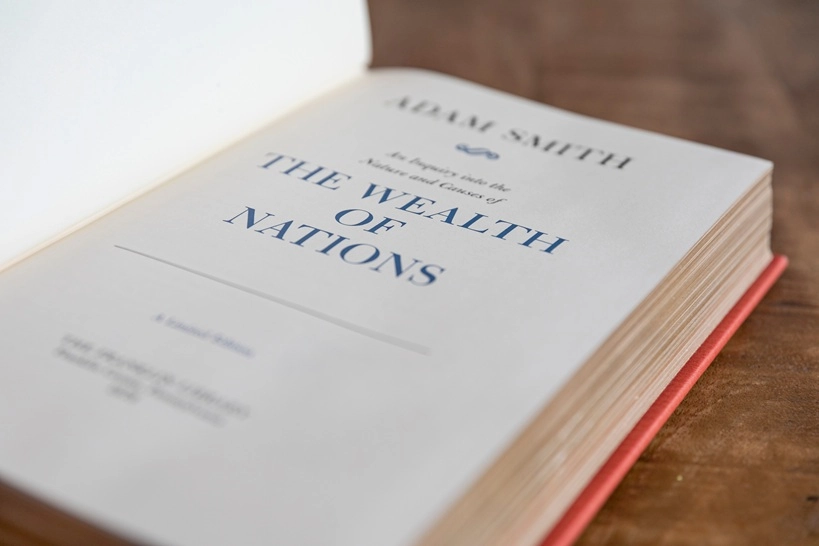
To deliver low-carbon transitions, we must understand the dynamics of capital. To this end, I develop a theory of energy-capital relations by reading Adam Smith’s The Wealth of Nations from an energy-analysis perspective. I argue that, for Smith, capital is any resource used to support production with the intention of generating profits through market exchange. In The Wealth of Nations, capital enables access to new sources of energy and increases energy efficiency. This theory of energy-capital relations explains trends seen in historical energy data: because it is profit driven, capital does not save energy, it redirects it to new uses. This suggests that low-carbon investment can only enable a low-carbon transition if coupled to a systematic challenge to the profit drive.
JEL Classification: B12, O44, P18, Q43, Q57
Keywords: economic growth, low-carbon transitions, Adam Smith, history of economic thought, capital, energy, capitalism
1. Introduction: Energy, Capital and Low-Carbon Transitions Under Capitalism
To date, the green rhetoric of states and companies has not led to meaningful reductions in carbon emissions. In absolute terms, annual global carbon emissions from fossil fuels increased from ~6 gigatons of carbon per year in 1990 to ~10 gigatons of carbon per year in 2022 (Friedlingstein et al. 2023). Carbon emissions are largely driven by the energy system that supports the capitalist economy, and there is no evidence that this is decarbonizing at the global scale. In 2020, fossil fuels accounted for around 80 percent of total world energy supply, the same figure as in 1990 (IEA 2022). In 2022 carbon emissions from fossil fuels accounted for around 90 percent of total global carbon emissions, up from 80 percent in 1990 (Friedlingstein et al. 2023). Carbon emissions from energy and industrial processes hit an all-time high in 2023 (IEA 2024). To change this increasingly dire picture, it is essential that we understand the economic drivers of emissions, and what economic changes are needed to reverse current trends.
There is disagreement over the extent and nature of economic change needed to facilitate a low-carbon energy transition. Radical economists agree that the global reliance on fossil fuels will require going beyond market-based solutions (Li 2011; Pianta and Lucchese 2020; Pollin 2019). But this still leaves us with a broad spectrum of options (Chester 2014). Can a low-carbon transition be implemented within a broadly capitalist framework if it is guided by an interventionist industrial strategy (Pollin 2015)? Or does it require changes to fundamental capitalist dynamics (Davis 2019; Riley 2023)? To cast new light on these debates, I take a step back from the immediate issues and take a history of economic thought approach. To this end, I explore the relationship between capital and energy in Adam Smith’s (1975) The Wealth of Nations. I use the resulting view of energy-capital relations to put forward an explanation of how energy use has developed under capitalism, and to explain why a low-carbon transition is unlikely without addressing core capitalist dynamics.
The decision to develop the analysis of energy-capital relations from The Wealth of Nations is grounded in the more general epistemological claim that returning to older works of economic theory is a useful way to conduct economic analysis. Blaug (1990) reminds us that all current economic theory is built from seldom read historical texts, and historians of economic thought have argued that revisiting these texts offers the opportunity to uncover new ways of interpreting key ideas, providing theoretical context that may have been forgotten (Bögenhold 2021; Schumpeter 1954). Additionally, actively engaging with historical thought presents the possibility for moments of creativity as old and new ideas are brought together. For example, Mair, Druckman, and Jackson (2020) use an analysis of economic ideas in utopian texts from the twelfth to nineteenth centuries to develop a vision of work in a post-growth future, and Stratford (2020, 2023) develops a theory of rents and resource extraction grounded in an analysis of the historical evolution of the concept of rent. The general approach of critical engagement with history of thought is perhaps best developed in the Marxist literature, where a substantive body of work draws on Marx’s writings to critically explore environment-economy relationships (e.g., Malm 2016; Moore 2017; Pirgmaier 2021; Saitō 2022).
On the other hand, relatively little attention has been paid to Adam Smith in the context of ecological or environmental economic analysis. Most recent interest in Smith’s environmental thought has come from environmental historians (see Steeds 2024 for a review). However, Steeds (2024), building on Jonsson (2014), has made the case for reading Smith as an ecological economist, arguing that Smith shares core ontological precepts of the discipline—notably that it is the environment that underpins all economic activity.
Smith (1975) is particularly relevant to debates about low-carbon transitions because The Wealth of Nations is the starting point for an interpretation of capital theory that has become widely used in energy-economy analyses. Capital theory itself has a long and storied history, with analysts giving it a variety of characteristics (Cannan 1921; Kurz 1990; Mair 2022).
Contemporary economic analyses of energy generally use a physical concept of capital. A common position for economists who focus on energy is that energy is important because energy use and capital are “quantity complements”: all else equal, when capital increases the energy used in production increases (Elkomy, Mair, and Jackson 2020; Finn 2000; Sakai et al. 2019). Conceived of as “representative machinery,” capital is seen as the physical stuff that channels energy use into production (Keen, Ayres, and Standish 2019: 41). Or as Daly (1968: 397) puts it, “physical capital is essentially matter that is capable of trapping energy and channeling it to human purposes.” This physical conception has its roots in the dominant interpretation of capital from The Wealth of Nations.
Prior to The Wealth of Nations, capital was a predominantly monetary construct, but historians of economic thought argue that after The Wealth of Nations, capital is taken to be predominantly physical (Hodgson 2014; Schumpeter 1954). However, I argue that Smith’s view of capital is actually a long way from the almost purely physical views seen in much energy-economy work. Rather, Smith’s view of capital is proto-Marxist. As Evensky (2005: 141) puts it, “Whether or not it was from Smith that Marx developed his notion of capital as self-expanding value, the outlines of that conception were certainly available to him in Smith.” From Smith’s perspective, capital is defined primarily as a socio-physical construct (Blaug 1990; Evensky 2005; Meek 1954). Capital sometimes has physical forms, which enables it to interact with flows of energy, but these are always conditioned by the social dynamics of profit and exchange.
Making a direct connection to energy requires reading Smith from the contemporary perspective of energy-economy analysis as developed by the subdisciplines of ecological, biophysical, and exergy economics (Brockway et al. 2019; Jackson 1996; Keen, Ayres, and Standish 2019; Smil 2017a). This is because, as a construct, “capital” pre-dates “energy,” and Smith was writing before the first recorded use of the term energy as we would understand it today (by physicist Thomas Young in 1807, see: Frontali 2014). So although work into energy—particularly among ecological economists and their forerunners in energy systems analysis (Cleveland et al. 1984; Odum 1973; Sakai et al. 2019)—uses a concept of capital that has its roots in an interpretation of Smith’s capital theory, explicit links are missing in Smith’s text. Despite this, Steeds (2024) argues that Smith’s analysis of agriculture shows an understanding of what contemporary analysts would call energy, a theme I develop here focusing on Smith’s conceptualization of capital.
The rest of this article is structured as follows. In section 2, I set out an interpretation of Smith’s capital theory from The Wealth of Nations that emphasizes the way it sees physical elements of capital as defined by social forces. In section 3, I outline the ways that energy fits into Smith’s theory of capital. This is the first contribution of the article, as I make novel links between Smith’s capital theory and contemporary energy-economy analysis. In section 4, I apply this interpretation of energy-capital relations to the historical evolution of energy use under capitalism, and the question of low-carbon transitions. This is the second contribution of the article, as I argue that Smith’s capital theory highlights the importance of the social context of energy systems. Specifically, it provides compelling explanations for the phenomenon of “energy additions”—where past “transitions” under capitalism have been associated with the overall growth of energy use (York and Bell 2019). This implies that the challenge of a low-carbon transition is not only investment in low-carbon energy systems but in challenging the logic of capitalism such that low-carbon energy can replace, rather than add to, the use of high-carbon energy.
2. Capital as a Socio-physical Construct in The Wealth of Nations
Interpretations of Smith’s capital theory generally emphasize its physical aspects (e.g., Cannan 1921; Hodgson 2014; Schumpeter 1954). These readings focus on Smith’s initial description of capital as a subset of the accumulation of the physical outputs of production (in Smith’s terminology “stock” [cf. Smith 1975: 279]), and the skills and abilities of workers (Smith 1975: 282). The focus on physical aspects of Smith’s capital theory makes sense from a history of ideas perspective. The physical aspects of Smith’s capital stand in contrast with earlier definitions that were primarily monetary (Hodgson 2014). There is also an intellectual lineage that can be traced in Smith’s views on capital, principally through Smith’s relationship with the French Physiocratic school whose own economic analysis emphasized physical flows (Meek 1954; Schumpeter 1954). However, the fact that Smith introduced a new role for physical goods within a broader concept of capital does not imply that Smith’s theory of capital was purely physical (Robinson 1962). Rather, Smith views capital as the accumulated monetary and physical resources that are brought into production to generate a profit. To see this, let us look first at Smith’s view of circulating capital.
Smith splits capital into two forms, circulating and fixed, and he is explicit that circulating capital has both monetary and physical forms. For Smith, circulating capital is defined by the fact that to turn a profit from it, its owner must give it up in exchange for something else. Consequently, circulating capital takes multiple forms: it is the money that will be used to pay wages to a worker, the product produced by that worker, the money realized at the point of sale of the product, and the commodities purchased using the money realized. As Smith (1975: 279) puts it, circulating capital is continually going from the capitalist “in one shape, and returning to him in another. . . it is only by means of such circulation. . . that it can yield him any profit.” Circulating capital is a process of purchasing and selling resources, often with a monetary form, in order to make more money (Evensky 2005). Circulating capital has different forms (some physical, some not) at different points in its circulation, but it is consistently capital.
Even when capital takes on its physical form, for Smith it is the underlying social dynamics of exchange and profit that define it as capital. In his opening to book 2, Smith argues that capital is an emergent property of exchange-based economies (Smith 1975: 276). In a society with no division of labor, he argues, people are self-sufficient, and there is very little exchange. But once you have a division of labor, you get exchange because each worker uses their labor to produce a subset of the goods needed to live. Other workers use their labor to produce a different subset of goods. The two then trade with one another to ensure all their needs are met. Drawing on the work of the Physiocrats, Smith then observes that production takes time (Schumpeter 1954). Consequently, in a market system, the purchasing of goods from other people “cannot be made till such time as the produce of his own labor has not only been completed, but sold” (Smith 1975: 276). This means that in either a monetary or barter economy, there has to be a stock of physical goods previously accumulated in order to enable work to happen before the products of that work have been sold (or are available for barter). For Smith, these goods are a form of capital. In this sense, capital can be physical commodities—but physical commodities accumulated in order to support exchange.
For Smith, profits are also an essential part of the definition of capital (Meek 1954). Whether fixed or circulating, physical or monetary, what makes something capital is the desire of the capitalist to earn money from it (e.g., Smith 1975: 281, 332). Smith’s theory of profit is scattered through The Wealth of Nations and is not entirely comprehensive (Blaug 1990; Christensen 1979). However, Smith does identify a construct called profits with some core tendencies that are sufficient to group him in the classical approach to profit as surplus and deduction (Hirsch 2021; Kurz 1990; Meek 1977). For Smith, surplus is primarily derived from the value that labor adds to raw materials. This value then goes to pay the wages of the worker and other costs of production, one of which is “the profits of their employer” (Smith 1975: 66). So, Smith’s theory of profit is deductive. Profit is the money capitalists attempt to gain back from production after all costs—including wages—have been accounted for (Meek 1977). An important addition here is that the profit drive for Smith is speculative: capitalists bring capital to support production because they “expect” to generate more money (Smith 1975: 279, 332)—it is not guaranteed. The attempt to gain profit is because capitalists use this as their income (cf. Smith 1975: 69, 279). This attempt is central to the dynamics of capital because profit is the “sole motive” that a capitalist has for bringing their resources into the exchange cycle of the economy (Smith 1975: 374).
To summarize, for Smith, capital is the accumulated resources (whether physical or monetary) brought to bear in support of exchange-based production, the ultimate aim of which is to provide the owner of capital with an income (profits). Consequently, it is not correct to view Smith’s capital theory as purely or even predominantly physical. Rather Smith’s capital is a socio-physical construct. This interpretation is not a refutation of other readings that emphasize the physical aspect of Smith’s theory. The physical elements are present, are important, and are relevant to our discussion of energy. However, the underlying premise is always that these physical elements are defined by social relations of profits and exchange. This analysis fits with readings of Smith that see his capital theory as proto-Marxist because of the way it frames capital in terms of social relations (Hodgson 2014; Pack 2013; Tsoulfidis and Paitaridis 2012). But it strongly cautions away from discussions of capital that abstract from these social relations in ways that leave capital as purely physical things. As with Marx (2013), when Smith talks about capital as physical things, his focus is on the way the physical interacts with social relations.
3. How Does Energy Fit into Smith’s Capital Theory?
Having sketched an interpretation of Smith’s capital theory focusing on the interplay of profit, exchange dynamics, and monetary and physical resources, we can turn to the question of how energy fits into Smith’s capital theory. In this section, I draw on energy-economy analysis to suggest two key ways in which energy might fit into Smith’s capital theory:
1. Capital is used to bring new energy sources into production.
2. Capital is used to make existing energy flows more efficient.
3.1. Accessing new energy sources
For Smith, one of the key ways that capitalists aim to generate profits from capital is by using it to increase labor productivity (in Smith’s terms “abridging” labor, see: Smith 1975: 17, 282). Here we have a link to energy-economy analysis, where labor productivity is often described in terms of substituting human labor for other forms of energy—since the industrial revolution this has typically happened through some form of fossil fuel–powered machinery (Smil 2017a). Smith discusses machinery in a number of places across The Wealth of Nations. Indeed, Kurz (2010: 1188) writes that one of Smith’s key growth mechanisms is the replacement of “labor power by machine power.”
In chapter 11 of book 1 of The Wealth of Nations (Smith 1975: 263), Smith discusses how cloth production in Italy was made more productive than in England by employing wind and water mills in the former, while the latter treaded it by foot. This is the same example pointed to by energy scientist Vaclav Smil (2017a), who argues that the introduction of waterwheels into industrial production were a source of substantive labor productivity growth. Energy-analysis allows us to say why the wind and water is more productive than the treading.
Energy provides a variety of functions, known as “energy services,” which are essential for production processes (Grubler et al. 2012). These are intuitive when put in the context of everyday experiences: achieving a comfortable temperature in an office or workplace requires thermal energy. Transporting goods or people requires kinetic energy. In the case of cloth production, the fulling process requires kinetic energy to manipulate the fibers of the cloth.
To deliver energy services, energy sources go through a series of transformations, known as the conversion chain (Brockway et al. 2019; Grubler et al. 2012). Energy is accessible to us through different carriers—known as primary energy sources (such as food, oil, or gas). In most use cases primary energy sources are then converted into other forms before delivering their service (Smil 2017b). This conversion is done by “conversion technologies.” Muscles are a “technology” that can be used to convert the chemical energy in food into mechanical energy. Oil or solar energy may be converted into electricity. Different economic processes may use multiple forms of energy with energy from multiple carriers requiring transformation multiple times.
From the perspective of increasing labor productivity, what is important is having energy available to do “useful” work (meaning provide the specific energy services that serve the interests of the system) (Brockway et al. 2019). The more energy available to do useful work, the more economic activity can be carried out per person. One way to increase the amount of useful energy available is by adding new primary energy sources to the system. This process often requires new conversion processes that enable the energy in the primary energy sources to be accessed and converted into energy services.
In the case of cloth production, the introduction of wind or water mills is an example of capital taking the form of a new conversion technology that enables access to a different primary energy source (Smil 2017b). In the human-powered treading process, solar energy is converted into chemical energy through the agricultural system. The chemical energy in food products acts as the primary energy source. People then eat this food, converting it to mechanical energy that manipulates the cloth as they tread it under foot. On the other hand, a wind or water mill introduces a new conversion technology that enables access to the energy available in wind and water by converting it into mechanical energy.
Note that this process is not only about energy efficiency. Wind and water mills are typically more energy efficient than human-power, but just as crucially they are more powerful: they bring a greater quantity of energy into the process of cloth production (Smil 2017b). The importance of scale is seen across energy-economy analysis. Hall and Klitgaard (2012: 117) draw on Polyani’s (1944) substantive definition of an economy to argue that all economic activity is the application of work to transform natural resources into goods and services. In the past, most of the work of transformation was done through muscle-power, but today muscle-power is a much smaller proportion of total work carried out because of the development of machinery that allows us to supplement our muscles with the “‘large muscles’ of fossil fuels.”
3.2. Increasing energy efficiency
There are places in The Wealth of Nations where we might hypothesize about energy efficiency gains explicitly. For instance, Smith tells an apocryphal tale involving a child and a fire engine, presented as an example of innovation leading to labor productivity growth. Smith writes that in the earliest fire engines a boy would be employed to open and shut different valves, until one such boy finds a way to connect the valves such that they “open and shut without his assistance” (Smith 1975: 20). Such an innovation adjusts capital in order to enable it to convert more of the primary energy source into useful energy. Prior to the boy’s innovation, the system required two primary energy inputs: the fossil energy to power the machine, and the food energy to power the boy. Once the boy innovates, the primary energy associated with his action is removed from the process and the machine uses only the fossil energy, thus increasing its overall energy efficiency. But machinery is not the only way in which humans’ access and turn energy flows toward growth of the economy in Smith’s capital theory.
Smith considers the useful abilities of workers to be a form of capital and here we can see another place where energy efficiency may fit into Smiths capital theory. When defining the useful abilities of workers Smith refers to dexterity: the skills and abilities acquired by workers through the repetition and simplification of tasks. When defining dexterity Smith talks about it in terms of efficiency gains. For example, a worker specializing in the production of nails will become more skilled in their production, and hence more efficient (Smith 1975: 18). But nowhere does Smith imply that an increase in dexterity is miraculous. And although it is intimately bound up with social organization through the division of labor, we can see how energy may fit into the process. Specifically, the increase in dexterity can be understood as partly a function of the fact that energy flows are being used more efficiently. Workers learn the best way to stir the fire, to heat iron and shape the head of the nail. An increase in the skill of a worker enables them to use energy more efficiently. In this way, more efficient use of energy flows can be seen as one of the ways that the division of labor enables increases in productivity.
3.3. Summary of the energy-capital relation in The Wealth of Nations
Smith views capital as the monetary and physical resources that are brought by capitalists into exchange processes with the intention of generating an income for themselves. Smith, like Marx, is clear that all production ultimately rests on inputs from the natural environment, so it is not surprising that in The Wealth of Nations we found examples of a subset of capital that generates profits by changing the way energy is used in production processes. Specifically, I presented two mechanisms that can be identified in The Wealth of Nations: bringing new energy sources into the economy (the transition from human power to wind and waterpower in the fulling process), and being made more energy efficient (through machinery innovations and specialization of labor).
We can now apply this interpretation of Smith’s energy-capital theory to the question of low-carbon transitions. The examples I have elaborated support Steeds (2024: 35) notion that Smith has an “intuitive” understanding of energy. Some of the critical functions of Smith’s conception of capital can be explained in terms of how it mediates our relationship to energy. In this way, Smith’s reading is close to more modern accounts of the role of energy (Keen, Ayres, and Standish 2019, Sakai et al. 2019). But what differentiates Smith’s from these accounts is an explicit emphasis on the social context in which energy is used by capital. Some accounts of the energy-economy relationship effectively, or explicitly, reduce production to energy use. In Smith’s account by contrast, energy use is framed and shaped by social forces. Recalling Smith’s core understanding of capital from section 2, it is clear that energy is being harnessed by capital in an attempt to generate profits within a market process. In other words, in a capitalist economy where most production follows the logic of capital, the major driver of energy use will be the attempt to generate incomes for the owners of capital. This insight, though simple, is often overlooked and has profound implications for a low-carbon transition.
4. A Smithian Analysis of Low-Carbon Transitions Under Capitalism
In this section, I apply the insights from the reading of Smith’s capital theory to historical data on energy use under capitalism. I argue that the theory provides a simple and compelling explanation for the constant expansion of energy use as new forms of energy have been added to the mix. Capitalists seek to use energy to grow their profits; therefore, they invest in efficiency measures or new energy sources in order to increase the total energy available to them. Energy is never saved in the sense of not being used. Rather, it is made available to new profit-seeking ventures.
Across both mainstream and radical interventions into low-carbon transition debates, there is often a focus on the investment needed to grow low-carbon and energy efficiency programs (e.g., Hrnčić et al. 2021; Pollin 2015, 2019; Qadir et al. 2021). The central argument in these works is that low-carbon transitions require substantial but not unreasonable levels of investment in low-carbon energy and energy efficiency programs. Approaching this from the perspective of energy-capital relations developed in this article, we are looking at the need to transition capital from one conversion technology to another. Today, much capital takes the form of conversion technologies designed to access the energy in fossil fuels. For a low-carbon economy we need capital to take the form of conversion technologies that can access energy in wind, solar, or other low-carbon forms. It is tempting to think about this in terms of the transition described by Smith from labor power to wind power in the fulling process. However, there is a fundamental difference between the transition from one energy source to another as developed in The Wealth of Nations, and that needed in the low-carbon transition.
Historically, transitions between dominant energy sources under capitalism have been consistent with Smith’s argument that capital is only motivated by the desire for profit. Past energy transitions under capitalism have been driven by a search for greater profits enabled by the new energy sources, not by pro-social or pro-ecological values. For example, Malm (2016) argues that the English transition from wood to water was driven by the desire of capitalists to concentrate and better control their workforce, simultaneously reducing losses from theft, making workers more efficient, and bringing a greater scale of energy into the production process. The consequence of the consistent searching for profits in capitalist energy transitions is that we have very few examples of energy sources declining under capitalism at the macro-scale. Under capitalism, energy transitions are better described as energy additions (York and Bell 2019).
In recent decades, there has been a remarkable growth in the use of low-carbon energy sources, but at no point in this period has energy production from fossil fuels decreased (figure 1; Malanima 2022). Indeed, looking at the evolution of 9 categories of primary energy sources since 1820 (figure 1), only fodder has seen a prolonged decrease under capitalism. For instance, in absolute terms, energy from coal overtakes fuelwood as the largest primary energy carrier in the late 1800s. But after this point the energy supplied by fuelwood continues to grow. Even in the case of fodder, although it has been in decline for approximately sixty years it still provided more than twice as much energy in 2020 than it did in 1820. Looking specifically at low-carbon fuels, the charts for renewables and nuclear energy show dramatic spikes and rapid growth. But these spikes do not coincide with declines in any other fuel source, and the International Energy Agency (IEA 2023a, 2023b) reports that 2022 was an all-time high for coal production, and forecasts record oil production in 2024.

Figure 2 depicts global energy efficiency, the scale of global production, and the total primary energy use 1820–2018. Energy efficiency of the global capitalist economy has improved drastically over the two-hundred-year period covered: in 2018, producing one unit of output took only 40 percent of the energy it would have taken in 1820. But as energy efficiency has grown, so has total energy use and total output, and these changes dwarf the gains in energy efficiency. In 2018, 41 times as much energy was used as in 1820, while global production grew by 2 orders of magnitude over the same period.

From the lens of our interpretation of Smith’s capital theory, the constant expansion of fossil fuel use alongside renewables and energy efficiency gains is not surprising. The purpose of capital development and deployment in our Smithian lens is to increase income for capitalists by facilitating exchange. So, we would expect capitalists to invest in capital that enables them to access new sources of energy, like renewables, in order to bring a greater scale and quantity of energy into production. But we would also expect them to continue to invest in fossil fuels for the same reasons. More energy means more production means more profit.
Likewise, we would expect capitalists to use their capital to increase energy efficiency: this reduces their costs. But we would also expect capitalists to take subsequent energy savings and use them to increase production further. As energy is used more efficiently in any given process, more energy is available to be used elsewhere in the economy or, as new energy sources are brought into production, the old sources are made available for new processes (Garrett 2014; Sakai et al. 2019; York and Bell 2019). As long as the capitalist appetite for greater incomes is present, they will seek to direct energy “savings” into new or expanded forms of production.
The practical implication of this theoretical analysis is that investment in low-carbon energy sources and energy efficiency measures—no matter how bold the proposals—will not succeed without a change to the social dynamics of capitalist production. Achieving a low-carbon transition therefore requires the formidable task of coupling a large and sustained investment program in renewables and energy efficiency with a challenge to the structural logic of capital. This requires wide-ranging shifts within capitalist economies to build low-carbon energy infrastructure and develop ways of producing that disrupt the constant profit chasing of capital. The former is required to ensure action can begin now, while the latter is needed to ensure that low-carbon investments do not simply continue to expand the energy base of capitalist production. Elaborating on such possibilities is beyond the scope of this article. However, there are research programs that seek to understand alternatives to profit-driven capitalist production, notably work in post-capitalism and the post-growth/degrowth literatures that identify noncapitalist logics of production (Gibson-Graham 2014; Colombo, Bailey, and Gomes, 2024; Mair 2024; Vandeventer, Lloveras, and Warnaby 2024). A useful future direction for research lies in asking how such non-capitalist modes of production might be scaled and applied to the global energy system.
5. Conclusion
In this article I have used a history of economic thought approach to analyze the relationship between energy and capital. Rereading The Wealth of Nations, I argued that Smith’s theory of capital is fundamentally socio-physical. Smith views capital as any accumulated resource that is used to support the exchange cycle of the market economy with the expectation that this will return a profit for the owner of the resource. Based on this reading, I argued that there are two ways in which energy might enter into Adam Smith’s capital theory: (1) capital is used to bring new energy sources into production; and (2) capital is used to make existing energy flows more efficient. Using this view of energy-capital relations, we can explain the major trends in historical energy-capital relations under capitalism.
Over the last two hundred years, energy use has grown continuously, and the incorporation of new primary energy sources has not systematically led to reductions in older primary energy sources. This is consistent with the idea that capital is used to bring new energy sources into production. Investment in renewables is what we would expect: renewable energy technology allows capitalists to access new primary energy sources. They use this to generate more profits. They continue to invest in fossil fuel technology for the same reasons.
Over the last two hundred years, there have been substantive gains in energy efficiency, and these have not led to reductions in energy use. This is consistent with the idea that capital is used to make energy use more efficient. The motivation of capitalists to make energy more efficient is to be more profitable. They then take energy savings from energy efficiency gains and use these to increase production, in an attempt to make more profits.
The implication of this analysis is that investment in low-carbon technology and energy efficiency is the (relatively!) easy part of achieving a low-carbon transition. These dynamics are fundamentally compatible with the logics of capital. The barrier to achieving a low-carbon transition is that as long as this investment takes the form of “capital” (i.e., it chases profits and supports exchange processes), then it is unlikely that investment in renewables or energy efficiency programs will reduce energy use from fossil fuels. To achieve a low-carbon transition we must invest in low-carbon technology and energy efficiency, while simultaneously developing new organizational forms that challenge the capitalist dynamics of expansion and accumulation.
Notes & Footnotes
References

